Facebook
 Google
 GitHub
 Linkedin
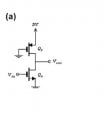
I get confused with the circuit bellow.

Here is the link to the lecture analyzing the circuit:http://www.youtube.com/watch?v=ZMEpc2o9_gU&feature=youtu.be
When Vin = 0V => Vgs (NMOS) = 0 < Vt => NMOS is in CUT OFF.
And therefore Ids = 0 A.
For PMOS, Vsg = Vs - Vg = 5V > |Vt| => PMOS is NOT in CUT OFF.
PMOS is in TRIODE or SATURATION.
In the lecture:
PMOS has Vsg > |Vt| and null current (Ids = 0) => He concluded that PMOS is in TRIODE.
He doesn't explain the reason why it is in triode. Therefore here is what I guess:
With PMOS in triode region:
Ids = -kn(Vsg -|Vt| - Vds/2)Vds (1)
With PMOS in saturation:
Ids = -1/2kn (Vsg - |Vt|)^2 (2)
As for the case in the video, Vsg =5V > Vt => PMOS is in triode or cut off.
Now because Vsg - Vt≠ 0 => Ids ≠ 0 => This case don't happen.
=> PMOS is in triode
But here is what is confusing me.
With Vin = 0V and NMOS is in CUT OFF therefore Ids = 0.
Can I now consider that D and S of the MOS is not connected and means that it acts as a open switch?
If it can be considered as an open switch then drain of PMOS D is not connected to ground and it is also in CUT OFF.
I think in real life these transistors is not ideal and they has resistance and capacitance but now let consider that they are all ideal.
Here is the link to the lecture analyzing the circuit:http://www.youtube.com/watch?v=ZMEpc2o9_gU&feature=youtu.be
When Vin = 0V => Vgs (NMOS) = 0 < Vt => NMOS is in CUT OFF.
And therefore Ids = 0 A.
For PMOS, Vsg = Vs - Vg = 5V > |Vt| => PMOS is NOT in CUT OFF.
PMOS is in TRIODE or SATURATION.
In the lecture:
PMOS has Vsg > |Vt| and null current (Ids = 0) => He concluded that PMOS is in TRIODE.
He doesn't explain the reason why it is in triode. Therefore here is what I guess:
With PMOS in triode region:
Ids = -kn(Vsg -|Vt| - Vds/2)Vds (1)
With PMOS in saturation:
Ids = -1/2kn (Vsg - |Vt|)^2 (2)
As for the case in the video, Vsg =5V > Vt => PMOS is in triode or cut off.
Now because Vsg - Vt≠ 0 => Ids ≠ 0 => This case don't happen.
=> PMOS is in triode
But here is what is confusing me.
With Vin = 0V and NMOS is in CUT OFF therefore Ids = 0.
Can I now consider that D and S of the MOS is not connected and means that it acts as a open switch?
If it can be considered as an open switch then drain of PMOS D is not connected to ground and it is also in CUT OFF.
I think in real life these transistors is not ideal and they has resistance and capacitance but now let consider that they are all ideal.
Attachments
-
 11.4 KB Views: 92
Last edited: