Facebook
 Google
 GitHub
 Linkedin

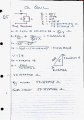
Hello,Hi this is the circuit i am trying to solve for resistance but it has to be done by using complex numbers i do not know where to start
ThanksView attachment 221389
First thing i did was verity that the problem solution was correct. It is correct to the number of digits they show.
To solve this you can do the following:
1. Calculate the complex impedance Z of R in parallel with L symbolically.
2. Calculate the current knowing the voltage and Z.
3. Solve for R.
Can you do #1 and #2 at least?
You got the right answer for the problem you did with the 0.318H inductor but yes you want to use complex numbers so try the above procedure.
To calculate two impedances in parallel you can do either:
1. Z=1/(1/Z1+1/Z2)
2. Z=Z1*Z2/(Z1+Z2)
but to do either of those you have to use complex numbers in the form a+b*j.
You need to use complex math to do this, so the next question is do you know how to do complex math? That includes using symbolic math where one or more variables are not yet known.
Here is a complete example using a capacitor in parallel with a resistor.
Problem statement:
We have a cap that is 0.0001 Farads, and voltage supply is 100 volts at 50 Hz,
the current is 5 amps, what is the value of the real resistor R in parallel with the cap?
The complex impedance of the capacitor is:
ZC=1/(j*w*C)
and with these values:
w=2*pi*50
C=0.0001
we get the cap complex impedance:
ZC=100.0/(pi*j)
and now put that in parallel with the resistor to get the total Z:
ZT=ZC*R/(ZC+R)
so that is:
ZT=(100*R)/(pi*j*R+100)
Now calculate the complex current Ic:
Ic=100/ZC=(pi*j*R+100)/R
now calculate the magnitude of the complex current:
(the magnitude of a complex number a+b*j is sqrt(a^2+b^2))
|Ic|=sqrt(pi^2*R^2+10000)/R
equate that to 5 amps:
sqrt(pi^2*R^2+10000)/R=5
solve for R which gives us two results:
R=-100/sqrt(25-pi^2)
R=100/sqrt(25-pi^2)
we know that R cant be negative if it is a real resistor, so we choose the second solution above:
R=100/sqrt(25-pi^2)=25.708388744447
Lastly we do the calculation for the magnitude of the current Ic again with the now known R and make sure we get 5. We can also calculate the voltage and make sure we get 100 volts AC.
Last edited: