Thevenins and Nortons with Complex Numbers

Thread Starter

Ancalagon

Joined Jun 1, 2025
1
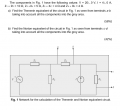
Hi guys, ive recently had a loss and ended up leaving something last minute. i just seem to be having issues with this problem and it will determine wether or not i get into third year engineering. if anyone has seen this problem before or has the expertise to solve it i would be extremly grateful.
 

Attachments

crutschow

Joined Mar 14, 2008
38,325
Sorry this is not a "do your homework for you" site.
If you show us what you have attempted, we can guide you towards a solution.

If you have no idea how to do it, then perhaps you need to stay in second year engineering.
 

WBahn

Joined Mar 31, 2012
32,706
Hi guys, ive recently had a loss and ended up leaving something last minute. i just seem to be having issues with this problem and it will determine wether or not i get into third year engineering. if anyone has seen this problem before or has the expertise to solve it i would be extremly grateful.
Having someone solve it for you would not only be cheating, but would only serve to help you did your hole deeper and lower your odds for long term success since you will moving on to courses that expect you to be able to work these kinds of problems with additional complexities added on top. You will just flounder more and, very likely, eventually quit the program.

Instead, show your best effort to get as far as you can and they try to describe what you might need to do next but are having trouble figuring out how to get there. That puts us in a position to help you actually learn the specific knowledge and skills that you are struggling with so that they are less likely to be stumbling points as you progress further.

One thing that might be causing you problems is that the author of this problem is doing you a big disservice by being very sloppy and conflating impedance and reactance. Sadly, this is pretty common.

At the "technician" level treatment, many students lack the math skills to work with complex numbers, so they are taught techniques that avoid it by using "reactance" and then a bunch formulas involving trig functions are thrown at them. That's fine as well as it goes, but the people that developed many of the texts written at this level have comparable math skills and they (knowingly or unknowingly) made things much more complicated than they needed to be by insisting on having both inductive and capacitive reactance be positive value and chose to deal with the fact that capacitive reactance is actually negative by embedding the necessary minus signs in the formulas that students are expected to memorize. This is why you commonly see (X_L - X_C) in these formulas. While this makes it easier for people with limited math skills to work with simple circuits, it greatly hinders their ability to work with more complex circuits, especially those involving unspecified decide parameters because without specific numerical values, they can't determine whether (XL-XC) end up being inductive or capacitive and therefore don't know where to plug it into the next step in their work.

So take a moment to learn what reactance really is now that you should have the math background to come at it in the proper direction, which is to start with the constitutive equations for resistors, capacitors, and inductors.

We have:

\(
v(t) \; = \; R \cdot i(t) \\
v(t) \; = \; L \cdot \frac{di(t)}{dt} \\
i(t) \; = \; C \cdot \frac{dv(t)}{dt}
\)

These are linear differential equations and a very powerful technique for solving them is the use of Laplace transforms. Hopefully, you have been exposed to them by this point, either in a Differential Equations math course, or in a Circuits II course (often called Transform Methods of Circuit Analysis). Assuming that you have, the if we take the Laplace transforms of the above equations to move them from the time-domain to the complex-frequency-domain, we get:

\(
V(s) \; = \; R \cdot I(s) \\
V(s) \; = \; L \cdot s \cdot I(s) \\
I(s) \; = \; C \cdot s \cdot V(s)
\)

Just as resistance for an ohmic device is defined as the ratio of voltage to current in the time domain, the impedance is defined as this same ratio in the complex-frequency domain:

\(
Z_R \; = \; \frac{V(s)}{I(s)} \; = \; R \\
Z_L \; = \; \frac{V(s)}{I(s)} \; = \; sL \\
Z_C \; = \; \frac{V(s)}{I(s)} \; = \; \frac{1}{sC}
\)

By transforming our components into the complex-frequency domain, we can work with arbitrarily complex circuits (as long as they are linear) and find the response of the circuit to arbitrary input waveforms.

But if we can restrict ourselves to working with those arbitrarily complex circuits operating in steady state at a single frequency, we can set

\(
s \; = \; j \omega
\)

everywhere and, potentially at least, make our lives easier.

\(
Z_R \rvert_{s=j\omega} \; = \; R \\
Z_L \rvert_{s=j\omega} \; = \; j \left( \omega L \right) \; = \; j \left( 2 \pi f L \right) \\
Z_C \rvert_{s=j\omega} \; = \; \frac{1}{j \omega C} \; = \; j \left( \frac{-1}{\omega C} \right) \; = \; j \left( \frac{-1}{2 \pi f C} \right)
\)

The "reactance" is defined as the imaginary part of the impedance at a given frequency.

\(
X_R \; = \; Im \{ Z_R \rvert_{s=j\omega} \} \; = \; R \\
X_L \; = \; Im \{ Z_L \rvert_{s=j\omega} \} \; = \; 2 \pi f L \\
X_C \; = \; Im \{ Z_C \rvert_{s=j\omega} \} \; = \; \frac{-1}{2 \pi f C}
\)

Now you can see what "reactance" is, where it comes from, and why capacitive reactance is properly a negative value. This removes the needless complexity of explicitly tracing inductive and capacitive reactance separately in equations -- you simply combine reactances as reactances the same way you do resistances. It's just that they can be either individually or collectively either positive or negative.

With all of that behind us, let's look at how your problem should have been presented:

The statement

\(
Z_1 \; = \; R_1 \; = \; 10 \; \Omega
\)

Is correct. But the statement

\(
Z_2 \; = \; X_L \; = \; 5 \; \Omega
\)

is not. This is stating, very explicitly, that both the impedance of component #2 is identically equal to the reactance of component #2, and both of these are equal to five ohms. But the impedance of an inductor is a complex quantity, so there needs to be an 's' in there, if working in the complex-frequency domain, or a 'j' in there, if working at a single frequency (often referred to as the phasor-domain).

Assuming that they wanted to make sure that you knew how to translate between reactance and impedance, they should have just stated

\(
R_1 \; = \; 10 \; \Omega \\
X_2 \; = \; 5 \; \Omega \\
X_3 \; = \; -4 \; \Omega \\
R_4 \; = \; 4 \; \Omega
\)

All the information you need to find the impedances is right there.
 
Top