Colpitts oscillator component values

Thread Starter

samudavid

Joined Jan 4, 2018
29
Hi again,

I would like to sum up the the learnings about the main topic of the thread (Colpitts Values). Please, feel free to correct everything.

1 - Fosc = 1 /(sqrt(LC)) C = C1//C3 (in the picture attached)

2- C3 is the feedback path. As an orientation, C1/C3 should be about 10, but at least 1. If the relation is too high, it may get distorted. If is so low, it may not start oscillating. A solution for a distorted signal is to add a low resistor (let say 51 ohm) between emitter and the two capacitors.

3- BJT should have a Hfe-Ic curve like the one in the 2n2222:

Because it beta is variating according collector current, thus the mild auto-regulation of amplitude is provided. If beta would be stable then generation regime would be much more hard.
A mosfet or Jfet amplifier will also do.


4- A lower R3 permits a higher current in the coil. 100 ohms looks like a better choice

Look at schematic and use logic. Circuit feeds by direct current from power supply.
How can direct current (minus) go into circuit? Through capacitors? No, definitely not!
Only through resistor to emitter of transistor.
By the way, transistor turns ON for short time, exactly in moment, when capacitor is fully discharged.
Transistor connects lower end of coil to minus through resistor (upper end of coil is always on plus) and provides coil with some portion of energy.
5- In fact, the base operation point could be set just with a resistor and a capacitor. See post #10 for further explanation.

6- Don't drink vodka while patrolling the river.


Thread Starter

samudavid

Joined Jan 4, 2018
29
Janis and Bordodynov, thank you very much for your comments.

The oscillator looks great, but the amplitude is so low for my application. I suppose that this is a rock solid oscillator but doesn't drive the coil with enough energy.

There is a question that still without answer (or at least for me) what about the component values?

I think the coil impedance at the oscillating frequency should be kept in a certain range and so the capacitors. For example, if I set C3= 10pF and C1=100pF with the 233uH coil, it doesn't oscillate (at least in LTSpice). Also, if I set the coil to 1uH letting the 10nF and 100nF capacitors, it neither start to oscillate. If I set 1uH, 1nF and 10nF it oscillates but only a few volts between 21 and 28 volts.

Any explanation for this?? Is there any rule to follow when designing theese oscillators?
 

Danko

Joined Nov 22, 2017
2,169
There is a question that still without answer (or at least for me) what about the component values?
Before design you need to know frequency F, resistance of load R_load and voltage of power supply V_ps.
Reactance X_L1 = X_C3 + X_C1 ≈ R_load / (5 .. 7) R_load usually is about 1kOhm
Capacitance C1 ≈ 2 * C3 * (V_ps - 1) for V_ps ≥ 1.5V
Capacitance C4 ≈ (10 .. 20) * C3
Resistance R2 ≈ (1.5 .. 2) * X_C1
Resistance R5 should be as low as possible, but keep sine form without distortion
Resistance R3 should be as high, as possible, but keep sine amplitude (peak-peak) on R_load close to 2 * V_ps
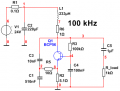
For example see picture below.

colp_best_100kHz.png
Edit:
For example, if I set C3= 10pF and C1=100pF with the 233uH coil, it doesn't oscillate (at least in LTSpice).
With C3 = 10pF and C1 = 100pF with the 233uH coil it will oscillate on frequency about 3MHz, then reactance of coil is 4.6kOhm. Then R_load should be 4.6 * 6 = 27.6kOhm.
In schematic above (for 100kHz) change C3 to 10pF, C1 to 100pF, C4 to 1nF, R2 to 200Ohm, R5 to 200Ohm, R3 to 1MOm, R_load to 27kOhm and it will oscillate about 3MHz.
If I set 1uH, 1nF and 10nF it oscillates but only a few volts between 21 and 28 volts.
1uH, 1nF and 10nF - it is about 5MHz, reactance is about 30Ohm, then R_load = 30 * 6 = 180Ohm.
In schematic above (for 100kHz) change C3 to 1nF, C1 to 10 nF, C4 to 10nF, C5 to 100nF, L1 to 1uH, R6 to 0.01 Ohm (close to real value for 1 uH), R_load to 180Ohm, R3 to 27k, R5 to 5.1 Ohm and it works just fine on 5.36MHz.
Also, if I set the coil to 1uH letting the 10nF and 100nF capacitors, it neither start to oscillate.
1uH, 10nF and 100nF - it is about 1.6MHz, then reactance is about 10Ohm and R_load is 10 * 6 = 60Ohm.
In schematic above (for 100kHz) change L1 to 1uH, R6 to 0.01 Ohm (close to real value for 1 uH), R_load to 60Ohm, R3 to 4.3k, R5 to 1Ohm and it works excellent on 1.62MHz.
=============================================================
If you have good working schematic of oscillator, but you need other frequency, you can recalculate component values.
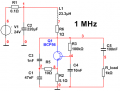
For example, you have 100kHz, but need 10 times more - 1MHz:
L1_1MHz = L1_100kHz / 10
C3_1MHz = C3_100kHz / 10
C1_1MHz = C1_100kHz / 10
C4_1MHz = C4_100kHz / 10
colp_best_1MHz.png
 
Last edited:

Thread Starter

samudavid

Joined Jan 4, 2018
29
Thank you Danko!!

This was exactly was I was wondering all the time! Your explanation is perfect. I'm sure that it will help many more people as I have found a few threads on the same topic without a definitive answer.

Just there is a little thing, you use this symbol "÷" meaning between?
R_load / 5÷7
means R_load divided by a value between 5 and 7? I think so, but there is a saying in my country that is better to ask and look stupid for a while than stay quiet and be ignorant for the rest of your life...

Thanks again Danko, great work.
 

Danko

Joined Nov 22, 2017
2,169
Just there is a little thing, you use this symbol "÷" meaning between?
means R_load divided by a value between 5 and 7?
Good question. In my interpretation it is "range of recommended value", "any value between first and second number", "any value from first number to second number", but now, i see, choice of division symbol for it was bad.
I will change "÷" for "..".
Thank you for valuable comment.
 
Top