Collector Feedback biasing

Thread Starter

electronicsenjoyer089

Joined Feb 24, 2025
182
Hello all,
i was building this circuit that its an amplifier made with bjt, i had some questions before simulating it.

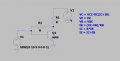
First of all what's the purpose of this feedback? and how i choose the right values for RC and RB?.

Like usually when i build this circuit what im trying to obtain? what data i got?

what i wanna obtain is a proper ib for my load by sizing RB, and what for the current that gonna drive the load? where is the load gonna be connected? at emitter ( in parallel ) or to collector?

Thanks for the help
 

Attachments

LvW

Joined Jun 13, 2013
2,026
At first, the DC biasing will not work because the DC feedback will be shorted by the voltage source V1.
Hence, a coupling capacitor would be necessary.
As you probably knows, the base of such a transistor stage must be DC-biased in order to bring the BJT in the "linear" amplificaton range.

For this purpose, there exist mainly 4 methods - and the best and mostly used method is a voltage divider at the base (driven by the supply voltage VCC.). For sufficient DC stability an emitter resistor Re is provided in this case.

However, another method for DC biasing with a certain stabilization effect is shown here in the task desription.
The feedback resistor Rf (NOT the same value as the collector resistor Rc) forms - together with the B-E path (pn junction) - a voltage divider which must be able to produce a DC voltage at the base Vb=(0.65...0.75) volts.
The corresponding calculation involves, of course, the collector voltage Vc and the currents Ib (into the base node) and Ic..
This voltage divider is driven by the collector voltage Vc=VCC-(Ic+Ib)Rc.
The relation between both currents Ic and Ib is given with B=Ic/Ib (transistor parameter).

Now - how works the negative feedback?
When - due to temperature changes (self-heating?) - the desired collector current Ic (and the product (Ib+Ic)Rc) increases, the voltage Vc will decrease -and with it also the base voltage Vb.
And the decreased base voltage will counteract the Ic increase and, thus, reduce Ic again (nearly) to its original value.

The bipolar transistor is a voltage-controlled device and the relation between Ic and Vbe is given by Shockleys well-known exponential expression Ic=f(Vbe/Vt).
 
Last edited:
Top