CNC Milling Bits - Shallow vs Wide?

Thread Starter

Robin Mitchell

Joined Oct 25, 2009
819
Hi all,

OUT GOES THE CHEMICALS!

Yes, I have moved from chemical etching to mechanical milling as I feel that the results (and speed) are far superior. However, I have a small problem.

My traces come out really rough when using engraving bits with angles greater than 30 degrees. Now, I have tried 0.2mm, 0.4mm and 0.1mm bits with perfect results on very narrow engraving bits. As soon as I use a larger angle bit the trace becomes rough and bits of copper are left behind. I know that my spindle speed rate is only 10,000rpm max which is well below the recommended spindle speed for making PCBs yet using a very narrow bit creates perfect results.

Is this because a narrow-angle cuts less copper and so only the tip is cutting whereas on wider bits the edges also cut?
 

spinnaker

Joined Oct 29, 2009
7,830
Hi all,

OUT GOES THE CHEMICALS!

Yes, I have moved from chemical etching to mechanical milling as I feel that the results (and speed) are far superior. However, I have a small problem.

My traces come out really rough when using engraving bits with angles greater than 30 degrees. Now, I have tried 0.2mm, 0.4mm and 0.1mm bits with perfect results on very narrow engraving bits. As soon as I use a larger angle bit the trace becomes rough and bits of copper are left behind. I know that my spindle speed rate is only 10,000rpm max which is well below the recommended spindle speed for making PCBs yet using a very narrow bit creates perfect results.

Is this because a narrow-angle cuts less copper and so only the tip is cutting whereas on wider bits the edges also cut?
You are likely pushing too much copper at too low of an RPM. I actually have the same issue but even a lower RPM. What software are you using to create gcode?

I use FlatCam. It has the ability to remove isolations in layers that I want to try. It will slow you down but likely yield better results
 

WBahn

Joined Mar 31, 2012
32,823
I think the problem is more related to having a tapered edge of copper that is too weak and so it tears easily. On top of that, if you are making a traditional cut (not a climbing cut) the mill is also trying to dig under the thin edge and rip it up. A faster speed makes the tears smaller and so it seems smoother.
 

Thread Starter

Robin Mitchell

Joined Oct 25, 2009
819
I use flatcam too (fantastic program) for generating Gcode and autoleveler to get the perfect z height. Currently, I mill 50 microns to only remove the 35 micron copper with perfect results but only if I use a very narrow bit (currently, I use 0.2mm 10 degree engraving bits).
 

Thread Starter

Robin Mitchell

Joined Oct 25, 2009
819
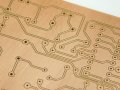
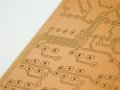
For those who are interested here are some photos. These are one pass and no abrasion was needed to get that trace finish.
I am working on a video which includes a secret ingredient to get the perfect PCBs every. single. time ;)
 

Attachments

shortbus

Joined Sep 30, 2009
10,050
On top of that, if you are making a traditional cut (not a climbing cut) the mill is also trying to dig under the thin edge and rip it up
That would be true if taking more than one pass. But when doing a single pass one side is climbing while the other is conventional cutting.
 
Top