Facebook
 Google
 GitHub
 Linkedin

Hey All,
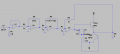
I've been building an audio amplifier very similar to the Class B amplifier described here. I previously had a problem with my amplifiers clipping before the rail, but I have fixed that by adding a few extra gain stages to take some of the load off each of the individual op-amps. My current schematic is attached as an image here. Overall, the circuit is working well enough but there are two peculiarities that I'd like to get ironed out before I put it together on a perfboard.
1) When I have no input, which is a likely circumstance for my use, I hear a lot of noise coming out of the speaker if I turn the gain up sufficiently loud. How can I do a better job of forcing the output to ground given zero (intended) input? Perhaps DC coupling the input instead of AC coupling the input would help this? I don't have much experience with AC coupling.
2) Similarly, when I have an input and I turn the gain up very loud -- over about 6V peak on the speaker -- my output becomes instantly distorted and my gain drops by, easily, a factor of 100. I have made a few measurements and have noticed that this always seems to correspond to the voltage at the anode of D1 dipping below 0 VDC. Any ideas how I can prevent this? I realize that I can lower the gain of the first gain stage to make the overall gain such that it will not cause the voltage at the anode of D1 to dip below 0 VDC, but I'd like to get as much gain as possible out of this amplifier.
I should say that I understand that this is not a perfect audio amplifier, and I don't intend it to be. This is not being used to amplify MUSIC, but rather to amplify a received, fixed frequency audio signal used to detect ground-loops.
Attachments
-
 24.7 KB Views: 56
Last edited: