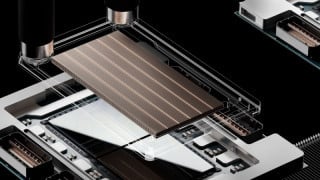
I just built a class D amplifier with the TI TAS5709. What I realize with this development is, as already said, the fantastic efficiency. My small PCB has 2x 20Wwithout any heat sink at all.
What also characterizes this unit is that there are two inductors per channel (forming a power LP filter). Some (lazy/saving/ignorant/low power users/..) don't put the inductors on the PCB, but use the internal inductance of the loudspeaker instead. That's possible, but will cause emi (high current switching through the cable) and could even bring audible disturbance.
Added to that, I also think that the small class D IC has more pins (48) than most "normal" amplifiers.
The inductors, while common, are not absolutely necessary.
The only problem I had with that article is the broad sweeping statements, some designs are going to be better than others. I liked his proposed solutions, for really high power levels they would be a really good idea.
The biggest argument for Class D efficiency is the lack of heat generated from reasonably high power levels. I don't think the other classes of amps even come close.
Interesting article.
From the viewpoint of the "energy saver" it's probably accurate. In fact I have realized that the class D IC's in my application get warm even without any output signal. The interesting thing is that they just get a "little warmer" at full load power!
Practically, for someone like me, designing a commercial audio system, the efficiency down at "don't-know-how-silent" doesn't matter a bit to me!
I have to design at worst case and save money! Worst case is full power and money is saved by small size, no heat sink, few and cheap components and fast designing and manufacturing.
If someone happens to improve the class D amp with low-rate-modulation or whatever, that's fine! It will give another sales argument!
Types of amps (tube, linear, digital) always have proponents that are almost religious in intensity. I would love to hear a blind test to see if some particular technology sounded better, somehow.
My theory is if designed competently they would be indistinguishable from each other. After all, the goal is to reproduce a wave form exactly. The speakers probably have more effect on the reproduction.
Audiophiles are strange, strange people to me, and they approach it much like a religion, with many items being subjective and a matter of faith.
I would tend to agree with that. That's why I'm so happy with my old Bose 901's. But there was quite a bit of difference when I rebuilt my Dynaco Stereo 400 as a Mike Leach Superamp (I recycled the transformer and humongus heat sink). The amp does make some difference.
I might disagree in the area of FM radio. HD radio seems to have a significantly improved sound quality over conventional FM. This is a subjective judgment, though.
MP3 compression has done nothing but lower the reproduction sound quality.

 Facebook
 Google
 GitHub
 Linkedin