Class ab amplifier questions

Thread Starter

Goodgrief

Joined Mar 26, 2019
7
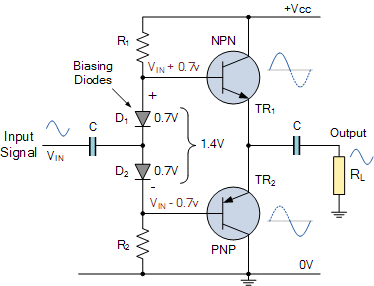
Hello. This is my first time on this site. I have been struggling to understand certain aspects of this class ab amplifier circuit.
The first issue I’m having is understanding how the base of TR2 receives -0.7v with the input at 0v. From how I understand it the base of the pnp transistor would receive a positive voltage equaling Vcc minus the voltage drop across R1 minus the voltage drop across D1 and D2. Where am I going wrong here?
The second thing is when Vin is in its positive alternation and the base of TR1 is supposed to recive that voltage. I do not understand how it receives that voltage when the cathode of D1 is facing the input. Would the diode block the positive alternation when it is oriented this way?
I’m not able to find any answers to this and I feel I am approaching this circuit the wrong way. Any help would be greatly appreciated. Thank you.
 

cmartinez

Joined Jan 17, 2007
8,760
Hello. This is my first time on this site. I have been struggling to understand certain aspects of this class ab amplifier circuit.
The first issue I’m having is understanding how the base of TR2 receives -0.7v with the input at 0v. From how I understand it the base of the pnp transistor would receive a positive voltage equaling Vcc minus the voltage drop across R1 minus the voltage drop across D1 and D2. Where am I going wrong here?
The second thing is when Vin is in its positive alternation and the base of TR1 is supposed to recive that voltage. I do not understand how it receives that voltage when the cathode of D1 is facing the input. Would the diode block the positive alternation when it is oriented this way?
I’m not able to find any answers to this and I feel I am approaching this circuit the wrong way. Any help would be greatly appreciated. Thank you.
Don't know much about amplifiers myself, but this is an excellent moment to learn to use a simulator. LTspice is the one most people use around this place. And most importantly, it's free!

Here's a small sim that I did for you. I suggest you start playing with its parameters and see how each component behaves.


upload_2019-3-26_19-45-25.png


Attachments

Thread Starter

Goodgrief

Joined Mar 26, 2019
7
Don't know much about amplifiers myself, but this is an excellent moment to learn to use a simulator. LTspice is the one most people use around this place. And most importantly, it's free!

Here's a small sim that I did for you. I suggest you start playing with its parameters and see how each component behaves.


Thank you very much! I will definitely try this!
 

crutschow

Joined Mar 14, 2008
38,504
The first issue I’m having is understanding how the base of TR2 receives -0.7v with the input at 0v.
Assuming the two emitters are biased at 0V, the base is not at -0.7V with respect to ground but is 0.7V below the emitter voltage.
The second thing is when Vin is in its positive alternation and the base of TR1 is supposed to recive that voltage. I do not understand how it receives that voltage when the cathode of D1 is facing the input.
Current is flowing through R1, R2 and both diodes.
When Vin goes positive, it raises the cathode voltage of D1, which reduces the current through R1 and D1.
Thus D1's anode voltage (and TR1's base voltage) is also raised by the same amount.
 

Thread Starter

Goodgrief

Joined Mar 26, 2019
7
Assuming the two emitters are biased at 0V, the base is not at -0.7V with respect to ground but is 0.7V below the emitter voltage.
Current is flowing through R1, R2 and both diodes.
When Vin goes positive, it raises the cathode voltage of D1, which reduces the current through R1 and D1.
Thus D1's anode voltage (and TR1's base voltage) is also raised by the same amount.
Thank you! That explains it perfectly. I’ve been watching videos and chewing on that schematic in my head for days now. It makes so much more sense when the the base voltage is referenced to the emitter. The diode problem is solved too since of course if the current in D1 is lowered the voltage would have to increase! Thanks for all the help! I really appreciate it!
 

crutschow

Joined Mar 14, 2008
38,504
When you get to that point, I can show you a bootstrap addition to the bias circuit that will allow a peak-peak output close to the supply voltage (the circuit shown has a pk-pk output of about 3V less than the supply).
 
Last edited:

Thread Starter

Goodgrief

Joined Mar 26, 2019
7
When you get to that point, I can show you a bootstrap addition to the bias circuit that will allow a peak-peak output close to the supply voltage (the circuit shown has a pk-pk output of about 3V less than the supply).
I am currently unable to build this circuit but I am curious about this bootstrap capacitor. Could you tell me more of how it works and it’s connection points? Does it maintain the voltage on the bases when the output is peaking? And would I need 2 bootstrap capacitors? One for the positive alternation and one for the negative alternation?
 

crutschow

Joined Mar 14, 2008
38,504
Okay, here's a little more for you to chew on.
Yes, you do need two bootstrap capacitors.

Below is the LTspice simulation of the circuit with added bootstrap capacitors C3 and C4, along with diodes D3 and D4.
This raises the AC bias voltage at node 3 (blue trace) to 16V peak, and at node 4 (red trace ) to -7V peak for a 4V peak output, to help drive the output transistors at their peak voltage outputs.

Tha circuit also has a high-output-current op amp as an input driver with gain of 4 and negative feedback from the output to stabilize the DC output at 1/2 the supply voltage (R3 and R4), and significantly reduce output AC distortion.

upload_2019-3-27_21-0-54.png
 

Thread Starter

Goodgrief

Joined Mar 26, 2019
7
Okay, here's a little more for you to chew on.
Yes, you do need two bootstrap capacitors.

Below is the LTspice simulation of the circuit with added bootstrap capacitors C3 and C4, along with diodes D3 and D4.
This raises the AC bias voltage at node 3 (blue trace) to 16V peak, and at node 4 (red trace ) to -7V peak for a 4V peak output, to help drive the output transistors at their peak voltage outputs.

Tha circuit also has a high-output-current op amp as an input driver with gain of 4 and negative feedback from the output to stabilize the DC output at 1/2 the supply voltage (R3 and R4), and significantly reduce output AC distortion.

View attachment 173484
Thank our very much! That’s gonna keep me busy for a while!
 
Top