Facebook
 Google
 GitHub
 Linkedin
Hi Copey84 – glad to see you are gaining a good understanding of the circuit and your test equipment, as well as an appreciation of through up-front testing of any circuit.
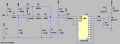
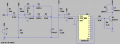
Recognize that the comparator output will only go high when the voltage across C2 is above the threshold set by R6 and R7 (1.33 volts). The voltage across C2 will quickly increase to the peak output of U1 minus the forward voltage drop across D1 (~0.6 volts). A loud “clap” will charge to a higher voltage than a quiet “clap”, so you will see some differences each time. Once C2 is charged, it will discharge at a slower rate determined by the value of R5 and C2 time constant.
As soon as C2 is above 1.33 volts, the output of the comparator will go high. C2 immediately begins to discharge slowly, but as long as its voltage is above 1.33 volts, the comparator output will remain high. With a single "clap", the pulse width out of the comparator will be about 0.569 seconds (nominally).
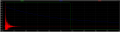
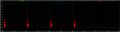
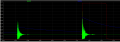
The red trace is the "clap" output of U1. The blue trace is the voltage across C2 (you can't look at it without loading the circuit, but the simulator can). The green trace is the pulse width output of the comparator. Notice that the trailing edge occurs when C2 discharges to 1.33 volts.
Here is what will happen if you clap a 2nd time, say 0.2 seconds later. Just prior to the 2nd clap, C2 will have discharged only to about 2.1 volts. Since this is above the 1.33 volt threshold, the comparator output is still high. When the 2nd clap occurs (at 0.2 seconds), C2 will again charge to the peak output of U1. And it will immediately begin to discharge again. The comparator output will continue to remain high until C2 discharges to 1.33 volts, at which time the comparator output goes low.
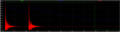
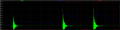
You can see that C2 charges to the peak, begins to discharge and is recharged to the peak again when the 2nd clap occurs. Notice that the total pulse width is now 0.769 seconds. It is exactly 0.2 seconds longer than the pulse width caused by a single “clap”. The pulse has been “stretched” by the amount of time in between “claps”. It is still a single pulse out of the comparator, albeit a bit longer. Time between claps up to about 0.5 second will extend a single pulse. Beyond that time, C2 will be able to discharge below 1.33 volts, thus ending the single pulse and a new 2nd pulse will begin. That is why you saw two separate output pulses.
Go ahead and experiment with clapping twice, but spacing the amount of time between claps. Look at the output of U1 and of U2 simultaneously (trust that C2 is discharging like the simulation shows). Trigger on the output of U1, about 1.75 volts.
You should be able to measure quite accurately what the clap spacing time is by looking at the time between the rising edge of the two claps (output of U1). You can measure the single-clap pulse width by measuring the time from the 2nd clap at U1 to the trailing edge of U2 output.
Let me know when you are ready for the rest of the circuit.
Recognize that the comparator output will only go high when the voltage across C2 is above the threshold set by R6 and R7 (1.33 volts). The voltage across C2 will quickly increase to the peak output of U1 minus the forward voltage drop across D1 (~0.6 volts). A loud “clap” will charge to a higher voltage than a quiet “clap”, so you will see some differences each time. Once C2 is charged, it will discharge at a slower rate determined by the value of R5 and C2 time constant.
As soon as C2 is above 1.33 volts, the output of the comparator will go high. C2 immediately begins to discharge slowly, but as long as its voltage is above 1.33 volts, the comparator output will remain high. With a single "clap", the pulse width out of the comparator will be about 0.569 seconds (nominally).
The red trace is the "clap" output of U1. The blue trace is the voltage across C2 (you can't look at it without loading the circuit, but the simulator can). The green trace is the pulse width output of the comparator. Notice that the trailing edge occurs when C2 discharges to 1.33 volts.
Here is what will happen if you clap a 2nd time, say 0.2 seconds later. Just prior to the 2nd clap, C2 will have discharged only to about 2.1 volts. Since this is above the 1.33 volt threshold, the comparator output is still high. When the 2nd clap occurs (at 0.2 seconds), C2 will again charge to the peak output of U1. And it will immediately begin to discharge again. The comparator output will continue to remain high until C2 discharges to 1.33 volts, at which time the comparator output goes low.
You can see that C2 charges to the peak, begins to discharge and is recharged to the peak again when the 2nd clap occurs. Notice that the total pulse width is now 0.769 seconds. It is exactly 0.2 seconds longer than the pulse width caused by a single “clap”. The pulse has been “stretched” by the amount of time in between “claps”. It is still a single pulse out of the comparator, albeit a bit longer. Time between claps up to about 0.5 second will extend a single pulse. Beyond that time, C2 will be able to discharge below 1.33 volts, thus ending the single pulse and a new 2nd pulse will begin. That is why you saw two separate output pulses.
Go ahead and experiment with clapping twice, but spacing the amount of time between claps. Look at the output of U1 and of U2 simultaneously (trust that C2 is discharging like the simulation shows). Trigger on the output of U1, about 1.75 volts.
You should be able to measure quite accurately what the clap spacing time is by looking at the time between the rising edge of the two claps (output of U1). You can measure the single-clap pulse width by measuring the time from the 2nd clap at U1 to the trailing edge of U2 output.
Let me know when you are ready for the rest of the circuit.