Circular Saw Bolt Turning Direction

Thread Starter

MrAl

Joined Jun 17, 2014
13,702
This is almost funny if it was not so critical to the operation of a circular saw.

A neighbor of mine bought a used circular saw. It had a blade already on it, but it was old and worn and a new blade was already purchased for it.
As he went to unscrew the bolt that holds the blade on, he may have turned it the wrong way and actually tightened it. In any case, it has a hex key recess bolt not a regular hex head bolt. That means it needed a hex key wrench. He turned it so hard it stripped the hex shape into a circle, so it no longer can be turned with a hex wrench. Since there is no outer hex shape to grab with a wrench, it's now just a circular bolt head and inside a circular recess. It's hardened steel too so it's hard to grab with pliers. It's such a small circular head too so it's hard to use the "center punch / tangent tap trick" to get the bolt to break free and then allow turning maybe by hand.

So this brought up the question of which way the bolt turns to loosen the bolt.
I've read now that you turn the bolt in the same direction as the way the blade turns when it's running. There may be some disagreement on the web to that though, it's hard to figure this out for sure.

Any ideas here?
 

wayneh

Joined Sep 9, 2010
18,100
With smaller bolts, I've used a Dremel to cut a slot in the head to allow using a regular screwdriver. That might be possible here but it would definitely be a challenge. A hacksaw, with the appropriate hardened blade, could possibly be used.

One challenge you have here is that you cannot use impact, since any pounding would be applied to the motor bearings.
 

MrChips

Joined Oct 2, 2009
34,797
I have a chop saw with a reverse thread hex key bolt.
The nut or bolt on a circular saw is tightened in the opposite direction of the blade rotation, otherwise the blade would come loose.
In other words, in order to loosen the bolt, you have to turn the bolt in the same direction as the blade rotation.
 

wayneh

Joined Sep 9, 2010
18,100
I have a chop saw with a reverse thread hex key bolt.
The nut or bolt on a circular saw is tightened in the opposite direction of the blade rotation, otherwise the blade would come loose.
In other words, in order to loosen the bolt, you have to turn the bolt in the same direction as the blade rotation.
That reminds me, applying torque to the blade - in the direction it turns - could help loosen the bolt. Of course you need to hold the shaft somehow. That's easy if it protrudes out the back. Worth a look.
 

MrChips

Joined Oct 2, 2009
34,797
The chop saw has a locking mechanism to lock the motor shaft.
My radial arm saw lock nut is also reverse thread. There is another nut on the back side of the blade. It requires two wrenches to undo the nut.
 

geekoftheweek

Joined Oct 6, 2013
1,429
I know it's a long shot, but if you can lock the arbor and then rotate the blade somehow it may come loose. Works great for grinders, but never tried it on a saw.
 

sagor

Joined Mar 10, 2019
1,049
Loosen in the direction the blade turns. Reason is, when the motor starts and blade is stationary, it applies a tightening motion (like moving blade backwards on stationary motor). Most circular saws have reverse thread when blade turns clockwise as viewed from the outside, so loosening bolt is done by turning clockwise.
Some circular saws have blade on other side (like some battery powered ones), blade on those spins opposite direction (CCW). Normal threaded bolt on those.
 

Thread Starter

MrAl

Joined Jun 17, 2014
13,702
That reminds me, applying torque to the blade - in the direction it turns - could help loosen the bolt. Of course you need to hold the shaft somehow. That's easy if it protrudes out the back. Worth a look.
Hi,

That's an interesting idea, we will have to try that. The blade can be scrapped too it's old and worn and a new blade has already been acquired. There is a button you press hard to get the armature to lock so you can turn the bolt.
 
Last edited:

Thread Starter

MrAl

Joined Jun 17, 2014
13,702
I have a chop saw with a reverse thread hex key bolt.
The nut or bolt on a circular saw is tightened in the opposite direction of the blade rotation, otherwise the blade would come loose.
In other words, in order to loosen the bolt, you have to turn the bolt in the same direction as the blade rotation.
Hi,

Yeah, that agrees with a couple different web sites too, and the saw I have is exactly like that also. The way I think it works is that they are depending on the mass of the bolt to hold the bolt still while the blade just starts to spin with a sort of jerking action, and the 'jerk' is actually a unit for the change in acceleration. The change in acceleration is so abrupt that the bolt cannot follow it fast enough to resist being tightened just a tiny bit more.
What is kind of strange is that the manual for the saw in question has no mention of which way to turn the bolt either to loosen or to tighten.
 

Thread Starter

MrAl

Joined Jun 17, 2014
13,702
Loosen in the direction the blade turns. Reason is, when the motor starts and blade is stationary, it applies a tightening motion (like moving blade backwards on stationary motor). Most circular saws have reverse thread when blade turns clockwise as viewed from the outside, so loosening bolt is done by turning clockwise.
Some circular saws have blade on other side (like some battery powered ones), blade on those spins opposite direction (CCW). Normal threaded bolt on those.
Hi,

Yes, that was my reasoning too, except my view is that it's the bolt that stays stationary for a short time once the motor starts. The bolt would screw in a very small additional amount then.
 

Thread Starter

MrAl

Joined Jun 17, 2014
13,702
The chop saw has a locking mechanism to lock the motor shaft.
My radial arm saw lock nut is also reverse thread. There is another nut on the back side of the blade. It requires two wrenches to undo the nut.
Hi,

Oh that's different. What's the extra nut for on the back?
 

MrChips

Joined Oct 2, 2009
34,797
Hi,

Oh that's different. What's the extra nut for on the back?
My radial arm saw has no blade or motor lock. Hence I have to use an open ended wrench on the nut on the back side. Both wrenches came with the saw.

I also have a portable circular saw and a table saw. I have not checked the mechanisms on those.
 

Thread Starter

MrAl

Joined Jun 17, 2014
13,702
Oh that's interesting too. I might get a set just to have in the future.

We did not really want to order anything else to do this with, but I would have ordered those.
What happened is that when I was not there he ground the head down with a grinder, trying to grind the head into a square. It was a square but such a poor square shape it was still of no use, and because of the hex recess for the hex wrench, the sides were compromised making it impossible to use anything inside the recess because the sides where then too weak.

What we ended up doing, and I have to say at that point I am surprised anything worked, we used a cut off disk for the grinder and ground the blade pressure washer sides. This washer is over 1/8 inch thick. We made two cuts so that the circular washer was now a circle with two straight sides as if it was going to eventually becomes a square with two more cuts. Then, banging the heck out of the one flat side to get the washer to turn, it turned (finally something turned) and then broke right off from under the bolt head. That relieved all the tension between the underside of the bolt head and the top of the washer, and that meant, to our surprise, that the bolt could turned by hand to be removed. With the bolt now removed of course the blade could be removed. Pure luck there.
Now the only thing left was to order the new bolt and washer, which is to arrive in a few days.

A side story is that while we were thinking about how to do this he ordered a new saw from Amazon, but it was "refurbished". The original saw we butchered was "used" and sold by a private seller. The refurbished saw had a broken lock button, so he sent it back.
Because of that I'll never buy a refurbished tool. That was $129 USD, but he did not know it at the time but if you buy all separate pieces (tool, 2AH battery, charger) it only costs $139 which is only $10 more.
I would think a refurbished tool would work like the original but that wasn't the case. Luckily Amazon has a good return policy, but you have to wait for the original tool to get back to the seller before you can get a refund.
 

Thread Starter

MrAl

Joined Jun 17, 2014
13,702
My radial arm saw has no blade or motor lock. Hence I have to use an open ended wrench on the nut on the back side. Both wrenches came with the saw.

I also have a portable circular saw and a table saw. I have not checked the mechanisms on those.
Hi,

Oh ok thanks. It's been years since I've used a radial arm saw, those things are really nice to use for building cabinets.

I've checked that old saw now and two others and they all match most of the info on the web: that you have to turn the bolt in the same direction as the way the blade turns when running normally in order to loosen it. That is for circular saws anyway. It may make sense for other saws too though because apparently they bet on the mass of the bolt to get it to tighten up when the armature first starts to turn.
Since the turning of the blade relative to the right or left handedness of the blade on the saw correlates to the direction the blade turns, we can also say that a right hand blade tool gets loosened counter clockwise just like a regular RH bolt, while a left hand blade gets loosened clockwise (like my saw). I like remembering the blade direction rule better though.
 

MrChips

Joined Oct 2, 2009
34,797
It is not the mass of the bolt. It is the torque on the blade when it hits the work piece.
The saw blade turns in the direction to push the work piece against a stop. It is this torque that will tend to tighten the bolt and not loosen it. For a hand saw, the cutting teeth of the blade comes up from underneath the work piece. This pushes the wood against the base plate. Again, it is this torque that is used against loosening of the bolt.
 

Thread Starter

MrAl

Joined Jun 17, 2014
13,702
It is not the mass of the bolt. It is the torque on the blade when it hits the work piece.
The saw blade turns in the direction to push the work piece against a stop. It is this torque that will tend to tighten the bolt and not loosen it. For a hand saw, the cutting teeth of the blade comes up from underneath the work piece. This pushes the wood against the base plate. Again, it is this torque that is used against loosening of the bolt.
Hi,

We might need a diagram here so you can show what you mean because when we talk about torque we have to show the turning direction of two things, or the turning of one and the other being considered stationary.

With my saw, you turn the bolt clockwise to loosen it, and the blade turns clockwise. If the blade grips the bolt head, it's going to turn the bolt clockwise, which loosens it. However, I am not sure this is what you mean because you have to show the directions of both pieces, the bolt and the blade and maybe even the armature.

In my line of reasoning, the bolt momentarily acts as if it is standing still (rotational inertia of rest) while the armature turns. The armature turns clockwise so relatively the bolt turns counterclockwise, which tightens it.

In your line of reasoning, the 'stop' has something to do with it, but I can't be sure what you mean by what the stop is.
If you mean the 'stop' tends to stop the blade from turning, then we can consider the blade to be stationary instead of the bolt, to start with. If the armature turns clockwise, then the bolt turns clockwise but its motion is limited by the friction between the underside of the bolt and the top side of the blade, which means the armature turns clockwise but the bolt can be considered to be stationary. Relatively, that means the bolt turns counterclockwise, which tightens the blade.
If this is part of how it works, then it's both the mass of the bolt and the friction from the blade top, which causes the tendency for the blade to try to go slower than the armature, and the bolt motion slowing also due to the friction from the top of the blade. The mass also makes it appear that the armature turns clockwise while the bolt is stationary which tightens the blade.

The bolt on the saw in question was so tight I was beginning to think someone very paranoid used a high-grade thread lock fluid before they put the bolt in, and tightened it with a lot of torque with a wrench with a long handle :)
 

MrChips

Joined Oct 2, 2009
34,797
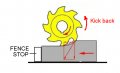
By "stop", I mean the fence that stops the work from moving.
By "torque", I mean the kickback force on the blade as it engages the work piece. Yes, friction between the blade and the nut or bolt tends to tighten the nut/bolt. You want to tighten the bolt by turning in the opposite direction of the blade's rotation. (Ignore the key slot on the blade shown in the diagram.)
saw blade rotation.jpg
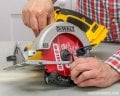
Dewalt reverse thread bolt.jpg

On this DeWalt saw, you access the bolt on the left side. The blade rotates clockwise. You loosen the bolt by turning clockwise.
 

Thread Starter

MrAl

Joined Jun 17, 2014
13,702
By "stop", I mean the fence that stops the work from moving.
By "torque", I mean the kickback force on the blade as it engages the work piece. Yes, friction between the blade and the nut or bolt tends to tighten the nut/bolt. You want to tighten the bolt by turning in the opposite direction of the blade's rotation. (Ignore the key slot on the blade shown in the diagram.)
View attachment 337496
View attachment 337495

On this DeWalt saw, you access the bolt on the left side. The blade rotates clockwise. You loosen the bolt by turning clockwise.
Hi,

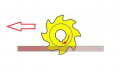
I think I agree with you, but the diagram with the yellow blade is not the way my saw works. The teeth on my saw meet the work with the teeth pointing UP not down as in the diagram. In that diagram, someone would be pushing the saw backwards. That's how my saw works anyway, but I don't think it matters for your suggestion about the torque and friction.
 

Attachments

Last edited:
Top