While we can provide some hints and suggestions, a big part of the point of the problem is for YOU to figure it out yourself; it's the struggle from which you learn, more so than the end result.
this is the problem, i need to build a exit and entrance door and count the no. of people who enter the door at the same it decreases when somebody leave
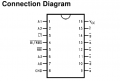
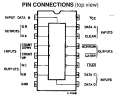
Just have a look at the datasheets of the chips.
Then you can see what signals are needed.
If you want to determine the direction of the persons going in and out of the room,
you will need TWO ldr's and make a circuit that can see the direction.
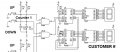
Imagine a circuit that creates a puls on the up pin when a person walks along LDR 1 and then LDR 2.
Imagine a circuit that creates a puls on the down pin when a person walks along LDR 2 and then LDR 1.
Imagine a circuit that creates a puls on the up pin when a person walks along LDR 1 and then LDR 2.
Imagine a circuit that creates a puls on the down pin when a person walks along LDR 2 and then LDR 1.
What about when two people are passing the sensors at the same time in opposite directions? Virtually every combination, including missed and overlapping hits.
The OP said that he was supposed to have separate entrance and exit doors, so just use one LDR on each door. You have to assume that people come through one at a time and that you only get one interruption per person (not one for each arm plus one for the torse and maybe a leg thrown in).
Have you tried building any of the circuits you've been directed to? Or the circuit that you yourself posted (which has some problems, but it's a start)?
Start by trying to just make a single digit count up or down in response to button presses. Once you have that working (and I suspect you are going to have some problems getting to that point), then it becomes much easier to do the rest.
So build just the one-digit version using buttons and tell us what happens when you try to use it.
i try to do it myself but it is not going smooth when it increase it always jump to far ex. 2 then 8 it always like that so that i try to see some other options
Debouncing an LDR is not the same thing as debouncing a mechanical switch.
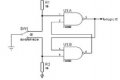
The dual NAND-gate circuit is the classic way of using a single-pole double-throw switch or push-button.
(What you have there is an R-S flip-flop.)
Except that circuit is incorrect. Both R1 and R2 should be pull-ups (to Vcc). 10kΩ is suitable for CMOS gates. For 74LS00 TTL gates, R1 and R2 should be around 1kΩ to 4.7kΩ.
Debouncing an LDR sensor is a completely different story.
The problem with the LDR is more about logistics than debouncing, as WBahn pointed out in post #12.
You can condition the signal from the LDR with a retriggerable monostable multivibrator such as a 74LS123 to produce an extended signal of a suitable duration.
The problem is that it does not identify the direction of motion.
Then there is the problem of two persons passing each other, one coming in and the other going out.
On a first iteration basis, you will need at minimum, two sets of sensors, staggered in position. One sensor will detect later than the other. From this you can determine direction.

 Facebook
 Google
 GitHub
 Linkedin