Facebook
 Google
 GitHub
 Linkedin
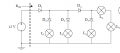
Consider the circuit shown in Figure.All diodes are ideal. Knowing that the maximum electrical specifications of the lamps are VL = 6 V and PL = 120 mW, determine:
1)The state of operation of each of the diodes.
2 ) The lamps do not light up and they get damaged. Justify each case.
3)The lamps that light up without exceeding the maximum specifications. Justify each case.
4)Equivalent resistance of the circuit (RIn)
1)Considering that Vs=12 V and Vl=6 V i would say:
D1 ON,D2 OFF,D3 ON,D4 ON, D5 OFF
2)L1,L5 dont light up.
For analyze what lamps got damage i did:
\( Ilamp=(120 mW)/(6 V)=0.02 A
Rlamp=(120 mW)/(0.02 A)^2=300 Ohm
\)
Then i calculated the current that goes through:
L2
\( IL2=(12-0.7-0.7)/(300 Ohm)=35 mA \) which is > 20 mA so L2 gets damaged(too much power dissipated on L2)
For L4 and L5,
\(
IL4=IL5=(12-0.7-0.7)/(600)=17,6 mA \) so these lamps dont get damaged.
4) \( Rin=((300 *300)(300+300)) + 600 =750 Ohm \)
Is this correct?
Thanks
1)The state of operation of each of the diodes.
2 ) The lamps do not light up and they get damaged. Justify each case.
3)The lamps that light up without exceeding the maximum specifications. Justify each case.
4)Equivalent resistance of the circuit (RIn)
1)Considering that Vs=12 V and Vl=6 V i would say:
D1 ON,D2 OFF,D3 ON,D4 ON, D5 OFF
2)L1,L5 dont light up.
For analyze what lamps got damage i did:
\( Ilamp=(120 mW)/(6 V)=0.02 A
Rlamp=(120 mW)/(0.02 A)^2=300 Ohm
\)
Then i calculated the current that goes through:
L2
\( IL2=(12-0.7-0.7)/(300 Ohm)=35 mA \) which is > 20 mA so L2 gets damaged(too much power dissipated on L2)
For L4 and L5,
\(
IL4=IL5=(12-0.7-0.7)/(600)=17,6 mA \) so these lamps dont get damaged.
4) \( Rin=((300 *300)(300+300)) + 600 =750 Ohm \)
Is this correct?
Thanks
Attachments
-
 23.5 KB Views: 34
Last edited: