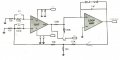
Circuit to test op amp offset voltage. How to calculate the close loop gain 10200?

Thread Starter

theresabingbing

Joined Mar 23, 2025
2
Need some help here. The circuit is for op amp VOS test measurement.
The formula given is VOS = Vout/ ACL = Vout/10200.

I do not understand how to get the 10200 ACL.
Also do not understand how to calculate the feedback resistor for this circuit.

I have gone through most of the servo loop material online.. Most of them have a very direct Rf (single resistor). In my circuit, there is 100 ohm resistor to ground. which is confusing for me.

Is there any one who can help/ guide on the ACL 10200 calculation & Rfeedback ?
 

Attachments

crutschow

Joined Mar 14, 2008
38,408
Is there any one who can help/ guide on the ACL 10200 calculation & Rfeedback ?
It's not complicated.
Let's go to the basics for an ideal feedback loop with an infinite (very large) open-loop amplifier dc voltage gain (which is likely at least 10E9 or 200dB here for the two op amps in series.)---

So the negative feedback means that the voltage at the Loop Amp output must equal the voltage at the UUT's (+) input (here due to its offset voltage) for a stable loop voltage.
The closed-loop gain is thus given by the value of the attenuation in that loop from output to input (for example a loop attenuation of 1/10 would give a gain of 10)

The attenuation of each 10kΩ/100Ω attenuator in the loop here (going right to left) is 100/(10k+100) or 1/101, giving a total attenuation for the two in series of 1/101 * 1/101 = 1/10.2k, thus giving the stated gain of 10.2k.
(That value is not exactly correct, since it ignores the small loading of the right attenuator output by the left attenuator, which will give about a 1% increase in calculated gain.)

Make sense now?
 
Last edited:

MrAl

Joined Jun 17, 2014
13,680
Need some help here. The circuit is for op amp VOS test measurement.
The formula given is VOS = Vout/ ACL = Vout/10200.

I do not understand how to get the 10200 ACL.
Also do not understand how to calculate the feedback resistor for this circuit.

I have gone through most of the servo loop material online.. Most of them have a very direct Rf (single resistor). In my circuit, there is 100 ohm resistor to ground. which is confusing for me.

Is there any one who can help/ guide on the ACL 10200 calculation & Rfeedback ?
Hi,

Where in this circuit is Vout?
 

Thread Starter

theresabingbing

Joined Mar 23, 2025
2
It's not complicated.
Let's go to the basics for an ideal feedback loop with an infinite (very large) open-loop amplifier dc voltage gain (which is likely at least 10E9 or 200dB here for the two op amps in series.)---

So the negative feedback means that the voltage at the Loop Amp output must equal the voltage at the UUT's (+) input (here due to its offset voltage) for a stable loop voltage.
The closed-loop gain is thus given by the value of the attenuation in that loop from output to input (for example a loop attenuation of 1/10 would give a gain of 10)

The attenuation of each 10kΩ/100Ω attenuator in the loop here (going right to left) is 100/(10k+100) or 1/101, giving a total attenuation for the two in series of 1/101 * 1/101 = 1/10.2k, thus giving the stated gain of 10.2k.
(That value is not exactly correct, since it ignores the small loading of the right attenuator output by the left attenuator, which will give about a 1% increase in calculated gain.)

Make sense now?
Thank you for your help crustchow. but why do you use 100/(10k+100)? how did you get this expression? why also do you do 1/101*1/101 when the two in series?
 

crutschow

Joined Mar 14, 2008
38,408
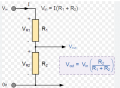
why do you use 100/(10k+100)
That's the voltage-divider attenuation for two resistors in series with one to ground.
Have you not studied any electric circuit theory?

1744552306610.png
why also do you do 1/101*1/101 when the two in series?
When you have two attenuators in series you multiply there individual attenuations together to get the total attenuation.
 
Last edited:
Top