Circuit to bring (U.S) wall voltage up to 90% over time

Thread Starter

lhawe1

Joined Oct 19, 2024
2
I would like to design a device that slowly ramps up wall voltage over a period of 10-20 seconds that ends up delivering 90-95% of RMS wall voltage to a consumer that would draw about a 5 amp peak current. My current idea is a Triac/Optocoupler circuit that removes the control potentiometer with a timed resistance circuit. Any recommendations on the timed control circuit?

Thank you
 

Thread Starter

lhawe1

Joined Oct 19, 2024
2
The application is a vintage tube circuit power supply. :)

It needs to be built and not purchased for irrelevant reasons!
 

Danko

Joined Nov 22, 2017
2,167
Last edited:

MisterBill2

Joined Jan 23, 2018
27,504
I have seen just such a circuit in an old hobby electronics book, listed as a time dependent light dimmer. It was also able to serve as a gradual light brightener. Probably a different TRIAC will be required for the higher current rating, that should not be a challenge.
It may take me a while to locate the book.
But now you have the keyword to do a search.
 

Ian0

Joined Aug 7, 2020
13,131
The B+ supply will reach full voltage when the trigger angle reaches 90°, (because then you will be delivering park voltage to the capacitor), but the voltage to the heaters will not reach maximum (because it is AC) until the trigger angle is 180°. That means for 10 seconds of the 20, you will have full anode voltage but not enough heater power. That is a situation which tends to strip the cathodes, and shorten the life of the valves.
 

MisterBill2

Joined Jan 23, 2018
27,504
Given that it is "a vintage Tube Circuit Power Supply, it probably also includes a rectifier tube. Of course it may also be possible to use an old trick of putting a six volt #47 pilot light in series with the center tap of the high voltage winding. That tends to slow the charging of the filter cap a bit.

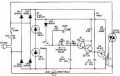
I did locate the circuit: "Time dependent Lamp Dimmer." It is in the second edition of the General Electric "Electronic components HOBBY MANUAL", on page 133. It provides both controlled brightening and dimming, switch selected.
The bad news is that it uses a GE-X10 unijunction transistor driving a Sprague # 35ZM923 pulse transformer to trigger a GEX12 triac. Thw GE-X12 is a 6 amp 200 volt triac with a 3 volt 50 mA trigger current.
Quite likely there is a more modern triac that can be triggered the same way. This circuit uses two NPN transistors in a darlington circuit to control the unijunction transistor, and a 100 mFd cap as the timing cap.
 

Danko

Joined Nov 22, 2017
2,167

Attachments

Last edited:

MisterBill2

Joined Jan 23, 2018
27,504
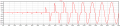
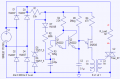
I am certainly impressed! Many thanks to DANKO for finding and reproducing the circuit. Looking at the simulation, it might not meet the TS requirements completely. (edit) BUT then I see that the timing capacitor was reduced from 100 MFD to 0.22 MFD, and the 5 meg variable was reduced to 680K! That removed most of the slow rise time. (end of edit)
At that point we need more information about the actual load. If the load is a tube type device with a power transformer and a rectifier tube, then there are possible schemes to more gently apply the high voltage.
Also, there is probably a scheme to slow the rapid action of the time dependent brightening circuit.
 
Last edited:

schmitt trigger

Joined Jul 12, 2010
2,085
I did locate the circuit: "Time dependent Lamp Dimmer." It is in the second edition of the General Electric "Electronic components HOBBY MANUAL", on page 133. It provides both controlled brightening and dimming, switch selected.
The beauty of all discrete circuits.
Nowadays, this couldn’t be done without an ARM microcontroller.
 
Top