Circuit breaker help!

Thread Starter

WCR

Joined May 1, 2024
10
The bow thruster does come off and on multiple times during a docking maneuver. It is simply an on and off with no speed or direction, except that it can work in reverse to move the boat in the opposite direction.
There is no battery shut off between the main bank of batteries and the bow thruster except for the three pull breaker that was installed by the manufacturer.
My main problem with an ANL type of fuse is that it would not be visible and it would be difficult to get to in this particular boat.
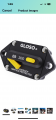
I was considering something similar but a combination of two items please see photos. One is a simple 24 V 300 amp on and off battery switch. The other is a 300a thermal breaker. I was considering building into the panel.
I have read many opinions through articles of people that have just used the breaker as a switch. Would you not recommend that?
This would be turned on in the beginning of the day when the boat is to be put into use. Or would you recommend using both in conjunction.
I attached photos of switches.
Thanks again
Bill

 

MisterBill2

Joined Jan 23, 2018
27,508
See post #15, my take is that the breaker IS used for the ON/OFF switch. That use will certainly lead to failure based on the reality that the contacts probably do not open and close "in Perfect Unison." A300 amp breaker would be rather large, and require a fair amount of effort to operate. So even if a single pole breaker were used, a separate run/stop control would be a good choice to reduce wear on the breaker, if no other reason.
The breaker manufacturer should be able to provide the claimed number of operations for a breaker on/off operation, That would certainly aid in the decision making.
 
Last edited:

LowQCab

Joined Nov 6, 2012
5,101
"" The bow thruster does come off and on multiple times during a docking maneuver.
It is simply an on and off with no speed or direction,
except that it can work in reverse to move the boat in the opposite direction. ""

What causes the Thruster to "come-On" or "Come Off" ?
What causes it to run in reverse ?

This should be the "Control-Box" that I was referring to.
There should be some Switches mounted somewhere to
provide this "On-Off, and Left-Right", Control.
This could be a single, spring-loaded, "Toggle-Switch" with a "Center-Off" position.

.
.
.
 

MisterBill2

Joined Jan 23, 2018
27,508
Both of those items are listed as "Battery Disconnect Switches", which implies to me that they are not for switching under full loads.

AND, the TS has answered that "No, there is no other control". Also, the breaker IS on the control panel. Not the power distribution panel.

With having two thrusters in front there would be no directional control. In a 60 foot class boat there would not be a pass-thru duct.
 
Last edited:

Thread Starter

WCR

Joined May 1, 2024
10
Sorry for the confusion and lack of information. The bowthruster is mounted in a tubular hole that passes through the hull. It goes port or starboard by reversing direction.
There is a control box mounted to the bow thruster motor. With a lower voltage controller that is intern controlled by an on and off and directional pad at the upper and lower helm. Those devices have a separate 20 amp breaker.
There is no load until one of the control pads is the on position and utilized.
 

Thread Starter

WCR

Joined May 1, 2024
10
So I guess my new question is since I believe I do not have a load while the unit is not being used. Can I Use the 24 volt single pole switched breaker or would you suggest also including the battery shut off switch?
 

LowQCab

Joined Nov 6, 2012
5,101
This is as I suspected.

It is highly unlikely that the Thruster-Control-Box or Motors pull any
measurable Current at all when the Motors are not being manually operated.

This can be easily be verified by testing with a Multi-Meter while the Motors are not running.

If no Quiescent-Current is measured,
then no "Disconnect-Switch" is necessary,
or even advantageous, in any way that I can think of.

This would also mean that there is no need to be concerned
about running the Batteries dead during long-term-storage.

A Fuse is required to protect the Wiring from the Battery to the Control-Box
against possibly melting and starting a FIRE in case of
some disastrous accident that causes a Short-Circuit directly across the Battery(s).
This Fuse should be sized relative to the Ampacity of
the particular Wire-Gauge of the Wire supplying the Motor-Control-Box.
A smaller sized Fuse is acceptable,
but it is unlikely that the existing Wire is actually rated for ~300-Amps,
so a smaller Fuse will likely be a better choice.

Maximum Fuse Size is dictated by the Wire-Gauge to be protected.

Recommended Fuse selection procedure ...........
Minimum Fuse Size is dictated by the maximum measured Current-draw demanded by the Motors,
under normal operating conditions.
This will insure adequate protection of the Motors from inadvertent jamming with debris, or other problems.
.
.
.
 

MisterBill2

Joined Jan 23, 2018
27,508
One caution about using a smaller fuse is that the 6KW label on the motor does translate to 250 amps at 24 volts. So to be safe from nuisance tripping or fuse clearing, AND to avoid overheating, I suggest going with the adequate rated wires and fuse. Or at least let us know the size of the wire.
And my previous answers were based on the information we were given. Also, as I have previously told folks, my mind reading ability is very poor on a good day, and useless on most days. That means that if I am not given the answers about the context of a question, the answer may not be nearly as good.

SO now having once received an answer that the circuit breaker was used to control the thruster and receiving the affirmative, and yet now being told that there is a directional control box with the controls that I had suggested I am rather confused.
 

Thread Starter

WCR

Joined May 1, 2024
10
Honestly, sorry for the confusion. It wasn’t meant to be. In my initial question I was trying to match up a circuit breaker to the breaker that already existed and served the boat for over the last 20 years.
After understanding that the breaker that was available to me was rated at a lower amperage. The conversation moved on because of the availability of the breaker that I thought I needed and opinions of those type of breakers for this particular use.
Even though it looks like we have went in circles, I now have a better understanding of what was originally installed and other alternatives.

The Italians make wonderful looking boats and yachts, but in my opinion, they tend to be over engineered.
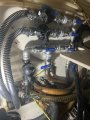
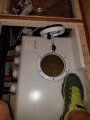
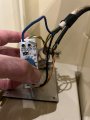
You would be absolutely blown away by the intricacy of the electronic heads. With multiple back up injection pumps associated with relays and electronic valves. I rebuilt some of this. photos attached.
I believe lowqcab was on to something from the very beginning, but it took information from all of you for me to get an understanding.
Thank
Bill

IMG_5376.jpeg20170419_174839.jpegIMG_4710.jpeg
 

MisterBill2

Joined Jan 23, 2018
27,508
I would not call that "over-engineered", but perhaps "over-designed". Any system whose failure would produce an unsafe condition is subject to being made redundant, which may be what we are seeing in the photos. Consider that in many commercial airliners TRIPLE REDUNDANCY is required. The fatal crashes of the two Boeing 737MAX airliners due to a single stall sensor proves the need for redundancy is real.

Now for the circuit breaker discussion, we have a unique situation as to the tradeoff between device size and device suitability for application. Using multiple breakers in parallel as a control device is a very poor choice for the reasons I explained earlier. BUT using a ganged breaker in parallel for overload protection and service disconnect can be acceptable, because in normal operation a circuit breaker will only trip a very few times in it's whole life, at most. Barring assembly defects, most circuit breakers may never trip during their service career.

That is totally the opposite of a breaker being used as a control device.

So a new question arises as to what lead to the failure of the original triple circuit breaker?
It is not likely that the failure was "for no reason", and if the system problem that lead to a failure, possibly by repeated tripping under full load, is not resolved, the replacement breaker may also fail in short order.
So this is a question that needs an answer.
 
Top