Choosing right Gate driver for MOSFET ?

Thread Starter

mishra87

Joined Jan 17, 2016
1,063
Because a voltage of 3.3V-2.5V = 0.7V is not enough voltage over the threshold value to fully turn on the MOSFET.
It would need a higher applied Vgs to fully turn on.
it's the voltage above the threshold value that determines how well the MOSFET is turned on.

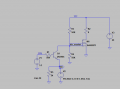
Below is an example circuit that uses a NPN BJT to level translate the signal without signal inversion.

R1 and R2 reduce the Vgs ON volage to keep it below the MOSFET maximum value (typically 20V).

View attachment 183150
I want to discuss a serious case about this circuit may be Mr. crutschow answer the same :

1. When there is no voltage at emitter of NPN transistor Q1, gets turn ON and collector current flowing through MCU DO pin case damage to MCU port because MCU sink max. 8mA current. So how to deal with this problem

2. When 3.3V appears at Q1 emitter ,Q1 gets turned oFF and MOSFET M1 conducts.

Could anybody confirm if my understanding is correct ?
 
Last edited:

Thread Starter

mishra87

Joined Jan 17, 2016
1,063
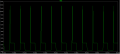
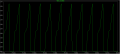
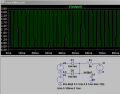
Simulation results of schematic posted mr. cruschow is not showing a good result for me. If my simulation file is correct.

Could he double check on below point.may be he can help to solve this issue ?

upload_2019-8-4_2-18-50.png

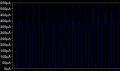
1. A short Current spike through Q1 may damage the micro controller.
upload_2019-8-4_2-20-8.png

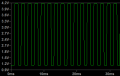
2. Poor gate charging characteristics of MOSFET. 12v from divider gets dip to 5.5V
upload_2019-8-4_2-21-52.png

Regards,
 

Attachments

jpanhalt

Joined Jan 18, 2008
11,087
1) You do not need any transistors to do 3.3V to 5V level shifting. This is XBee's design:

upload_2019-8-3_17-0-48.png
Albeit, the turn on will be slow, but mishr87 does not consider that a problem.

2) @mishra87 Doesn't need a level shifter according to his/her analysis. Why are we still concerned about that?

3) Last and not least, if you are going to add another transistor, why not use the correct mosfet to begin with?
 

Thread Starter

mishra87

Joined Jan 17, 2016
1,063
What problem?
The maximum input sink current required by my circuit is 0.53mA.
I think STM32F4 -max sink current is 8mA as per datasheet
Correct.
The maximum input sink current required by my circuit is 0.53mA.
Review post #23 about emitter current and MOSFET gate charge characteristics

Regards,
 

crutschow

Joined Mar 14, 2008
38,529
1. A short Current spike through Q1 may damage the micro controller.
That is just due to stray capacitance, and is too short to do any damage.
And likely the normal on-resistance of the micro output will limit the current to much less than shown in the sim.
2. Poor gate charging characteristics of MOSFET. 12v from divider gets dip to 5.5V
"Poor" is a relative term.
For the slow speed operation of the motor on/off, that dip will have no significant effect on the motor drive (as can be seen from the plot of the switching current through the MOSFET in my sim).
 

jpanhalt

Joined Jan 18, 2008
11,087
Again, why not use a better mosfet? Surely, a city with a metropolis of almost 6 million in a much larger state has a better mosfet available for you.
 

Thread Starter

mishra87

Joined Jan 17, 2016
1,063
That is just due to stray capacitance, and is too short to do any damage.
And likely the normal on-resistance of the micro output will limit the current to much less than shown in the sim.
"Poor" is a relative term.
For the slow speed operation of the motor on/off, that dip will have no significant effect on the motor drive (as can be seen from the plot of the switching current through the MOSFET in my sim).
Thanks for your quick support.

1. So what could the be optimum value that can be reduced for base of Q1. I think 50K has to reduce 4.7K or 10K
2. Mosfet potenial divider value can be 50k to 10k or 15k

Even doing this we have few benefit.

1. Low will turn ON comparatively fast due to high charging current to MOSFET input capacitance and reduction in rise time .
2. Mosfet gate voltage increases 5.5 to 10V which will help to reduce Pd of mosfet.

cons : mcu sink current will increase ?

What is your opinion and how to optimized these value to be more efficient .

Regards,


Regards.
 

crutschow

Joined Mar 14, 2008
38,529
If all you are doing is turning a motor on and off, the speed of the shown circuit is fine.
Lowering the resistance values will reduce the switching time of the MOSFET but you need to keep the value of the input sink current below 8mA.
That means the resistors should be no lower than about 4k (all resistors equal).
 

Thread Starter

mishra87

Joined Jan 17, 2016
1,063
That actually does 5V to 3V conversion not 3V to 5V, which is what is needed here.
Thank you so much for support and guidance.!

Further to this discussion i want to know how do i calculation MOSFET turn ON time.?
Mosfet charging current ?
MOSFET conduction and switching loss?

I assume mosfet Rupper=Rlower= 18K
MOSFET = RD3L150SN (I will go ahead with this mosfet)

Regards,
 

Thread Starter

mishra87

Joined Jan 17, 2016
1,063
If all you are doing is turning a motor on and off, the speed of the shown circuit is fine.
Lowering the resistance values will reduce the switching time of the MOSFET but you need to keep the value of the input sink current below 8mA.
That means the resistors should be no lower than about 4k (all resistors equal).
After reviewing your circuit some people says...
Its not good practice to turn on MOSFET using such a high value gate resistance and may cause delay turn ON.
Usually people 10 ohm gate resistor.

So please suggest if there is any alternate way to do this. ?

Regards
 

crutschow

Joined Mar 14, 2008
38,529
ts not good practice to turn on MOSFET using such a high value gate resistance and may cause delay turn ON.
It depends upon the application and the amount of the "delay".
I don't think a few microseconds delay will be a problem in your circuit.
Otherwise you should ask those "some people" about an alternate design. :rolleyes:
 

Thread Starter

mishra87

Joined Jan 17, 2016
1,063
It depends upon the application and the amount of the "delay".
I don't think a few microseconds delay will be a problem in your circuit.
Otherwise you should ask those "some people" about an alternate design. :rolleyes:
Thanks !!!
Yes, you are correct.
People are ready to accept the design.
Reason : high value resistance on mosfet Gate is not recommended. Only 10 ohm series gate can be used.
Could you give a strong reason to convince them and gain the trust.

Regards
 

jpanhalt

Joined Jan 18, 2008
11,087
@iimagine
Pardon my ignorance but what is the purpose of D1 connected to 3.3V?
In simulation, D1 in that circuit does not seem to affect output. However, since both Microchip and XBee promote or use that circuit for level shifting, it is the circuit I decided to post. Of course without it, the MCU driving the load needs to sink the entire current, which is less than a mA in this simulation. I modified the circuit by adding an addition diode drop to get well above Vgs(th) (shown below). All simulations here are with the modified circuit.

With D1&D3 disconnected:
upload_2019-8-5_13-11-17.png


Voltage at "output:"
upload_2019-8-5_13-7-35.png

Note that the "low" voltage is below 1.2V (i.e., lowest Vgs(th) of the original mosfet).

Schematic simulated with D1&D3 disconnected:

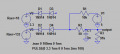
upload_2019-8-5_13-6-34.png

Source and sink series resistance for outputs is not provided in the datasheets for the PIC's I checked. Since outputs (source and sink) are limited to 25 mA at 3.3V, I assigned 132 Ω. That value doesn't make a whole lot of difference. The 91k was added to "discharge" the mosfet gate but is also probably not required. It does drop Vgs (low/off) a little.

This was just a thought at the time. I have never tested it for this purpose and would have chosen a more appropriate mosfet to begin with to avoid all of these gate drive complications.
 

crutschow

Joined Mar 14, 2008
38,529
Reason : high value resistance on mosfet Gate is not recommended. Only 10 ohm series gate can be used.
Could you give a strong reason to convince them and gain the trust.
Again, that's if you need the fastest switching speed.
If it's just for an on/off function, than obtaining the fastest switching speed just adds unnecessary complexity to the circuit.
Turning the motor rapidly on and off is only needed if you are doing something like PWM switching to control the motor speed.

My design goal is always to make the circuit as simple as possible to do the required task. :D
 
Top