Choosing a correct driver for LED lamp

MisterBill2

Joined Jan 23, 2018
27,573
That 72 volts would be a common voltage, one that I have come across. AND that is a reasonable guess. But just to be safe, why not try 12 volts first. AND, for a shop light fixture, exact matching is not a requirement.
 

timm27

Joined Dec 11, 2020
27
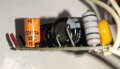
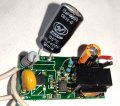
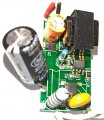
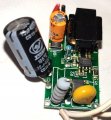
Oh - that is interesting - I don't recall seeing this photo of the internal driver in your first (or any subsequent) posts before this. In you first post you say: "I guess the internal driver has gone". I don't see any semiconductors on the small circuit board other than the diode labelled D1. This can't be a linear regulator, so I assume there will be some, to make a buck converter operating from 100 - 265V input.

I think it is going to be difficult to fix this just with guess work.
 

MisterBill2

Joined Jan 23, 2018
27,573
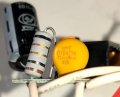
We could get a clue from the voltage rating of those two large capacitors, and possibly learn something from seeing that IC hidden below that large black capacitor that is folded down on top of something. That is hiding all of the important stuff.
And it might even take just replacing those caps to fix it. Very good quality photos, by the way.
We just need to see more.
 

Thread Starter

dimitrygo

Joined Oct 16, 2024
11
A good guess then is that it takes 24x3 = 72V. This makes sense since a driver with max of 48V lit it dimly.

And 25W / 72V = 347 mA

I would say it needs a constant current driver at 350 mA and a voltage compliance range that includes 72V. However it is a terrible design since it first parallels 3 LED, puts 24 of those in series then parallels 2 strings like that. There is no way all LEDs are getting the same current unless they were carefully matched.

Edited to add: this might do it.
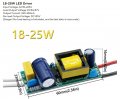
Thanks, this is a good guess indeed. But this driver in your link costs as much as 2 working lamps. I can get this driver below for less than $3. I think I am going to try it.
NewDriver.jpg
 

Thread Starter

dimitrygo

Joined Oct 16, 2024
11
We could get a clue from the voltage rating of those two large capacitors, and possibly learn something from seeing that IC hidden below that large black capacitor that is folded down on top of something. That is hiding all of the important stuff.
And it might even take just replacing those caps to fix it. Very good quality photos, by the way.
We just need to see more.
Thanks, I even didn't know my phone is capable to shoot that good.
I am not going to fix the circuit, especially if I can get a suitable driver for less than $3 as I posted above.
 

MisterBill2

Joined Jan 23, 2018
27,573
I am still wondering about the components hidden under that big capacitor. AND, the voltage rating of thoose two capacitors could either verify or disprove the 72 volts guess.
 

BobTPH

Joined Jun 5, 2013
11,524
The large black capacitor is on the AC inout side. The yellow one in on the output. It appears to be half wave rectified and if there is feedback, I don’t see it. So it is likely not a constant current driver. No wonder they are so cheap.
 

MisterBill2

Joined Jan 23, 2018
27,573
The large black capacitor is on the AC inout side. The yellow one in on the output. It appears to be half wave rectified and if there is feedback, I don’t see it. So it is likely not a constant current driver. No wonder they are so cheap.
That four terminal flat black device very close to the mains terminals certainly looks like a bridge rectifier to me. Not to be confused with the 7-legged IC nearby.
 

BobTPH

Joined Jun 5, 2013
11,524
That four terminal flat black device very close to the mains terminals certainly looks like a bridge rectifier to me. Not to be confused with the 7-legged IC nearby.
Agreed, now look near the other capactor, there is a single diode. That, I believe, is a half wave rectifier for the output.
 

momososo

Joined Nov 15, 2016
10
This is a simple non-isolated buck constant current LED driver circuit. You can replace it with the same specifications driver.

1. It is important to confirm that all on board LED chips are working properly before you buy a new driver.
You can use DMM to test one by one.

2. Choose safety-certified products.
 

momososo

Joined Nov 15, 2016
10
Are you referring to the failed board from the lamp? Because it would be odd to have a transformer on a non-isolated driver.
Hi, I mean the internal driver is non-Isolated AC/DC buck converter. It's hard to find the datasheet of the switching IC LC6654A but it's use to replace BP2833A. Can refer to BP2833A application circuit. L1 is inductor with SMD bobbin.
No visible defects on the driver. Some of the LEDs in the picture look like have black spots. So I recommend measuring the LED to make sure the light is good.
 

Thread Starter

dimitrygo

Joined Oct 16, 2024
11
Hi, I mean the internal driver is non-Isolated AC/DC buck converter. It's hard to find the datasheet of the switching IC LC6654A but it's use to replace BP2833A. Can refer to BP2833A application circuit. L1 is inductor with SMD bobbin.
No visible defects on the driver. Some of the LEDs in the picture look like have black spots. So I recommend measuring the LED to make sure the light is good.
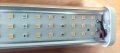
These are not black spots. These are red, blue, UV and IR LEDs and all of them have some reflective surface in the center. The rest of the LEDs are "normal" white.
leds.jpg
 

MisterBill2

Joined Jan 23, 2018
27,573
IF the TS has access to any sort of DC supply that can provide enough voltage to power the LED assembly thru a resistor that will allow a positive verification that the LEDs are still functional.

DANGER!!! The following discussion is relative to a NON-ISOLATED MAINS OPERATED POWER SUPPLY, WHICH CONTAINS HAZARDOUS AND POTENTIALLY FATAL VOLTAGES!!!

I have not experimented with a common triac light dimmer plus an external diode of adequate rating, and an adequately rated filter capacitor, as a test power supply. Such a supply will still need a series resistor and being constantly monitored to verify it is not providing excess voltage during the test.

HOPEFULLY THIS SUGGESTION IS NOT A VIOLATION, as I have not provided a circuit diagram , and also attached an explicit warning.
 

MisterBill2

Joined Jan 23, 2018
27,573
OK, so they work!! Now the same setup can serve to discover the voltage and current requirements.
Once the voltage for normal brightness is found, us that voltage and measure the current. Then you have all the specs for the replacement CC driver module.
 

Thread Starter

dimitrygo

Joined Oct 16, 2024
11
OK, so they work!! Now the same setup can serve to discover the voltage and current requirements.
Once the voltage for normal brightness is found, us that voltage and measure the current. Then you have all the specs for the replacement CC driver module.
How the required voltage can be found? I don't have any equipment.
 

MisterBill2

Joined Jan 23, 2018
27,573
How the required voltage can be found? I don't have any equipment.
If you do not have even a multimeter to measure voltage then probably you also lack the items to do the test that I suggested. Are you even able to solder the connections to connect a replacement driver module???
 
Top