Choosing a correct driver for LED lamp

Thread Starter

dimitrygo

Joined Oct 16, 2024
11
Hello.
I understand this is a silly question but maybe someone here has an experience with this kind of LEDs and can help me.
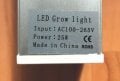
I have this LED lamp and I guess the internal driver has gone. The only info I have is on the second picture, there are no specifications on the LED strip.
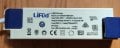
I also have this driver on the picture and tried to connect it and the LEDs react with very-very weak illumination.
So my question - does someone here have an experience with this kind of LEDs and can help me to choose correct characteristics of the LED driver.
LED1.jpgLED2.jpgLED3.jpg
 
Last edited:

Ya’akov

Joined Jan 27, 2019
10,226
Welcome to AAC.

There is a ≥80% chance the failure or the internal driver circuitry is a result of bad electrolytic capacitors. Replace the caps is very likely the fastest easiest and cheapest solution. I suspect—though haven’t checked—that a suitable drive will coast as much as replacing the entire lamp.
 

Thread Starter

dimitrygo

Joined Oct 16, 2024
11
Welcome to AAC.

There is a ≥80% chance the failure or the internal driver circuitry is a result of bad electrolytic capacitors. Replace the caps is very likely the fastest easiest and cheapest solution. I suspect—though haven’t checked—that a suitable drive will coast as much as replacing the entire lamp.
Thank you. It is either entire driver or entire lamp, I am not going to fix the circuit. There are some very cheap drivers on Chinese sites, but I don't know what to look for.
 

Ya’akov

Joined Jan 27, 2019
10,226
Thank you. It is either entire driver or entire lamp, I am not going to fix the circuit. There are some very cheap drivers on Chinese sites, but I don't know what to look for.
You’ll need to trace the PCB and work out how the LEDs are wired. Then you need to guess how much current they are being driven with. Then you can work out the voltage you need. It can be done, but it is a fiddly thing and the caps are simple.

Good luck with it, whatever you do.
 

timm27

Joined Dec 11, 2020
27
Hello.
I understand this is a silly question but maybe someone here has an experience with this kind of LEDs and can help me.
I have this LED lamp and I guess the internal driver has gone. The only info I have is on the second picture, there are no specifications on the LED strip.
I also have this driver on the picture and tried to connect it and the LEDs react with very-very weak illumination.
So my question - does someone here have an experience with this kind of LEDs and can help me to choose correct characteristics of the LED driver.
View attachment 333751View attachment 333752View attachment 333753
The details on the LED array suggests that it needs 100 - 265 V AC across it. The LED 'driver' you show says it will give you 25 - 42 V DC - which won't be any use at all for your LEDs.

What is the relationship of these two modules, the LED Grow Light and the LED Driver?

If this were on my bench I'd wire the LED array directly to 230V mains, and use the LFud module for some other project.
 

Thread Starter

dimitrygo

Joined Oct 16, 2024
11
The details on the LED array suggests that it needs 100 - 265 V AC across it. The LED 'driver' you show says it will give you 25 - 42 V DC - which won't be any use at all for your LEDs.

What is the relationship of these two modules, the LED Grow Light and the LED Driver?

If this were on my bench I'd wire the LED array directly to 230V mains, and use the LFud module for some other project.
There is internal driver in this lamp that transforms AC to DC. 100-265V AC is an input this lamp can accept.
There is no relation between the driver I tried and the lamp, I just have this driver and thought it can fit because of its output power.
 

BobTPH

Joined Jun 5, 2013
11,486
If you can figure out how many LEDs are in series, you can make a good guess at the voltage (multiply by 3.3V) the current is 25 divided by the voltage.

I would not be surprised if the driver you show would work. Or, for that matter, would not.
 

MisterBill2

Joined Jan 23, 2018
27,316
The driver label that we see in post #1 tells us it is a 700mA CC driver, with an output voltage range of 25 to 42 volts.
So if the TS has access to a DC power supply it should be possible to experimentally connect the LED section and slowly increase the voltage until the LEDs illuminate.
If an ammeter is available then adjust the voltage until the current gets up to 600 mA, and note the voltage. That would be the condition for operation that I recommend.
OR, purchase an equivalent driver module from an honest supplier.

If the LEDs fail to light, then the problem may be an open LED string, and others will need to suggest the diagnostic process.
 

timm27

Joined Dec 11, 2020
27
The driver is irrelevant - it is not the correct driver for the LED Array. The LED Array needs 10 - 265 V AC - as I see it it does not need a driver block at all.
 

BobTPH

Joined Jun 5, 2013
11,486
The driver is irrelevant - it is not the correct driver for the LED Array. The LED Array needs 10 - 265 V AC - as I see it it does not need a driver block at all.
Re-read the original post. The internal driver is dead and he is trying to replace it.
 

WBahn

Joined Mar 31, 2012
32,760
The driver is irrelevant - it is not the correct driver for the LED Array. The LED Array needs 10 - 265 V AC - as I see it it does not need a driver block at all.
No, the LED array does NOT need 100 V to 265 V AC across it. That is the range of AC voltages that the LED driver that is part of that lamp assembly can tolerate as input. The lamp assembly is rated as drawing about 25 W.

Assuming the driver is 90% efficient, that's about 22.5 W delivered to the LED array. As near as I can tell, there are 48 columns of 3 LEDs each, for a total of about 144 LEDs. So that's about 150 mW per LED. If the Vf across each is about 3 V, then that's about 50 mA per LED.

But, beyond that, we need to now how many parallel strings of LEDs and how many LEDs are in each string. That may or may not be easy to trace out.
 

MisterBill2

Joined Jan 23, 2018
27,316
OK, I see now that I was a bit mislead. BUT I am quite certain that the LED array will not survive the application of AC power at all. If the TS has a multimeter and a variable DC power supply then the process I described in post #8 will work, except that the correct voltage and current will need to be determined experimentally. The fact that the driver in the picture is not adequate tells us that the voltage will need to be above whatever that device is providing, but not a lot greater. So a voltmeter is certainly going to be required.
 

timm27

Joined Dec 11, 2020
27
I'd go back and read the label on the end of the array: "Input 100 - 256 V AC - 25 Watts. "

Unless you have a circuit diagram for the 'inside' of the array - I'd start from that. The OP says he guesses the driver is gone, but provides no evidence. Connecting to his LiFud driver gives a weak glow from the LEDs, so clearly is not getting enough current through the device. A pretty good indication that he is not applying enough volts ... 'nuff said!
 

MisterBill2

Joined Jan 23, 2018
27,316
Certainly the fact that the display lit some tends to show that the LED strings are still able to light. Now the question is at what voltage. To make a reasonable guess at the voltage will require knowing how many diodes are in each of the series segments. That will require a careful examination of the LED board.
 

WBahn

Joined Mar 31, 2012
32,760
I'd go back and read the label on the end of the array: "Input 100 - 256 V AC - 25 Watts. "

Unless you have a circuit diagram for the 'inside' of the array - I'd start from that. The OP says he guesses the driver is gone, but provides no evidence. Connecting to his LiFud driver gives a weak glow from the LEDs, so clearly is not getting enough current through the device. A pretty good indication that he is not applying enough volts ... 'nuff said!
Yes, start from that and then make reasonable inferences. Is it reasonable to infer that you are applying the input directly to an array of LEDs? That, somehow, you can apply 100 VAC this is array and pull 25 W and then turn around and apply 265 VAC to it and still pull 25 W?

No, that is not reasonable at all.

It is far, far, far more reasonable to expect a driver circuit that takes that input, over that wide range of input voltages, and transforms it into a constant DC output current that drives the array of LEDs, resulting in a near constant power draw regardless of what the input voltage happens to be as long as it is within the specified range.

It is also far, far, far more reasonable to expect this commercial LED grow lamp to use the same approach that nearly every other multi-element LED lamp uses to power the LEDs.
 

MisterBill2

Joined Jan 23, 2018
27,316
With a failed driver, which id probably indeed the problem, based on the LEDs just sort of lighting indicating that they work. Usually the LEDs in a light like that are divided into a parallel set of series strings, and powered with a current regulated supply. But discovering how many LEDs in each string can be a challenge because of the reflective coating that surrounds all the LEDs.
Often it is possible to probe the solder connection at the edge of the LED, and see how many are between the positive and negative connections of each short string. I have used a VARIAC variable transformer with a rectifier to apply a voltage and see what it takes to light up the string. that requires patience to not over-shoot and fry things..
 

WBahn

Joined Mar 31, 2012
32,760
He said the first post that it had a driver circuit that has failed.
Agreed. But the post I was responding to is asserting that because the TS doesn't provide evidence that there is a driver (that has gone bad), that we need to assume that there is no driver and that the input voltage is being applied directly to the LED array. My point is that, regardless of whether the TS mentioned a driver or not, it is far more reasonable to assume that there IS a driver. Certainly, the assumption that there is a driver is completely consistent with the TS's first post.
 

Thread Starter

dimitrygo

Joined Oct 16, 2024
11
To all.
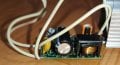
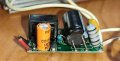
This is the internal driver:
Driver1.jpgDriver2.jpg

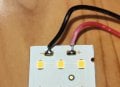
This is a designation on the LED strip (for those that still want to connect AC to it):

PlusMinus.jpg

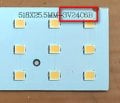
This is an only spec I see on the LED strip:
Spec.jpg

This is the other side of the LED strip. There are 2 separate large groups of 24 small groups each one of them contains 3 LEDs:
LED2.jpg
 
Last edited:

BobTPH

Joined Jun 5, 2013
11,486
A good guess then is that it takes 24x3 = 72V. This makes sense since a driver with max of 48V lit it dimly.

And 25W / 72V = 347 mA

I would say it needs a constant current driver at 350 mA and a voltage compliance range that includes 72V. However it is a terrible design since it first parallels 3 LED, puts 24 of those in series then parallels 2 strings like that. There is no way all LEDs are getting the same current unless they were carefully matched.

Edited to add: this might do it.
 
Last edited:
Top