Changing MOSFET makes circuit stop working

Thread Starter

gumattos

Joined Jan 16, 2017
9
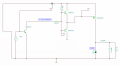
Hello everyone, I am facing a very interesting problem here. I already worked with MOSFETs before, but never seen something like that. I have a circuit using TL494 oscillating at ~80KHz and it works fine, I am driving the MOSFET normally, and it is a IRF9540. However, if I replace the IRF9540 for a IRFR5305, the output goes to Vcc and not the regulated output, any ideas? I am using a SB360 schottky diode with an input of 24V (the same for 48V input). Anybody have any idea why the circuit works with one MOSFET and not the other?

The original circuit is 48V and it works great with the IRF9540 but the same problem happens with the IRFR5305.

I couldn't find the model for TL494 on TINA so I just build this schematic for representation.

I tested the IRFR5305 with the multimeter and it seems to be working correctly, I have 5 of them, all new, one of them I haven't used yet in case I am doing something very wrong so I have a brand new for testing, the other four have the same problem. Sorry for the bad english.
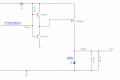
tina forum.PNG
 
Last edited by a moderator:

wayneh

Joined Sep 9, 2010
18,085
Check the data sheets. I'm guessing there is a difference in the threshold voltage such that the second MOSFET never shuts off.
 

Hypatia's Protege

Joined Mar 1, 2015
3,228
I have a circuit using TL494 oscillating at ~80KHz and it works fine, I am driving the MOSFET normally, and it is a IRF9540. However, if I replace the IRF9540 for a IRFR5305, the output goes to Vcc and not the regulated output
Having reviewed the datasheets, I see no obvious indication of incompatibility...
http://www.vishay.com/docs/91078/91078.pdf
http://www.infineon.com/dgdl/irfr5305pbf.pdf?fileId=5546d462533600a401535632522820ff

So...
To begin - please verify the signal at the gate of the IRFR5305, if as expected please check the signal at the cathode of SD2 (C3 disconnected)...

Best regards and good luck!
HP:)
 
Last edited:

Thread Starter

gumattos

Joined Jan 16, 2017
9
Having reviewed the datasheets, I see no obvious indication of incompatibility...
http://www.vishay.com/docs/91078/91078.pdf
http://www.infineon.com/dgdl/irfr5305pbf.pdf?fileId=5546d462533600a401535632522820ff

So...
To begin - please verify the signal at the gate of the IRFR5305, if as expected please check the signal at the cathode of SD2 (C3 disconnected)...

Best regards and good luck!
HP:)
Hello, thank you for the reply, I will try to access a oscilloscope and take a look at the waveforms. Another thing, as the SB360 is 60V and the MOSFET is 55V, maybe the the spikes created by the indutor could be affecting the MOSFET, what do you think?
 

Thread Starter

gumattos

Joined Jan 16, 2017
9
When T2 turns on there is the full input voltage of 24 V across gate to source on a device only rated for 20V.

Exceeding Vgs is so critical you don't even want to come close since it instantly destroys the device.
Oh, my bad, the schematic is wrong, the real circuit is 100 Ohm and 220 Ohm, so the divider sets 48V and 33V sorry.
 

Hypatia's Protege

Joined Mar 1, 2015
3,228
When T2 turns on there is the full input voltage of 24 V across gate to source on a device only rated for 20V.

Exceeding Vgs is so critical you don't even want to come close since it instantly destroys the device.
I missed that:oops: -- @gumattos Thus it seems the '9540 was 'cutting you a break' whereas the '5305 merely 'broke':( --- FWIW, Having first corrected the circuit, it may be interesting to try another '5305 so as to 'clinch' the diagnosis, as it were - FWIW it may be possible to detect a punctured gate via a DMM resistance reading - otherwise static bias analysis will readily reveal such damage...

Best regards
HP:)
 

Hypatia's Protege

Joined Mar 1, 2015
3,228
Oh, my bad, the schematic is wrong, the real circuit is 100 Ohm and 220 Ohm, so the divider sets 48V and 33V sorry.
If I'm 'following you', each 'T2-on' state is still grounding the MOSFET's gate? (and, hence, imposing 24V (V2) across the the latter's G-S "junction")

Best regards
HP
 
Last edited:

Thread Starter

gumattos

Joined Jan 16, 2017
9
If I'm 'following you', each 'T2-on' state is still grounding the MOSFET's gate? (and, hence, imposing 24V (V2) across the the latter's G-S "junction")

Best regards
HP
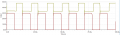
My intention in this circuit is the gate oscillating between 48V and 33V, like this simulation and circuit, with I used a BD137 as the transistor on the TL494 and the oscillator as the square wave generator, and the result is what I wanted, and it's inside the 'safe zone' I guess.

Capturar.PNG

2.PNG

The green (yellow?) wave is the voltage on the gate and the red is the oscillator that turns the BD137 that is the internal transistor on TL494 on and off.
 
My intention in this circuit is the gate oscillating between 48V and 33V, like this simulation and circuit, with I used a BD137 as the transistor on the TL494 and the oscillator as the square wave generator, and the result is what I wanted, and it's inside the 'safe zone' I guess.

View attachment 118825

View attachment 118826

The green (yellow?) wave is the voltage on the gate and the red is the oscillator that turns the BD137 that is the internal transistor on TL494 on and off.
Allright - Let's 'walk through' this...

1) The Source of the MOSFET is connected to the positive rail of V2
2) The Gate of the MOSFET is connected to the emitter of T2
3) the collector of T2 is connected to the negative rail of V2
4) When T2 enters (or approaches) saturation, V2 (48V) is placed across the MOSFET's G-S "junction"
5) The MOSFET dies!

But then there must be 'a hole in there somewhere' inasmuch as the IRF9540 would not survive either:confused::confused::confused:

Best regards
HP:)
 
Last edited:
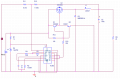
Here is the complete circuit


View attachment 118833
Thanks! -- Please perform the initial troubleshooting procedure outlined below - then report your results to this thread:)

Please note
- In the interests of perspicuity and eschewal of an all too common source of error/misapprehension fairly plaguing discussion of positive channel/junction device operation, I have elected to represent quantities merely as 'magnitudes' in the following -- sans introduction of ambiguity! Should you find such 'treatment' condescending or otherwise 'irksome' please merely 'read-over' same with my apologies!:oops:

1) Please remove the MOSFET from the circuit then observe the signal at the emitters of Q1/Q2 with attention to the peak 'excursion' from the positive rail of V1

2) Should the magnitude of said excursion fall within operational limits (i.e. well below 20V yet greater than 8V) please install a known good IRFR5305 then have another 'look' at said signal (it's barely possible the gate capacitance is producing unexpected operation).

Note Re: step 2 (above): Gate-Source signal magnitudes in excess of 20V will damage the gate insulation whereas Gate-Source magnitudes much less than 10V will likely prove insufficient to drive the device into saturation...

3) Should the gate signal remain within limits following installation of the IRFR5305 - please observe the signal at the MOSFET's Drain...

Best regards and good luck!
HP:)
 

Alec_t

Joined Sep 17, 2013
15,101
The circuit in post #15 shows a TL493 and a 48V supply. Are you now using a TL494?
You apparently (see below re R12/13) have no pull-up resistor from the C1 and C2 outputs of the '494 to either the 48V rail or to Vcc (33V?), so Q1 cannot turn on. However, the rated maximum voltage for the C1 and C2 pins is 41V so a 48V rail would kill them. Failure to switch Q1 on results in the FET being permanently on.
Are R12/R13 connected together or not (the pic isn't clear). If not, there is nothing to pull the base of Q2 down.
Vgs is excessive (as HP has noted).
 
Last edited:

cmartinez

Joined Jan 17, 2007
8,722
Are R12/R13 connected together or not (the pic isn't clear)
I would also suggest redrawing it, and placing the positive rail on top, and ground at the bottom. And the components placed in such way that currents could be followed vertically, and not sideways. That would make the diagram far easier to read.
 
Top