Change darlington with two transistors

Thread Starter

samili

Joined Dec 2, 2024
11
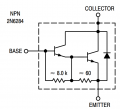
Hi. Im looking to remake a circuit which uses a 2n6284 that fails quite often. Would it be possible to use two npn transistors with the same values or am i in the wrong? I dont have too much knowledge in modifying existing circuits.
Any help is appreciated
 

BobTPH

Joined Jun 5, 2013
11,487
Hi. Im looking to remake a circuit which uses a 2n6284 that fails quite often. Would it be possible to use two npn transistors with the same values or am i in the wrong? I dont have too much knowledge in modifying existing circuits.
Any help is appreciated

Schematic? The choice of transistor might be important, or might not. We can’t know until we see the circuit.
 

Thread Starter

samili

Joined Dec 2, 2024
11
Schematic? The choice of transistor might be important, or might not. We can’t know until we see the circuit.
Okay. Im working on creating a schematic. It's for blower motor speed control on a old car so it's not too complicated. Got to remove the old unit first and map everything out. Should be done in a few days or so.
 

boostbuck

Joined Oct 5, 2017
1,040
..... use two npn transistors with the same values ....
I'm not quite sure what you mean by that, but you could replace an NPN darlington with two NPNs, yes. Given you have a circuit where the 2N6284 is failing regularly, you will have to try and replicate (or exceed) speed and power considerations with your substitutes. If it's a blower speed control I doubt speed is an issue, but power will be. Maybe there is a heatsink limitation with the current installed device - a car can be a challenging environment for semiconductors.

1733180595565.png
 

MisterBill2

Joined Jan 23, 2018
27,317
I suggest discovering why the darlington transistor fails. My experience is that transistors rarely fail "for no reason", but rather that most failures are caused by exceeding some maximum allowable variable, most often current or voltage.
So I suggest studying the data sheet for the 2N6284 transistor and then measuring the actual working conditions, because my guess is that you will discover a problem of some sort.
 

Thread Starter

samili

Joined Dec 2, 2024
11
I suggest discovering why the darlington transistor fails. My experience is that transistors rarely fail "for no reason", but rather that most failures are caused by exceeding some maximum allowable variable, most often current or voltage.
So I suggest studying the data sheet for the 2N6284 transistor and then measuring the actual working conditions, because my guess is that you will discover a problem of some sort.
It's a circuit made in 1990 by Delanair which places half the circuit inside the blower housing, there's a lot of moisture going through there and since a lot of the components are unprotected they start to corrode at the solder joints. so yes there is a reason behind it, there would not be a problem if everything in the system is in pristine condition. i'm looking to move the whole speed control circuit outside of the blower housing to prevent the quick degradation of everything (hopefully)
 

LesJones

Joined Jan 8, 2017
4,511
It may be mounted in the blower housing to provide cooling for the transistors. Do you know if the transistors are just used to behave like a resitor dissipating power or do they control the power to the motor using PWM (Pulse widthe modulation.)

Les.
 

Thread Starter

samili

Joined Dec 2, 2024
11
Thanks for all the comments!
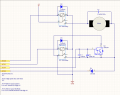
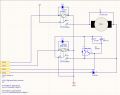
So i have started mapping everything out, i used pictures and a wiring diagram to get it together (I haven't gotten a opportunity to remove the blower yet, it takes a couple of hours to get it out). i'm quite certain (100%) that the diagram is wrong and i will post a updated one when i take the blower out. but maybe it will give a small insight in how the system operates. i should also include that the hvac system uses two blowers, so the motor speed feedback is used to make sure that the two motors are in sync.
Speed controller.png
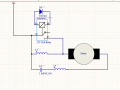
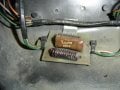
i also made an alternative diagram for the isolation relay circuit since there is a small pcb with 3 components which intercepts some of the wiring to the motor.
isolation relay.png
Isolation relay pcb.jpg
this is the first diagram I've ever made so please go easy on me haha
 

Thread Starter

samili

Joined Dec 2, 2024
11
It may be mounted in the blower housing to provide cooling for the transistors. Do you know if the transistors are just used to behave like a resitor dissipating power or do they control the power to the motor using PWM (Pulse widthe modulation.)

Les.
Yes it's to provide cooling, i think it's used as a pwm
 

LesJones

Joined Jan 8, 2017
4,511
In post #10 I think you have the collector and emitter connrctions the wrong way round. In your circuit you have the collector connected to ground.
Les.
 

Thread Starter

samili

Joined Dec 2, 2024
11
In post #10 I think you have the collector and emitter connrctions the wrong way round. In your circuit you have the collector connected to ground.
Les.
Yes now that you say it, been scratching my head for a while because i couldn't see how it would work, i also see that the Zener diode is the wrong way round now as well. thanks for the input :)
 

LesJones

Joined Jan 8, 2017
4,511
That looks better. It now makes sense. The transistor will dissipate quite a lot of power so it will get hot. It looks like a closed loop speed control design. The circuit that controls the drive to the base of the transistor will adjust the current into the base to give the required voltage accross the motor for the selected speed. If it was not closed loop the speed would depend on the hfe value of the transistor. (That is something that can vary widely between samples of the transistor.)
From the datasheet on the 2N6284 it looks like it has an internal diode between the collector and emitter. You may have to add this diode externally to your darlington pair. Where the wire from the anode of this diode crosses the wire to the emitter of the trnsistor there shold be a dot indicating that the wires join at that point.
The 1N4148 is not a zener diode. It is just a low current silicon diode.
Les.
 

MisterBill2

Joined Jan 23, 2018
27,317
OK, I see that certainly the transistor is handling a lot of current So any location outside of the airflow will need a large heat sink.
Another choice could be a good conformal coating over the various parts.
BUT if the blower only has a high speed and a low speed, using a resistor and another relay would be an alternative that might last a lot longer.
 

Thread Starter

samili

Joined Dec 2, 2024
11
That looks better. It now makes sense. The transistor will dissipate quite a lot of power so it will get hot. It looks like a closed loop speed control design. The circuit that controls the drive to the base of the transistor will adjust the current into the base to give the required voltage accross the motor for the selected speed. If it was not closed loop the speed would depend on the hfe value of the transistor. (That is something that can vary widely between samples of the transistor.)
From the datasheet on the 2N6284 it looks like it has an internal diode between the collector and emitter. You may have to add this diode externally to your darlington pair. Where the wire from the anode of this diode crosses the wire to the emitter of the trnsistor there shold be a dot indicating that the wires join at that point.
The 1N4148 is not a zener diode. It is just a low current silicon diode.
Les.
alright, sounds promising. once i got the blower out i will confirm the diagram and if it checks out, ill order a custom pcb.
greatly appreciate the help!
 

Thread Starter

samili

Joined Dec 2, 2024
11
OK, I see that certainly the transistor is handling a lot of current So any location outside of the airflow will need a large heat sink.
Another choice could be a good conformal coating over the various parts.
indeed, my plan is 3d print a case to house the electronics and heatsinks. I will also add a 40mm cooling fan controlled by the isolation relay to promote cooling. I'm also thinking about moving the relays to the custom PCB so everything that steers the motor is contained in one unit.
 
Top