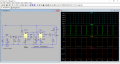
I think that spec is there for cases where multiple flip flops are being clocked synchronously where differences in threshold voltages would cause them to latch the wrong data.And yes, the clock edge speed could be the problem as seen here from the data sheet:
![]()
Well, that's certainly a valid theory, but I think it's so the internal latches switch at the same time to avoid any possible race conditions.I think that spec is there for cases where multiple flip flops are being clocked synchronously where differences in threshold voltages would cause them to latch the wrong data.
The voltage is undecided for now. The aim is to make selectable pre-amps and I'll let the CD4013 run on whatever the pre-amps end up using. Now that I've got something to work with I'll certainly try out your suggestion.Not sure if I missed the voltage you wish to use, but in your opening post your on line schematic shows a 12 volt source but your schematic shows a 9 volt source.
Maybe also why the HEF4013 worked as a drop in replacement where the CD4013 wouldn't because of the Schmitt trigger on the clock input as noted by Kjeldgaard.That would explain why the op was having a problem when he slowed down the clock edges with the debounce circuit.
I once helped redesign a circuit that had a similar problem. It was a microprocessor with an external peripheral chip.Well, that's certainly a valid theory, but I think it's so the internal latches switch at the same time to avoid any possible race conditions.
That would explain why the op was having a problem when he slowed down the clock edges with the debounce circuit.
The reason for the delay circuit from Q- to D is to meet hold time requirement. D has to be held steady not only prior to leading edge of the clock (setup time requirement) but also a bit after the clock transition (hold time requirement). The idea is to avoid second transition due to D changing prior to clock transition end. I would rather look at the de-bouncing circuit. My usual tack is to have the cap across the 1 Meg, not to GND.Your modified circuit is a real mess. Especially since the original is poor.
Focus on original schematic, try removing the capacitor and 100k resistor from the "Q-bar" output path. Connect "Q-bar" directly to "D" input.
Cap across the 1 Meg, 1k to GND
| Thread starter | Similar threads | Forum | Replies | Date |
|---|---|---|---|---|
|
|
Help with CD4013 for latch, then DG413 for 3PDT audio switch | Digital Design | 4 | |
|
|
CD4013 circuit flips but doesn't flop | Digital Design | 86 | |
| 4 | cd4013 flip flop outputs always on | Digital Design | 17 | |
|
|
CD4013 flip-flop | Digital Design | 12 | |
|
|
LTSpice and CD4013 | Digital Design | 12 |