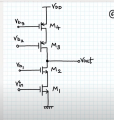
Hello , Im having trouble with biasing these mosfets. Actually I am trying to make an amplifier that is at least near to be rail to rail.
Now I wonder , how should I bias those M4 , M3 , M2.
If you can share an working example , I be really happy.
It depends on who You ask, and specifically, what exact Specifications You expect it to achieve,
as in, how-high-is-up, and how much Money do You have ?
.
.
.
It depends on who You ask, and specifically, what exact Specifications You expect it to achieve,
as in, how-high-is-up, and how much Money do You have ?
.
.
.
If you are able to bias each device with resistors from that devices Drain and Source, it could work. Maybe..
I suggest reviewing the biasing schemes used for cascode tube amplifiers many years ago. It was some brilliant development work done in the 1950 to 1965 era.
If you are able to bias each device with resistors from that devices Drain and Source, it could work. Maybe..
I suggest reviewing the biasing schemes used for cascode tube amplifiers many years ago. It was some brilliant development work done in the 1950 to 1965 era.
Unfortunately much of the vacuum tube presentations were in articles I read at the time, in publications that were often shared with others, prior to 1970. They may be archived someplace. I do not have access to any of that now.
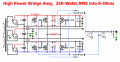
It's not tested, but it should work just fine with careful selection of the High-Current/High-Voltage Op-Amps.
As a ~250-Watt-Audio-Amp, it will generate a substantial amount of Heat,
so the Output FETs may need to be doubled or even tripled to dissipate the Heat.
.
.
.
The audio amplifier in the circuit does not come close to my understanding of a cascode circuit . Not even slightly similar to any of them that I have seen. They were, all small signal RF amplifiers. Only one input, only one output. A series power amplifier is rather vastly different. Your circuit is intended to increase the power output by extending the voltage swing, which is very reasonable but totally different.
It is a bad idea to connect two current sources in series. The cascade is a good current source. You can achieve that the output level in the simulation is equal to half of the power supply by making the parameters of the p- and n-channel transistor models the same at Vn =-Vp, but in reality you will not achieve this. Negative feedback should be used. As an intermediate internal stage, you can use your combination of four transistors, i.e. as part of a larger circuit. You don't use an operational amplifier without direct current negative feedback. The situation is similar here. Your cascade has a high gain.
Now a question: Since designs for working audio amplifiers at all sorts of power levels are freely available, at up to over 1000 watts, WHY consider using stacked transistors when proven and available designs are around?? High gain in a power output stage is seldom used, because it is very tricky to keep linear and stable.
So what is the motivation for the proposed stacked devices????

 Facebook
 Google
 GitHub
 Linkedin