Car battery charger rewireing

Thread Starter

saxa

Joined Jul 15, 2018
14
Hi all, I hope I am posting this into the correct forum. I am a newbie in electronics so I want few advises and suggestions on how to do that thing correctly.

I got an old broken car battery charger from my neighbour and I want to make it go again and possibily modifiy ti to be a better one.
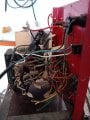
Here is a picture of it and of its internals, the circuit is very simple and I think I understand it well, but there are still some things i can not
understand well. So lets go by the design and doubts.
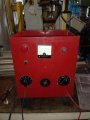
car_battery_charger.jpg car_battery_charger_top.jpg

The circuit itself is composed from a transformer, which has different windings yo get out different voltages. These goes connected to a switch for voltage selection, then they go to the rectifier bridges, from there there are 2 electrolitic condensers and from there they flow goes to the battery leads, the negative going directly to the negative of the battery and the positive passes through an AM meter then a fuse and then to the positive battery lead.
Here is a schematic of the whole circuit. Originally probably this went to some more switches, which i dont know why.

Schematiccircuit.png

Here is the photo of the capacitors and their values are 4700uF and 1500uF , if i get it correctly since they are in paralel we can
consider it as one cap of 6200uF , correct ?
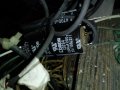
capacitors.jpg

One first thing is that I have no idea on why the primary winding of the transformer has another one which divides the main voltage from 128V and give the voltage of 65V , why does it need that ?

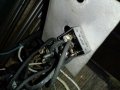
The other thing I do not get is why there are 2 rectifier bridges ? BR1 and BR2 are KBPC5010 .
bridge_rectifier.jpg

The third thing is that when I rewire it and make the measurement with the capacitors connected the voltage started up to grow and grow.

Lastly I want to know if I choose the correct voltage output from the transformer. The transformer has a lot of output windings rangeing from 0V up to 32V
from what i could measure. I choose the 2 wires which showed on 17,70V. Is that tyoo high for a 12V car or truck battery ?

Will I be able to charge the truck battery with it which has the capacity of 110Ah ?

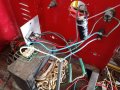
Here is a picture of how it is right now rewired.
rewired_full.jpg

I also plan to insert in a new AM meter as the old one was broken, and possibly also an additional Volt meter. Probably digital ones, opinions ?

Many thanks for your help.
Sasa
 

Attachments

Hymie

Joined Mar 30, 2018
1,347
On a more practical note (than my first response), this unit needs a complete re-wire.

There are so many things wrong with this unit (based on the photos), if it were mine I’d probably throw it in the bin.

I’d strongly advise against connecting the unit to the mains supply.
 

Thread Starter

saxa

Joined Jul 15, 2018
14
Thanks, thats also what I thought, but right now spending few dollars to buy a mine is not an option, and I would like to get a bit of learning with it. Of course one of the first things i did was to unsolder out all the wires which were just flying around. I bent all the ones on the transformer secondary side so they do not make much confusion as before. Surely this unit is old and way far from being well protected against some kind of electrical shock.

Anyway if possible please answer my questions about various doubts.
 

be80be

Joined Jul 5, 2008
2,395
You need to start with the transformer I think you need to map out it first it more then likely has output's that need to hook together to get a higher amp output. with the right voltage.
 

Thread Starter

saxa

Joined Jul 15, 2018
14
Hi be80be, yeah I did that, and used 2 wires of all those which gave me out 17,70V those are going now to only one bridge rectifier, as I read on the internet that although is it possible to have them in parallel but it has not much advantages.
So right now I can get this 17,7 V on the output, but when I measure it with the 2 capacitors on the voltage goes up and grows without stopping.
I think I measured it until 27V.

Why is that happening ?

And should I put back the both of the bridge rectifiers or can I safely use only one ?
 

Reloadron

Joined Jan 15, 2015
7,886
So right now I can get this 17,7 V on the output, but when I measure it with the 2 capacitors on the voltage goes up and grows without stopping.
I think I measured it until 27V.

Why is that happening ?
If you apply 17.7 VAC to a bridge rectifier (only one bridge rectifier) two of the four diodes will conduct on alternate half cycles of the AC waveform. If each diode has a forward voltage drop of 0.7 volts you will drop about 1.4 volts. Your DC voltage should be about 16.3 VDC less any capacitors. When you add the capacitors into the circuit they will charge to the peak value of your AC sine wave or 1.414 * RMS so you get about 17.7 * 1.414 = 25 Volts. I have no idea why you are seeing 27 Volts but the effect you are seeing is normal.

The idea behind placing two full wave bridges in parallel is to increase the current handling ability. That said it is really not considered a good practice for a few reasons. There are ways to do it using balancing resistors but I do not see any used. While not really a good practice I have seen it done in some commercial applications. Just my opinion as to not a good practice.

As to the charging voltage of a sealed lead acid battery? I suggest you give this a read. Applying too high of a charge voltage will eventually cook the battery as well as cause excessive current draw.

Ron
 

Thread Starter

saxa

Joined Jul 15, 2018
14
Hi Reloadron ! Thanks for your answer. Now it confuses me, the bridge rectifiers should have 4 diodes in it, so one should be enough, also
because from the datasheet I saw it should handle about 50 amps. Here is the datasheet link http://www.mouser.com/ds/2/80/KBPC10005-G Thru225890. KBPC5010-G Series RevA-184672.pdf for the KBPC5010. I think 50 amps is more than enough to charge a battery.

So should I place both bridges back on it as they were ?

Thanks for the thread, I will give it a read.
 

Thread Starter

saxa

Joined Jul 15, 2018
14
Ok thanks, this is what I did, as you see in the last picture this is how it is now wired. One rectifying bridge, the 2 caps in parallel and then going out to the battery will be next step, of course i want to add back a new AM meter and possibily a volt meter too.
 

shortbus

Joined Sep 30, 2009
10,050
My question is why the capacitors in this charger? I've been inside many old chargers and have never seen a cap in any of them. And by old some of them even had selenium rectifiers in them. Is it possible that who ever messed up the wiring added the caps?
 

Reloadron

Joined Jan 15, 2015
7,886
My question is why the capacitors in this charger? I've been inside many old chargers and have never seen a cap in any of them. And by old some of them even had selenium rectifiers in them. Is it possible that who ever messed up the wiring added the caps?
That thought also crossed my mind. I have an old light weight charger 6/12 Volt and any of the older basic chargers I have seen and used had no capacitors in them. Never saw a need for filter caps in a lead acid battery charger.

Ron
 

Thread Starter

saxa

Joined Jul 15, 2018
14
My question is why the capacitors in this charger? I've been inside many old chargers and have never seen a cap in any of them. And by old some of them even had selenium rectifiers in them. Is it possible that who ever messed up the wiring added the caps?
Exactly, since i got this from my neighbour I have no idea if somebody already messed the things up. From what I can see the caps were already there when i got it. And surely somebody cut off all those wires for selecting the different voltage options.
 

Thread Starter

saxa

Joined Jul 15, 2018
14
That thought also crossed my mind. I have an old light weight charger 6/12 Volt and any of the older basic chargers I have seen and used had no capacitors in them. Never saw a need for filter caps in a lead acid battery charger.

Ron
Ron, I also read that up somewhere that they are not needed I think on stack exchange, since without it it "agitates" the battery cells better.
But since they were there I just thought I should leave them there.
 

ian field

Joined Oct 27, 2012
6,536
Hi all, I hope I am posting this into the correct forum. I am a newbie in electronics so I want few advises and suggestions on how to do that thing correctly.

I got an old broken car battery charger from my neighbour and I want to make it go again and possibily modifiy ti to be a better one.
Here is a picture of it and of its internals, the circuit is very simple and I think I understand it well, but there are still some things i can not
understand well. So lets go by the design and doubts.

View attachment 156238 View attachment 156239

The circuit itself is composed from a transformer, which has different windings yo get out different voltages. These goes connected to a switch for voltage selection, then they go to the rectifier bridges, from there there are 2 electrolitic condensers and from there they flow goes to the battery leads, the negative going directly to the negative of the battery and the positive passes through an AM meter then a fuse and then to the positive battery lead.
Here is a schematic of the whole circuit. Originally probably this went to some more switches, which i dont know why.

SchematicView attachment 156237

Here is the photo of the capacitors and their values are 4700uF and 1500uF , if i get it correctly since they are in paralel we can
consider it as one cap of 6200uF , correct ?
View attachment 156242

One first thing is that I have no idea on why the primary winding of the transformer has another one which divides the main voltage from 128V and give the voltage of 65V , why does it need that ?

The other thing I do not get is why there are 2 rectifier bridges ? BR1 and BR2 are KBPC5010 .
View attachment 156241

The third thing is that when I rewire it and make the measurement with the capacitors connected the voltage started up to grow and grow.

Lastly I want to know if I choose the correct voltage output from the transformer. The transformer has a lot of output windings rangeing from 0V up to 32V
from what i could measure. I choose the 2 wires which showed on 17,70V. Is that tyoo high for a 12V car or truck battery ?

Will I be able to charge the truck battery with it which has the capacity of 110Ah ?

Here is a picture of how it is right now rewired.
View attachment 156243

I also plan to insert in a new AM meter as the old one was broken, and possibly also an additional Volt meter. Probably digital ones, opinions ?

Many thanks for your help.
Sasa
That's a lot of wiring for that schematic!!!

I'd just rip it out and start over as per schematic.

By the look of it - it may well have started out with a selenium rectifier. Its probably worth a bit of research into forward volt drop.
 

be80be

Joined Jul 5, 2008
2,395
You have missed the point most big chargers like you have parallel the low voltage wiring to get more amps.
Or I wasn't clear
But you need to list all the wires on the transformer.
I would start with numbering them then test to see if there the same I would almost bet you have two 17 volt outputs but need to see how may wires there are 4 6 or 8

I have a big transformer the low side can do 32 volts at 40 amps or two 16 volts at 40 amps or one 16 volt at 80 amps.
To get the 80 amps I have to parallel the two 16 volts
 
Last edited:
Top