Car and 4 wheeler battery desulfator

Thread Starter

stryped

Joined Sep 17, 2023
136
I have been thinking of building a battery delsulinator in an attempt to revive some dead batteries. My family has 4 vehicles, 2 four wheelers, 3 ring lawn mowers, a tractor and a non boat with 3 marine batteries. It seems I am buying batteries a lot and they are expensive. I ran across this article that contains a few different designs: https://www.homemade-circuits.com/battery-desulfator-circuit-explained/
Which one would work the best? I am a tinkerer and not an expert, but can follow directions! Any help is appreciated!
 

MrChips

Joined Oct 2, 2009
34,629
This is an interesting topic and needs further real experimentation. I will look into this and report any useful information.
 

Thread Starter

stryped

Joined Sep 17, 2023
136
This is an interesting topic and needs further real experimentation. I will look into this and report any useful information.
Thanks. I am having a problem understanding the description of using a bridge rectifier for desulication. It says:

The transformer voltage must be rated approximately 25% more than the battery voltage rating, that is for a 12V battery a 15 to 16V supply may be used across the battery terminals.
The current can be approximately equal to the Ah rating of the battery for those which need to be revived and are badly sulfated,

Is it saying the transformer needs to output 15 to 16 volts ac into the bridge rectifier or the rectifier needs to output 15 to 16 volts to the battery?
Also, is it saying the rated current of the transformer needs to be equal to the car battery? That would be a huge transformer I would think….
 

LowQCab

Joined Nov 6, 2012
5,101
A Battery-Delsulfinator will seldom recover more than ~50% of the Battery's Capacity.

According to my experience, You will be wasting your time and money.
I've wasted many hours trying this back in the day and it was never completely satisfactory,
the Battery will just leave You stranded in the worst possible place, at the worst possible Time.
.
.
.
 

dl324

Joined Mar 30, 2015
18,220
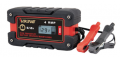
I second buying a battery maintainer. I have 5 and have recovered 4 car/lawn tractor batteries and several SLAs.

$40 at Harbor Freight:
1733930372178.png
 

Tonyr1084

Joined Sep 24, 2015
9,744
I second buying a battery maintainer. I have 5 and have recovered 4 car/lawn tractor batteries and several SLAs.

$40 at Harbor Freight:
View attachment 337740
THIRDSEY'S! I have it too.

Something I learned about SLA batteries - not quite the same as Wet Lead Acid batteries, but similar enough, is that if you don't charge them regularly they can sulfate. I have one of those battery boosters you keep in the trunk until you need it. It's been my experience that when gifted a couple of them to friends they put them in the trunk and forget about them. Then when they need it - even though it says it has 12 volts, and they think it's ready to go, sulfating has occurred because the battery has not been charged in months or even a year or more. Even SLA's on my bench have gone bad from sitting unattended. But the booster I have I charge it once a month. Sometimes not for a few months, but it's almost always being charged up. Even though it sits at 12.7V when it's put on the charger it boosts up to 14 volts, which helps to keep sulfating down. If you charge your batteries regularly they will last. If you let them sit too long they sulfate. It's like breathing through a Covid mask - difficult, but you can still breathe. Sulfates choke the plates making it hard for them to deliver their full current. Not voltage, current. Even though they may read good - if they've not been charged in a while - they may have sulfates clogging them up.

You may have to buy new batteries for your toys. But keeping them charged once at least every three months should keep them at the ready for years to come.
 

Tonyr1084

Joined Sep 24, 2015
9,744
I have 5 and have recovered 4 car/lawn tractor batteries and several SLAs.
I have one. I use it to keep my dual 12V car batteries ready for running my seldom used elevator. And when I suspect a car battery may be showing signs of age - I'll put it on THAT battery. Been happy with mine. So glad someone suggested this to me years ago.
 

crutschow

Joined Mar 14, 2008
38,324
Keeping a battery charged certainly minimizes sulfating, and is much better than trying to de-sulfate one, which apparently is only marginally successful.
If the battery is not close to an AC outlet for the charger, then a solar-powered trickle-charger would also work.
 

Externet

Joined Nov 29, 2005
2,626
Batteries care success is by never letting them discharge and abandoned. A lead-acid battery will never recover its capability after being 24 hours discharged. When dead, they are dead, and the fault is the users.
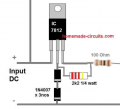
Connecting a dormant battery to a tiny regulated 13V supply during storage avoids any useless effort$ to desulfate cadavers. Which can be implemented by a 7812 chip and a couple of diodes fed by a rectified source.
And yes, I keep my dormant batteries on bare cold concrete floors, never living under weeds at backyard. Also yes; watering them is part of success even they won't grow more.
 

Tonyr1084

Joined Sep 24, 2015
9,744
Spoken of this before in other threads, I keep a 12V Wet LA battery held constantly at 13.8V. I only use it to play a car radio in my shop. The first battery used was an old car battery. At last check it was still good after 10 years from date of manufacture. Recently I upgraded to a small tractor battery for size and space as opposed to having a full sized car battery sitting around.
Which can be implemented by a 7812 chip and a couple of diodes fed by a rectified source.
7812 will hold a battery at nominal voltage but not at a float voltage of 13.6, which is where a resting battery should be held.
 

bassbindevil

Joined Jan 23, 2014
918
Putting a little solar panel battery maintainer on vehicles that are parked in sunlight should help. The cheaper amorphous silicon cells seem to be better at gleaning energy from diffuse light, like cloudy conditions.
 

Tonyr1084

Joined Sep 24, 2015
9,744
With the 100Ω resistor the current would be around 130mA. So that would seem like a trickle or float charger. If you want something that can push a few amps, maybe 10 or 20 amps - you'll need an appropriate sized transformer.
 

Thread Starter

stryped

Joined Sep 17, 2023
136
With the 100Ω resistor the current would be around 130mA. So that would seem like a trickle or float charger. If you want something that can push a few amps, maybe 10 or 20 amps - you'll need an appropriate sized transformer.
I don’t understand. Doesn’t even that circuit using a 7812 chip require a transformer? Wouldn’t the amperage be dictated by the transformer?
 

Externet

Joined Nov 29, 2005
2,626
MainsAC-------->transformer--------->rectifier---------->7812----------->batteryload

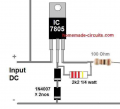
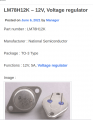
The image on post #12 [that i borrowed from the web] is only for the above portion "7812" regulator.
The 7812 comes in flavors 78L12 (low), 78M12 (medium) , 7812 , 78T12 (three) , 78H12 (high) ... each capable of different currents. Even with a super-current capable dictating transformer, the current is limited to the chosen 7812 flavor capability.
But for 'maintenance - float - trickle' charging, the transformer can be of 1 Ampere ~14V

1734013729354.png
1734014701369.png
 
Last edited:

Tonyr1084

Joined Sep 24, 2015
9,744
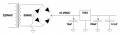
This is a drawing I did for someone else. The numbers suit their purpose. A transformer capable of a couple amps - lets say 10 amps on the secondary side - full wave rectified and filtered with the 10µF cap through a regulator chip, in the case of this conversation (also, not showing the diodes between the regulator and ground) will produce (with a 7812) 12 volts. Ignoring amperage capabilities of the regulator, the 100Ω resistor will allow a max current of no more than (12VDC ÷ 100Ω =) 0.12A or 120mA. That's Ohm's Law at work. Voltage divided by resistance equals amperage. Not to be overlooked is wattage. In the above example, 12V x 0.12A = 1.44 watts (of heat). Though the drawing doesn't show all that, it's just one of my stock drawings that should give you a better understanding of what goes on. Keep in mind the regulator will need to handle that much wattage. A heatsink may be required, depending on all the parameters.
Screenshot 2024-12-12 at 7.28.49 AM.png
Wouldn’t the amperage be dictated by the transformer?
No, not necessarily. It's dictated by the component's capabilities and by the load (resistance). A tiny transformer may not be capable of producing that much amperage. Trying to draw too much current from a transformer will result in heat, possibly excessive heat, likely failure, possible fire.

If you're wondering why the image above shows 30VAC before rectification and 41.2VDC after that's because of the filter cap and the transformer secondary being capable of 30VAC RMS. RMS is the useful energy of the transformer. Peak voltage is achieved after filtering. 30VAC = 41.2VDC. 30VAC x 1.414 = 42.4VDC Peak voltage. The reason why the number above doesn't agree with the math is because each diode in the bridge rectifier drops 0.6 to 0.7 volts. Since current is always passing through two diodes, there's a 1.2V drop. 42.4VDC Peak - 1.2Vf (forward voltage drop) = 41.2V (assuming 0.6Vf per diode).
 
Last edited:
Top