Capacitor for tig welder substitution

Thread Starter

hoader

Joined Mar 27, 2015
29
Hi: I have a monster 60 year old 300 amp tig welder. The high frequency circuit does not work. First thing it mentions is testing the capacitors. I found 2 that were bad. The parts book labels it as 2 of 0.002 uF 6000 volt mica capacitor. I ordered a 0.002 uF 10,000 volt metal polyester film capacitor. Same capacity, higher voltage range should substitute well. The axial capacitors I bought have #18 gauge or smaller leads. The original caps. have #10*32 studs for terminals and in a case about 2.5" * 1.5" * 1". I think I am missing something important here. What gives? George
 

DickCappels

Joined Aug 21, 2008
10,661
Your film capacitor will have a much higher dissipation factor than the mica capacitors, but they might be fine depending mainly upon the temperature of the dielectric during operation. The risk is decreased operating life.
 

mvas

Joined Jun 19, 2017
539
Hi: I have a monster 60 year old 300 amp tig welder. The high frequency circuit does not work. First thing it mentions is testing the capacitors. I found 2 that were bad. The parts book labels it as 2 of 0.002 uF 6000 volt mica capacitor. I ordered a 0.002 uF 10,000 volt metal polyester film capacitor. Same capacity, higher voltage range should substitute well. The axial capacitors I bought have #18 gauge or smaller leads. The original caps. have #10*32 studs for terminals and in a case about 2.5" * 1.5" * 1". I think I am missing something important here. What gives? George
What is the RMS Amps Rating on the original capacitor vs the new capacitor?
 

MisterBill2

Joined Jan 23, 2018
27,315
Capacitor volume does relate to current capacity, and so if the new smaller ones are not able to handle the current you will discover it quite quickly. BUT ALSO, mica capacitors are bigger than other types, and for a welder it may be that the case was for mechanical strength. AND, if they fail, you may need to purchase transmitting capacitors. They are usually rated for much more power. But they cost more.
 

Thread Starter

hoader

Joined Mar 27, 2015
29
mvas: I don't know what the amperage rating is on either capacitors or how to find out. I thought farads was a quantity of electrical energy like joules or watts. Shocking I went through a couple years of college (35 years ago) and never understood this. The studs bolt on to a copper strip is 24 gauge and .5" wide. It is attached to the points. The point gap is 0.008" and the strip . Ok, this welder can be adjusted to a very low current. Less than most buzz boxes.
MisterBill2: that is a great handle. Transmitting capacitors? I have some homework to do. Thanks for telling me where to look.
hoader
 

DickCappels

Joined Aug 21, 2008
10,661
The RMS ripple current rating is often given in capacitor datasheets or catalogs. If you can't get the catalog all you can do is guess.

The transmitter caps are high power mica caps and are a very good suggestion.
 

MisterBill2

Joined Jan 23, 2018
27,315
Capacitors have quite a few parameters aside from the value of capacitance, and many of those parameters are important in some applications but not others. The voltage rating is the one that most folks are aware of, but in addition there is internal resistance, dielectric loss, and the current rating. There is also the "Q" factor and internal inductance. That is why there are so many different kinds of capacitors available.
In the instance of the welder, those capacitors are charged and discharged very rapidly and to a great amount. This means that a lot of current is flowing in and out through the conductive portion of the capacitor dielectric material through the conductive parts. Current flow generates heat, and heat can cause a number of problems. (This is very similar to how a microwave oven heats things.) Usually the amount of heat that can be safely dealt with is related to the bulk of the capacitor, among other factors. That is part of why the capacitors used for motor starting and running are bigger than similar capacitance devices used in other types of electronic circuits.
So now you have a bit of an explanation, not a complete education, but hints as to why there is more to be aware of than just capacitance and voltage rating.
 

Thread Starter

hoader

Joined Mar 27, 2015
29
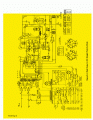
I found several manuals for the welder, some more useful than others. This one actually explains how the high frequency circuit. Still worried about about what amperage rating is needed for the capacitor. I also have a schematic to follow. I was expecting the frequency to be around 400 to 600 Hz. My jaw hit the floor when I saw approx. 1 MHz. I remember something about frequency changing current flow through inductors and capacitors meaning, this is above my pay grade..
 

Attachments

MisterBill2

Joined Jan 23, 2018
27,315
The circuit is way more complex than just the 300 amp buzz box my uncle had, that is for sure. I did not study it long enough to understand how the high frequency is generated, but I do see some capacitors that may be involved in some higher current than is seen in the things that I work with. Hopefully somebody else will have more experience with welder circuits and be able to help.
I wonder if a moderator could set a flag in the power forum asking experts to take a look. There is a lot about this organization that I am not aware of yet.
 

MisterBill2

Joined Jan 23, 2018
27,315
If you do post a schematic, would you please turn it so it can be read?
I can read the circuit, download it and use a viewer to enlarge and rotate it. I see a couple capacitors C2and C3 that may be in a high current area, but then I also see C4, C5, C6, C7, and C8 around those diodes and either they are protective devices or else they are part of the circuit that makes the high frequency, which I do not see that part in this circuit. In fact I see no active devices at all, making me really wonder how that works. I hope that somebody else understands how high frequency gets generated without active devices. Which capacitors did you replace??
 

MaxHeadRoom

Joined Jul 18, 2013
30,594
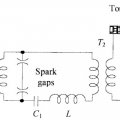
It looks like it is the same as a typical H.V. Plasma spark gap oscillator to initiate the air ionization/conduction, IOW it consists of a coil, spark gapped contacts, and capacitor.
For capacitors, any welder supply house should stock them.
Also WIMA MKP4 variety are used in HF heating tank circuits.
Looks like the spark gap is marked G!.
Max.


upload_2019-3-13_15-1-20.jpeg
 
Last edited:

shortbus

Joined Sep 30, 2009
10,050
I can read the circuit, download it and use a viewer to enlarge and rotate it.
Your more trusting than I am I guess. I could do that too but when some one comes asking for help they should make it easy for those trying to give it. Many people before me have asked it to be done, in older threads.
 

MisterBill2

Joined Jan 23, 2018
27,315
Your more trusting than I am I guess. I could do that too but when some one comes asking for help they should make it easy for those trying to give it. Many people before me have asked it to be done, in older threads.
Shorty, Not that I am trusting, but rather that I am persistent. And I know a few tricks. I never hesitate to ask for clearer pictures when they would be useful in getting a better understanding to answer a question. That comes from years of designing industrial test systems, needing to understand the ultimate requirements and how bad parts are different from good ones. Now Max has said that the high frequency comes from a spark-gap oscillator. Yes, I see that such could exist but I was expecting more common active devices. Spark gap is an interesting concept indeed.
Years ago, at an interesting job, we got a new team supervisor and about the second thing he said was "I trust nobody". Naturally, after that, every time we created a design we ALWAYS said "Trust Me, it will work". Of course, they always did work, so we could get away with that very well.
 

shortbus

Joined Sep 30, 2009
10,050
I meant trusting not to get a virus or trojan horse type thing. Any high frequency start welder I've ever been around has used a couple of spark gaps, even my little inverter Tig has them. And when HF start stops working that's the first place to look, the gaps. Most welders are also in areas that have a lot of grinding dust and it gets in the gap and bridges it, shutting down the HF start. The welder cooling fan gets it in the circuit board area.
 

Thread Starter

hoader

Joined Mar 27, 2015
29
Shortbus: Sorry it is sideways. The manual is in PDF form and I couldn't find a way to copy a section to another document I could attach.
The 2 of 0.002 uF 6000 volt mica capacitors tested bad, would not hold a charge, infinite resistance and they are leaking. I need to change those capacitors and 4 of the rectifiers and a couple relays (physically broken). Then I believe the points will have something to do.
Maxheadroom: thanks for the explanation. I will contact local welding shops for capacitors. Hoader
 
Top