Capacitor filters for thermisters.

Thread Starter

MB107

Joined Jul 24, 2016
400
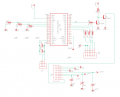
I have recently completed a PCB board to control the PWM fan on a Mercedes radiator fan. The board works very well and I have no issues in the current application. However several people on the Arduino forums have pointed out that my filtering caps are not connected correctly. I have also tested the board without caps and it works just as good without them. So I really cant tell if the caps are doing there job correctly or not. I will be building a new board to integrate a time delay shut off circuit so I will have the opportunity to correct this if it needs to be corrected. The caps that are in question are C1, C2, C3. I'm not sure if I used the correct symbols for those caps, but they are regular ceramic non-polarized 0.1uf caps. Not shown in the schematic are three thermisters connected across pins 11-12, 13-14, 15-16.

Your thoughts would be appreciated.
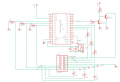
1647983031376.png
 

Ian0

Joined Aug 7, 2020
13,131
It depends on what voltage references you are using for the A/D.
If the positive and negative references are 3.3V and 0V, then your filter capacitors are effective, but somewhat unconventional, provided that the 3.3V supply is also well decoupled, and that pins 12, 14 and 16 join directly to pin 29 of the Arduino.
However, if your references are ground and some other voltage (say a 1.2V reference with its lower end connected to ground) then the capacitors would be better connected to ground instead of 3.3V. Connected to 3.3V, any ripple on the 3.3V supply that is not present on the 1.2V reference will be emphasized, rather than suppressed.
 

Thread Starter

MB107

Joined Jul 24, 2016
400
It depends on what voltage references you are using for the A/D.
If the positive and negative references are 3.3V and 0V, then your filter capacitors are effective, but somewhat unconventional, provided that the 3.3V supply is also well decoupled, and that pins 12, 14 and 16 join directly to pin 29 of the Arduino.
However, if your references are ground and some other voltage (say a 1.2V reference with its lower end connected to ground) then the capacitors would be better connected to ground instead of 3.3V. Connected to 3.3V, any ripple on the 3.3V supply that is not present on the 1.2V reference will be emphasized, rather than suppressed.
Than you for the reply

Yes I am using 3.3V and the pins 12, 14 and 16 go to pin 29 on the Arduino through a trace on the PCB board. The ground reference is connected via pin 2 on JP4 to the vehicles chassis ground and all points labeled ground are on a ground plane of the PCB board and should be a 0V.

So I'm not sure what you mean when you say connect the capacitor to ground instead of 3.3v. As it is now one side of the cap is connected to ground through a resistor and the other side is connected to 3.3V. Do you mean to just move the connections shown on the right side of resistors R3, R4 and R5 to the left side. That would still leave the other side of the cap on the 3.3v?
 

Thread Starter

MB107

Joined Jul 24, 2016
400
@Ian0

Hello Ian0

It sounds to me like what you are saying is that this would be the more conventional approach. Can you please confirm.


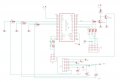
1648309192285.png
 

Thread Starter

MB107

Joined Jul 24, 2016
400
Where are the thermistors now?
Ahh I just realized I put my new connectors in there. So they are now between 3-6, 4-7, and 5-8. I broke the original connector int two so J3 is now for LED troubleshooting lights only.
 

Ian0

Joined Aug 7, 2020
13,131
Ahh I just realized I put my new connectors in there. So they are now between 3-6, 4-7, and 5-8. I broke the original connector int two so J3 is now for LED troubleshooting lights only.
You seem to have lost the divider resistors?
 

Thread Starter

MB107

Joined Jul 24, 2016
400
You seem to have lost the divider resistors?
Divisor resistors are still R1, R2 and R4, I think?

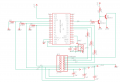
That schematic in post 4 has all grounds going to the ground plane on the PCB. The way I understand it is it should be the equivalent of this sketch. with thermisters on 3-6, 4-7, 5-8.

So originally I had the caps going across the thermisters. Now I have the Caps going from 3.3V to ground. If that's correct I would think I could just put 1 cap from the 3.3V output pin 29 of the Arduino to ground, since pins 3, 4, 5 are connected by a trace on the PCB to pin 29 of the Arduino?
Capture2.JPG
 

Thread Starter

MB107

Joined Jul 24, 2016
400
Hello everyone.

I have a circuit to power a fan that uses 3 thermisters that sense radiator temp, condenser temp and under hood temp. I am concerned about the radiator temperature sensor I have chosen to work with the Arduino Nano 33 BLE board.

The Nano 33 BLE will accept digital inputs of up to 15ma and it operates at 3.3V. So far I have driven the car with this and all works very well. But I was doing some analysis and realized that the car has never been driven at water temperatures over 95° C and as we get into the warmer months that could change. According to the coolant temperature themister data sheet the resistance at 95°C is 209.7Ω. That thermister is located across pins 11 and 12 on connector JP3 in the diagram and its uses a 220Ω complimentary resistor R5.

If I understand this correctly at 209.7Ω I calculate using I = V/R that I am putting 3.3V/209.7Ω = 15.7ma. slightly exceeding the maximum allowable. The problem comes in at red line temperature of 120° C where the resistance is down to 102.2Ω and the corresponding current is 32ma.

But I am a little confused because I would think some of that current would drain through the resister R5 to ground and reduce the current to the IO pin. So if I am putting too much current through it, one solution would be to find another sensor. But if I could also reduce it by changing R5, I could just change the calibration constants in my program. So I guess what I really need to know is what is the proper way to figure out that current on the IO pin.

Thanks


1648446971126.png
 

Attachments

Ian0

Joined Aug 7, 2020
13,131
No current goes into the pin, provided that the pin voltage remains between -0.3V and 3.6V. All the current goes through the 220Ω resistor and the total current is 3.3/(Rth+220)
 

Thread Starter

MB107

Joined Jul 24, 2016
400
No current goes into the pin, provided that the pin voltage remains between -0.3V and 3.6V. All the current goes through the 220Ω resistor and the total current is 3.3/(Rth+220)
Thank you Ian0

That also implies that if the thermister were shorted, I would still be in safe operating current at 15ma
 

Thread Starter

MB107

Joined Jul 24, 2016
400
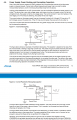
Check section 4.6 of this document for the definitive word on filtering. You may get a redirect notice, go ahead with the redirection of your browser to get to the document.

AVR040: EMC Design Considerations - Microchip Technology
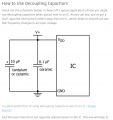
Just doing some reading on this. It is quite an eye opening document. I would have never thought that these two circuits they presented were any different and that one was incorrect and one was correct. I also did a search on Decoupling capacitors and found the second picture. Apparently I have that correct (totally by luck) with the 0.1uf cap nearest the Arduino And there is a lot of good information on how to deal with ground plane.

I really like this document because it breaks things down into good, better and best practices. The current system I have runs fine in the car so I hope I'm at least at good. But with a new revised board maybe I can get to best.

Once again Thank You.

1648488192401.png

1648488445295.png
 

Thread Starter

MB107

Joined Jul 24, 2016
400
A gentlemen on the Mercedes Forum proposed this for my circuit. Does this look good. This is from the first circuit diagram I posted with the three thermisters connected across pins 11-12, 13-14, 15-16.

1648701828082.png
 
Top