Capacitive touch sensor light for bed

Thread Starter

Dalvirc

Joined Aug 21, 2024
2
I'm trying to upgrade my bed with touch sensor light. I know about TTP223 touch sensors but these only work for one spot
My plan is to stick a long piece of conductive strip which will run from one side of the headboard to the other. The light should turn on if I touch anywhere on that stip.
There are touch sensor switches available that works with 110/220 V. But I am looking for something that can work with low voltage.
 

BobTPH

Joined Jun 5, 2013
11,463
The potential problem I see with that is that the long strip acts like an antenna and cannot be distinguished from the touch easily.
 

Ian0

Joined Aug 7, 2020
13,097
I'm trying to upgrade my bed with touch sensor light. I know about TTP223 touch sensors but these only work for one spot
My plan is to stick a long piece of conductive strip which will run from one side of the headboard to the other. The light should turn on if I touch anywhere on that stip.
The larger you make the touch sensor the less well it will work, because the untouched capacitance to ground increases with the size of the sensor, but the touched capacitance stays the same (it varies with the size of the finger), so the difference between them (which is what you have to detect) reduces.
I would suggest using several small sensors, and the circuit from Lancaster's book (in @joeyd999 's post above).
You can use a 74HC574 instead of the 4013, and make 8 sensors with hardly any more circuitry.
 

Ian0

Joined Aug 7, 2020
13,097
I've been using that circuit for years, but I've never seen it in print!
I always used 74HC, with a 33k resistor.
33k because I thought 1M would be too big, and 1k too small, so I took the geometric mean, and it worked, so I never changed it.
I used several gates in series to drive the D-latch clock, to give a longer delay. 4000 series will probably manage a long-enough delay with 1 gate.
 

MisterBill2

Joined Jan 23, 2018
27,159
There are also other schemes besides just altering the capacitance. Many years ago I created a touch sensor that used the pickup of the mains 60 Hz field to trigger a biased thyratron tube. That operated a 120 volt relay that switched on a reading light when I sat in my reading chair. Many years later a design was published that used an FET to do the same thing. Presently it could be done either with a biased CMOS gate, or inverter, or simply a high impedance input amplifier triggering the latch circuit.
The large benefit of this general scheme is that it does not produce any radiated field that can be detected to warn of it's presence. In addition, it does not sense motion, but rather presence.
Actually, it worked very well as a proximity sensor: It would trigger even if I had the pickup hidden under the stuffed cushion of the easy chair. It did not need a touch at all.
 
Last edited:

PhilTilson

Joined Nov 29, 2009
152
Given the requirement for a long sensor, why not use two parallel conductors and sense the current that flows when your finger/hand bridges them?
 

Tonyr1084

Joined Sep 24, 2015
9,744
I have two similar to this unit. One is connected to a bare wire that runs up the back side of the headboard on my wife's side and one on my side. From the sensor to the bare wire is about 3 feet and the wire itself is about 18 inches. Each unit controls a single outlet under the bed. Nightstand lamps are plugged into those units. Never experienced any issues with lighting the lamps or extinguishing them. They have incandescent bulbs in them so dimming is possible. I haven't tried using LED lamps yet but for the amount of use they get and the desired amount of light - I see no reason to further mess with it.

You say you want to use low voltage. What's your low voltage source? Is it a power brick with 12VDC output? Maybe 2 amps capable? Do you want a low voltage sensor? Can you use a 110VAC sensor that switches a 12VDC power brick? This information would help us zero in on your needs.
 

MisterBill2

Joined Jan 23, 2018
27,159
Many of the commercially available touch sensors use an oscillator and radiate a signal rich in harmonics that can cause interference with assorted receivers nearby. In areas served by most wains wiring there is enough of an ambient electrical field to work with an induced field sensor scheme. Those systems do not require an actual touch, unless the are adjusted to be less sensitive.
 

MisterBill2

Joined Jan 23, 2018
27,159
An optical beam sensor will require a source of that beam that will consume power full time. It will also, probably, require a bit of alignment. So the "low voltage" would reasonably not come from batteries. AND it would certainly be subject to unintended triggering. The TS requested touch sensing quite clearly.
One product I have seen is doorknob touch security devices. Some of the circuits I have sen for that use one or two CMOS 4000 series logic devices and make a lot of sense. Simple, cheap, low voltage, and low powered. Just replace the alarm noise device with a relay for the output device
 

Art Vandelay

Joined Nov 1, 2024
140
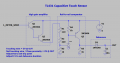
Hey, I designed this circuit for a similar project. It works surprisingly well for the simplicity. Connect OUT to a flip-flip, latch or microcontroller to store the state. Make sure not to exceed 10mA at the ref pin of the TL431 which is why R1 is there. I tested the circuit on a breadboard with a 1 meter long wire. Replace R2 with a pot to dial in a precise trip point when you are touching the wire. A longer wire may require adjustments to the amplifier stage to reduce the gain.

1.png
 
Top