Cannot change 90 Mhz FM receiver (SRR) to 16 MHz FM

Audioguru again

Joined Oct 21, 2019
6,826
You are talking about receiving FM at 16MHz. But the simple old regen circuit uses an AM detector. The AM detector detects distorted FM when the circuit is tuned to one side of an FM transmission by using "slope detection".
 

MisterBill2

Joined Jan 23, 2018
28,031
The regenerative radio I built back in about 1957 was a Knight Kit "Space Spanner." Still have it, but the filter capacitor has failed. Only three tubes, one was the rectifier, one the audio amplifier, and the last was the receiver. It may have covered 16 MHZ,I don't recall, it was a while ago. AND, that radio was a serious shock hazard.
 

Thread Starter

kabirh56

Joined Oct 2, 2023
20
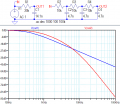
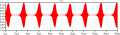
You can see difference between filters:

View attachment 304526
Thats very interesting. I will have to check the effect in reality. Since I want to only stop the quench freq ie> 20 kHz , I am ok with 5kHz and up in the graph= -20dB = 10^-2= 1/100 reduction.. But the top red line going above is really interesting.. I will check the difference I think. Thank you sir.
 

MisterBill2

Joined Jan 23, 2018
28,031
If an audio amplifier follows the output shown, it is rather important to keep the quench frequency out of the audio amplifier to avoid overheating and distortion and other grief.
 

Audioguru again

Joined Oct 21, 2019
6,826
The filter is to make the sound muffled like an old AM radio.
When FM stereo was invented, the super regen quench frequency beat with the 19kHz stereo pilot and the ultrasonic stereo sidebands making whistles.
 

Danko

Joined Nov 22, 2017
2,222
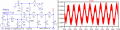
@Danko Sir, sorry to say, this circuit did not receive. It did not have any hissing Radio nose either. Checked with working LM386 amp . Is this a verified circuit? I am still checking for any issues from my side.
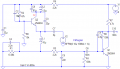
It can not receive anything, because right now it works in LTspice only.
It should be tuned by some electronics guy with brain, knowledge, soldering iron and oscilloscope.
So, let's back:
Now when i am trying to change the LC tank so it matches 16 Mhz frequency, The Super regen quenching sound is not there anymore. It seems that the circuit is tuned in some other way to respond to around 90 MHz only.
I have tried the LT spice analysis but I could not understand how can I get the regen Output.
In your working circuit I changed values of L2, C3, C4, C8, circuit now is quenching.
It is all you need for super regeneration.
And please read this very important information: http://www.r-type.org/articles/art-285.htm
"that its performance, which is best at the very high frequencies (where other types of receiver tend to fail), falls off at the lower carrier frequencies"

1696926838693.png_____1696926934520.png
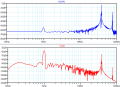
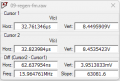
1696927138118.png
 
Last edited:

Thread Starter

kabirh56

Joined Oct 2, 2023
20
It can not receive anything, because right now it works in LTspice only.
It should be tuned by some electronics guy with brain, knowledge, soldering iron and oscilloscope.
So, let's back:

In your working circuit I changed values of L2, C3, C4, C8, circuit now is quenching.
It is all you need for super regeneration.
And please read this very important information: http://www.r-type.org/articles/art-285.htm
"that its performance, which is best at the very high frequencies (where other types of receiver tend to fail), falls off at the lower carrier frequencies"

View attachment 304599_____View attachment 304600
View attachment 304603
I will try this. I am newly learning Sir.
 

Thread Starter

kabirh56

Joined Oct 2, 2023
20
You are right sir. The tuning is really hard on the ears. I think at the end, regenerative receivers do not agree well on lower bandwidths. So I am also looking for some other kind of receiver which can be made with transistors now
 

MisterBill2

Joined Jan 23, 2018
28,031
One interesting alternative is the direct conversion variety of receiver, functionally similar to the ancient "synchrodyne" receivers of the octal tubes era. Those receivers mixed a synchronized oscillator signal with the AM signal to produce audio. It does work, but stability was always an issue. Current direct conversion methods can provide impressive results.
So there is an option that is much easier to make work than the regenerative designs.
 
Top