Can you use one base resistor for multiple transistors?

Thread Starter

Matthew464

Joined Jan 22, 2017
13
Hey guys. I know that when wiring leds in parallel you need to give each led its own resistor, because if not, one led can draw too much current and possibly overheat. Now does this concept apply to just LEDs or all diodes? I'm wondering because I am making a circuit with a lot of switching transistors and I was trying to save some resistors by using one base resistor for multiple transistors at a time. Could this cause any potential problems?
 

dl324

Joined Mar 30, 2015
18,336
I am making a circuit with a lot of switching transistors and I was trying to save some resistors by using one base resistor for multiple transistors at a time. Could this cause any potential problems?
It depends, but generally a bad idea.

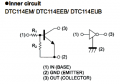
Post a schematic showing how the transistors will be driven, what the transistors will be driving, how many transistors will be connected in parallel, and the part number for the transistors.
 

#12

Joined Nov 30, 2010
18,224
If all the emitters are grounded, the base emitter junctions are just like LEDs. They won't match in the first place and the hot one will go into thermal runaway. If the emitters have resistors, you can lock the bases together.
 

WBahn

Joined Mar 31, 2012
32,878
Hey guys. I know that when wiring leds in parallel you need to give each led its own resistor, because if not, one led can draw too much current and possibly overheat. Now does this concept apply to just LEDs or all diodes? I'm wondering because I am making a circuit with a lot of switching transistors and I was trying to save some resistors by using one base resistor for multiple transistors at a time. Could this cause any potential problems?
Depends on the specifics. The problem with LEDs is that they have a negative temperature coefficient, meaning that as they heat up, they want to allow more current for the same voltage across them. BJT transistors exhibit similar behavior. But if you take steps to mitigate this, such as giving each transistor its own ballast resistor at the emitter, then you can get away with it. Post your schematic so that we can discuss it.

NOTE: Fixed goof where I put "positive" tempco instead of negative.
 
Last edited:

EM Fields

Joined Jun 8, 2016
583
Depends on the specifics. The problem with LEDs is that they have a positive temperature coefficient, meaning that as they heat up, they want to allow more current for the same voltage across them. BJT transistors exhibit similar behavior. But if you take steps to mitigate this, such as giving each transistor its own ballast resistor at the emitter, then you can get away with it. Post your schematic so that we can discuss it.
Actually, LEDs exhibit a negative temperature coefficient of resistance, which means that as they heat up their anode-to-cathode dynamic resistance will decrease which, unless ballasted, will result in allowing more and more current through the diode which will get it hotter and hotter until the magic smoke is released and the LED stops working.

As far as I know, that's true for all semiconductor diode junctions except for Zeners with a reverse breakdown voltage less than about 6 volts, a fact which is used to get close to a zero TC by building a forward-biased silicon diode in series with the Zener in some old-timey shunt voltage reference diodes like Motorola's venerable 1N829.
 
Last edited:

RichardO

Joined May 4, 2013
2,270
Actually, LEDs exhibit a negative temperature coefficient of resistance,
Interestingly, the LED's I looked at (unfortunately I don't remember which kind but probably red) had a tempco similar to silicon. In other words, for the same forward voltage drop the LED and silicon had the same millivolts of change for the same temperature change.
 

WBahn

Joined Mar 31, 2012
32,878
Actually, LEDs exhibit a negative temperature coefficient of resistance, which means that as they heat up their anode-to-cathode dynamic resistance will decrease which, unless ballasted, will result in allowing more current through the diode which will get it hotter and hotter until the magic smoke is released and the LED stops working.

As far as I know, that's true for all semiconductor diode junctions except for Zeners with a reverse breakdown voltage less than about 6 volts, a fact which is used to get close to a zero TC by building a forward-biased silicon diode in series with the Zener in some old-timey shunt voltage reference diodes.
Yea, I mistyped. For silicon junctions it's about -2 mV/°C. Thanks for the catch.

The balancing out in zeners at around 5.6 V is because at the point the tempcos of the zener breakdown and the avalance breakdown cancel out.
 

EM Fields

Joined Jun 8, 2016
583
Yea, I mistyped. For silicon junctions it's about -2 mV/°C. Thanks for the catch.

You're welcome.

The balancing out in zeners at around 5.6 V is because at the point the tempcos of the zener breakdown and the avalance breakdown cancel out.
As I understand it, at around 5.6 volts the mechanism which clamps the voltage across the diode will be the Zener voltage, which is different from the avalanche voltage, which comes into play with higher reverse voltages across the Zener.

In any case, the innards of the diode will comprise a Zener with a positive tempco in series with a diode with a negative tempco, the plan being that they'll exquisitely cancel each other out, and what'll be left will be the pristine reference voltage comprising the sum of the Zener's reverse voltage and the temperature compensating diode's forward voltage,
 

Thread Starter

Matthew464

Joined Jan 22, 2017
13
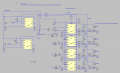
Here is a picture of my circuit and the ltspice file. I removed a lot of the circuit so we can focus on the transistors.

The purpose of the circuit is to light up leds in a sequence (one after the other). The 2 timers on the left are to control which transistors are turned on. I have also included 100k trimmer resistors on the collector of each transistor to control the duration for how long each led stays on. Sorry if its a little jumbled.
 

Attachments

EM Fields

Joined Jun 8, 2016
583
Interestingly, the LED's I looked at (unfortunately I don't remember which kind but probably red) had a tempco similar to silicon. In other words, for the same forward voltage drop the LED and silicon had the same millivolts of change for the same temperature change.
A typical silicon diode will have a tempco of about minus 2.1 millivolts per degree Celsius.

It would be nice if, instead of relying on your faulty memory, you'd do the legwork required to substantiate your claim.
 

RichardO

Joined May 4, 2013
2,270
A typical silicon diode will have a tempco of about minus 2.1 millivolts per degree Celsius.

It would be nice if, instead of relying on your faulty memory, you'd do the legwork required to substantiate your claim.
Point well taken. See figure 1 in the attachment.

All of the LED's have a negative tempco. It looks like the LED's measured have about half the tempco of silicon. Silicon is about -3 mv/degC/volt. My quick calculations show that the LED's are more like -1mv/degC/volt. So much for my memory. :(

UV is about -0.7mv/degC/volt, blue is about 1.0mv/degC/volt, green is about 1.0mv/degC/volt, red is about 0.8mv/degC/volt,


edit: Oops. 1mv/degC/volt is 1/3, not half, that of silicon which as 3mv/degC/volt.
 

Attachments

Last edited:

ian field

Joined Oct 27, 2012
6,536
Hey guys. I know that when wiring leds in parallel you need to give each led its own resistor, because if not, one led can draw too much current and possibly overheat. Now does this concept apply to just LEDs or all diodes? I'm wondering because I am making a circuit with a lot of switching transistors and I was trying to save some resistors by using one base resistor for multiple transistors at a time. Could this cause any potential problems?
There are several transistor configurations - generally defined by which terminal is AC decoupled. The common base configuration has possibilities - but you'll need to make that 2 resistors.

Theoretically you could bias several common base stages from a single reference voltage as long as its adequately decoupled.

The only application that springs to mind ATM; is the common base section of the casc-ode video amplifiers in a colour monitor - in some makes; all three were base biased by a 7808 3-terminal regulator.
 

Picbuster

Joined Dec 2, 2013
1,059
Hey guys. I know that when wiring leds in parallel you need to give each led its own resistor, because if not, one led can draw too much current and possibly overheat. Now does this concept apply to just LEDs or all diodes? I'm wondering because I am making a circuit with a lot of switching transistors and I was trying to save some resistors by using one base resistor for multiple transistors at a time. Could this cause any potential problems?
A transistor is a current driven device. ( its amplification is Ic/Ib) the voltage between base and emitter should, as result of the base current go above the 0.6V approx. to get the collector to conduct.
Putting all the base parallel you could calculate what happened.

Mosfet's are voltage driven with an input impedance acting capacitive ( @ low frequencies) this will a better solution at < 50Khz switching speed.
Picbuster
 

MrAl

Joined Jun 17, 2014
13,709
Hi,

Yes the base emitter voltage changes with temperature and also they are not exactly the same for each transistor anyway, so some way to drive them is required that will allow roughly the same current but allow different BE drops. There is also the switching times to watch out for.

It is not a good idea to parallel transistors unless you have to. If you can find a single transistor to do the job you are better off.
 

ian field

Joined Oct 27, 2012
6,536
Hi,

Yes the base emitter voltage changes with temperature and also they are not exactly the same for each transistor anyway, so some way to drive them is required that will allow roughly the same current but allow different BE drops. There is also the switching times to watch out for.

It is not a good idea to parallel transistors unless you have to. If you can find a single transistor to do the job you are better off.
Its not the best plan - but equal emitter resistors for each transistor goes some way to balancing the current.
 
Top