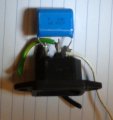
Can you identify the device in the picture? Is it a capacitor?

Thread Starter

km4hr

Joined Mar 7, 2018
2
I disassembled a PC power supply. There's a device connected across the incoming 110 AC power plug (see attached picture). I think it's a capacitor, but I'm not sure. See the rectangular blue part with numbers stamped on it. Is it a capacitor? Is it electrolytic? I want to use the device in an experiment, but I need to know what it is.

Is this the so-called "X" capacitor? Or what's it for?
 

Attachments

ebp

Joined Feb 8, 2018
2,332
It is being used as an "X" capacitor, but usually X caps are marked with AC voltage and have a whole lot of little safety agency logos marked on them. Typically they are potted in epoxy in little plastic boxes.

It looks like it is probably just a "dipped" (in epoxy) metallized polyester film capacitor, 0.68 µF10% tolerance ("K"), 400 VDC
 
I disassembled a PC power supply. There's a device connected across the incoming 110 AC power plug (see attached picture). I think it's a capacitor, but I'm not sure. See the rectangular blue part with numbers stamped on it. Is it a capacitor? Is it electrolytic? I want to use the device in an experiment, but I need to know what it is.

Is this the so-called "X" capacitor? Or what's it for?
it is a capacitor but not electrolitic.
its used for the initial surge when the AC cord is frist plugged into the outlet.
it helps to absorb the spike in voltage from0 to 120vac.
 

takao21203

Joined Apr 28, 2012
3,702
CBB capacitor

These are coiled up metal foil having inductance and not so good for high frequency.
The capacity does decrease with frequency (in the MHz range).

X2 capacitors sometimes have a small resistor built in
 

ebp

Joined Feb 8, 2018
2,332
it is a capacitor but not electrolitic.
its used for the initial surge when the AC cord is frist plugged into the outlet.
it helps to absorb the spike in voltage from0 to 120vac.
No. It causes a current spike.
It is an EMI/RFI countermeasure intended to locally short-circuit differential high-frequency noise produced by the power supply to keep it off the AC mains. In many countries safety regulations require that the capacitor be discharged to a safe voltage within a specified time so a resistor is usually used across the capacitor to meet that requirement. My guess is that that cap is there because one in parallel with it on the supply circuit board proved inadequate to meet EMI/RFi requirements for certification - or it might be there just to save space on the PCB.

Switch mode power s
 

ebp

Joined Feb 8, 2018
2,332
CBB capacitor

These are coiled up metal foil having inductance and not so good for high frequency.
The capacity does decrease with frequency (in the MHz range).

X2 capacitors sometimes have a small resistor built in
Many of those capacitors have then ends fully metallized so that even though they are wound construction the inductance is low.

There are snubber network capacitors with built-in resistors. I've spec'd a lot of X caps and don't recall ever seeing built-in resistors mentioned in any of the datasheets.
 

takao21203

Joined Apr 28, 2012
3,702
Many of those capacitors have then ends fully metallized so that even though they are wound construction the inductance is low.

There are snubber network capacitors with built-in resistors. I've spec'd a lot of X caps and don't recall ever seeing built-in resistors mentioned in any of the datasheets.
Ive dissected some that arent.

Youre right recent parts dont have resistors, some older parts do though. More like here in Europe, with all the logos on them look like a X2 capacitor, voltage rating is approx the same, infact they are X2 kinds with a resistor.

These large blue kinds, I have seen them (after long searching) sold as 1000pcs and made in Korea. Pretty much look like the one in the picture.
 

ian field

Joined Oct 27, 2012
6,536
It is being used as an "X" capacitor, but usually X caps are marked with AC voltage and have a whole lot of little safety agency logos marked on them. Typically they are potted in epoxy in little plastic boxes.

It looks like it is probably just a "dipped" (in epoxy) metallized polyester film capacitor, 0.68 µF10% tolerance ("K"), 400 VDC
400V is might get away with it (for a while) on 230V mains.

230v stuff is usually marked something like 275VAC.

The safety markings are more likely on CE certified stuff.
 
Top