Can you explain how this circuit can turn 17 V RF to 340 VDC?

Thread Starter

Darkstar

Joined Sep 3, 2010
182
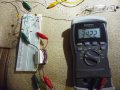
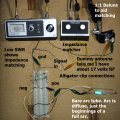
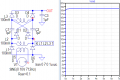
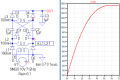
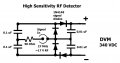
This is a puzzle. I found this circuit long ago described as a high sensitivity RF detector. It resembles a full wave rectifier. Just out of curiosity I put about 17 V RF from my CB radio into the input and I got 340 V DC out. It's not just a pulse either, it's continuous and can start an arc in a mercury arc lamp. Attached are photos of the voltmeter, circuit schematic and glowing arc tube. The SWR meter shows 1.4:1 which is a good impedance match. I had to put a couple 1:1 baluns in the coax to get the low SWR so I wouldn't fry my transmitter. Neither the transmitter voltage nor the RF alone or together are enough to ionize the mercury vapor. There's no high voltage trigger or RF to help excitation. The lamp is running on the DC output of the circuit, continuously. The lamp's not full brightness of course, but it makes enough ozone to smell and would burn your eyes and skin if run too long. It doesn't work the same with a 60 Hz input so the RF is doing something weird. Maybe there are high voltage DC pulses at 27 MHz? Can anyone explain how this can happen?High Sensitivity RF Detector, small circuit.jpgVoltage & ferrite core.jpgLighted Arc & Notations, 1.jpg
 

Alec_t

Joined Sep 17, 2013
15,103
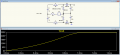
Wiring inductance plus the charge pump action produces this result in a sim:-
1720712694063.png
I think the voltage plateaus because of diode breakdown.
 

MisterBill2

Joined Jan 23, 2018
27,182
Very interesting indeed. It seems that there may be some resonance resulting in a peaking effect, or maybe the BALUN devices are performing a voltage step up. OR, maybe that CB radio is delivering a bit more than 3.5 watts.
 

Thread Starter

Darkstar

Joined Sep 3, 2010
182
Very interesting indeed. It seems that there may be some resonance resulting in a peaking effect, or maybe the BALUN devices are performing a voltage step up. OR, maybe that CB radio is delivering a bit more than 3.5 watts.
I'd heard about charge pumps but I never did anything with them so I just knew of voltage multipliers with transformers, caps & coils, or caps and diodes. I'd never seen this happen before.

I suspected some kind of resonance or maybe some component was breaking down at it's peak voltage giving brief voltage spikes which were maybe causing high frequency DC pulses. Just guesses. I don't have a scope to look at anything with. The Baluns are 1:1 and I use them to help match the CB to the one third of a half wave ground plane that i can fit in my living room. They do help. I didn't want RF reflections to be a complicating issue so I used them to give me a very low 1.4:1 SWR. I also put the DC output leads around a clamp-on Ferrite so nobody could say stray RF was affecting the meter or exciting the lamp. The baluns actually lower the measured transmitter output voltage by 1 volt each when I use them. Without them my coax acts like an antenna and i don't want my condo neighbors to get upset.

As far as I know this old CB is not far out of spec. I have found that if I make my dummy antennas with the wrong kind of resistors that don't work well with RF I get a big voltage drop across the supposedly 50 ohm load making my wattage calcs way off. I've gotten as much as 60 V across the resistor in the past. I wasn't using wire wound resistors but I have some of unknown composition which repeatedly give me high voltage drops. My best ones give 16.5 to 17.2V across a 49.7 ohm resistor. This does work out to be too high watts but I don't know why.

Because the antenna is so poor all I can do is listen. I've never spoken to anyone. But listening is a puzzle too. I'm near Chicago. There are the same bunch of guys on there who say they're from Wisconsin, So. Carolina, Colorado, Washington, California. It's not skip, as they are clear as a bell for long periods, day after day. They must have amps and not be worried about Feds tracking them down. Unless rules have changed in the decades since I got the CB in the late 60's.

I'd heard about charge pumps but I never did anything with them so I just knew of voltage multipliers with transformers, caps & coils, or caps and diodes. I'd never seen this happen before. It sure was a surprise to see that arc light up & smell the ozone from the shortwave UV-C put out by the light, even before the full arc had formed. I initially had a glass jar over the lamp to protect my eyes but it kept distorting the view of the lamp and wiring.
 

MisterBill2

Joined Jan 23, 2018
27,182
I'd heard about charge pumps but I never did anything with them so I just knew of voltage multipliers with transformers, caps & coils, or caps and diodes. I'd never seen this happen before.

I suspected some kind of resonance or maybe some component was breaking down at it's peak voltage giving brief voltage spikes which were maybe causing high frequency DC pulses. Just guesses. I don't have a scope to look at anything with. The Baluns are 1:1 and I use them to help match the CB to the one third of a half wave ground plane that i can fit in my living room. They do help. I didn't want RF reflections to be a complicating issue so I used them to give me a very low 1.4:1 SWR. I also put the DC output leads around a clamp-on Ferrite so nobody could say stray RF was affecting the meter or exciting the lamp. The baluns actually lower the measured transmitter output voltage by 1 volt each when I use them. Without them my coax acts like an antenna and i don't want my condo neighbors to get upset.

As far as I know this old CB is not far out of spec. I have found that if I make my dummy antennas with the wrong kind of resistors that don't work well with RF I get a big voltage drop across the supposedly 50 ohm load making my wattage calcs way off. I've gotten as much as 60 V across the resistor in the past. I wasn't using wire wound resistors but I have some of unknown composition which repeatedly give me high voltage drops. My best ones give 16.5 to 17.2V across a 49.7 ohm resistor. This does work out to be too high watts but I don't know why.

Because the antenna is so poor all I can do is listen. I've never spoken to anyone. But listening is a puzzle too. I'm near Chicago. There are the same bunch of guys on there who say they're from Wisconsin, So. Carolina, Colorado, Washington, California. It's not skip, as they are clear as a bell for long periods, day after day. They must have amps and not be worried about Feds tracking them down. Unless rules have changed in the decades since I got the CB in the late 60's.

I'd heard about charge pumps but I never did anything with them so I just knew of voltage multipliers with transformers, caps & coils, or caps and diodes. I'd never seen this happen before. It sure was a surprise to see that arc light up & smell the ozone from the shortwave UV-C put out by the light, even before the full arc had formed. I initially had a glass jar over the lamp to protect my eyes but it kept distorting the view of the lamp and wiring.
Two explanations for hearing those folks: Long-haul drivers can be based all over the country and pass thru the Chicago area. And also, some of them may be running a lot more power, far above the3.5 watts.
 

Pyrex

Joined Feb 16, 2022
501
I guess, it's a typical high frequency circuit, so it must be made accordingly. The rectifier to be fitted in a compact metal box, components with short leads, coaxial connector for the input. Feedthrough capacitors for the DC output. Same design as a TV tuner is made. Only in this case the measurement results will be adequate, and unwanted resonances will be suppressed to an acceptable level
 

MisterBill2

Joined Jan 23, 2018
27,182
The resonant response of a "High Q Resonant Circuit" is quite impressive on some occasions. Like a Tesla Coil, in fact.
Consider that a true "Tesla Coil" IS a High Q Resonant circuit.
 

Thread Starter

Darkstar

Joined Sep 3, 2010
182
The resonant response of a "High Q Resonant Circuit" is quite impressive on some occasions. Like a Tesla Coil, in fact.
Consider that a true "Tesla Coil" IS a High Q Resonant circuit.
Previously I said something about making dummy antennas with resistors that appeared to be just fine for RF but gave huge voltage drops. They weren't wire wound. I mentioned getting a 60 V drop across a "50" ohm load at one time. I wanted to come back and clarify that wasn't with this CB. It was with a 60 yr old tube unit which wasn't working for unknown reasons. I had voltages varying all over. That's how I managed to get 60 V output.
 

MisterBill2

Joined Jan 23, 2018
27,182
Developing a rather high voltage across even a two foot section of wire is entirely possible if a resonant condition exists. This is why the correct "ground" connections for shielded small signal wiring is sometimes seen as an art, not a science.
 

Thread Starter

Darkstar

Joined Sep 3, 2010
182
Developing a rather high voltage across even a two foot section of wire is entirely possible if a resonant condition exists. This is why the correct "ground" connections for shielded small signal wiring is sometimes seen as an art, not a science.
I believe it but never had to do it. I've seen circuit boards, especially for very high frequency circuits which appear to be laid out oddly because of interactions between the traces and grounds or capacitances and inductances between them and neighboring traces. I've heard that in a resonant circuit voltages can get to 50 times the input voltage. I've often heard about atmospheric voltage being something like 2000 volts for every few feet above ground (don't quote me on the specifics.) I've never come close to measuring or detecting anything near this. The most sensitive circuits I ever tried to make were for detecting charges in storm clouds and another was for an electroencephalogram (EEG) circuit. They didn't work. I got signals, but they didn't seem to make any sense. Both had high quality instrument amplifier chips and for the EEG I made gold electrodes. The EEG circuit board was normal size but densely populated. The cloud charge detector had some tiny circuits. I got some free samples of a new instrument amplifier circuit from IIT and it turned out to be a surface mount device. I had to put 6 or 8 very tiny legs onto the nearly microscopic pads so I could mount it on my ordinary circuit board. To do that I made a very small tipped soldering iron by sharpening the end of a wire and wrapping it around the end of an ordinary soldering iron. The iron was grounded against currents induced by the heating element. It worked. I had good eyesight and steady hands back in those days. to do that I made a very small tipped soldering iron by sharpening the end of a wire and wrapping it around the end of an ordinary soldering iron. The iron was grounded against currents induced by the heating element. It worked.

Concerning static electricity in a typical office environment, one winter day, an electrical engineer was walking through the carpeted office and touching the cubicle doorways every few feet to feel the static spark. He looked over at me as he passed & said something like "about 5000 V per step, I'd say." At that job I worked in a cleanroom fabricating microcircuits. The floors were coated with a conductive coating. We all wore the usual white "bunny suits". What you can't see unless you're up close is that the white material has black conductive carbon fiber threads running vertically and horizontally every couple inches or so which drains off static charges to the conductive boots & then to the floor. I'm sure you know all it takes is a simple brush against some plastic object and you can become highly charged.
 
Top