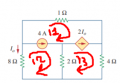
can this circuit be solved with mesh analysis?

Thread Starter

Amr Moneer

Joined Jan 25, 2018
10
i'm trying to solve this problem using mesh analysis but i'm stuck. clearly we have 3 meshes and there are current sources in common between mesh 1 and mesh 2. and between mesh 1 and mesh 3 so we have to make a super-mesh. the problem is, when i remove the 4A source (the one between mesh 1 and mesh 2) i'm left with the the 2Io source connected in series with the 2ohm resistor. should i remove them too and make a super-mesh that spans the whole circuit or what?
 

Attachments

WBahn

Joined Mar 31, 2012
32,749
i'm trying to solve this problem using mesh analysis but i'm stuck. clearly we have 3 meshes and there are current sources in common between mesh 1 and mesh 2. and between mesh 1 and mesh 3 so we have to make a super-mesh. the problem is, when i remove the 4A source (the one between mesh 1 and mesh 2) i'm left with the the 2Io source connected in series with the 2ohm resistor. should i remove them too and make a super-mesh that spans the whole circuit or what?
Yes, this circuit can be solved with mesh analysis.

If you think about it a bit, you should be able to find a way to make a minor change to how the circuit is drawn (that doesn't change the circuit) that eliminates the need for a supermesh at all.

But you can certainly use a supermesh and still get the answer almost as easily.

Now. Why are you removing the 4 A source. A supermesh doesn't remove any sources, it merely internalizes them within the supermesh.

You need to keep expanding your supermesh until you have eliminated all current sources from the mesh boundaries. I think that's what you are asking in your last question and, if so, the answer is yes.

If you internalize two sources, then you need two auxiliary equations relating the currents that make up the supermesh.
 

Thread Starter

Amr Moneer

Joined Jan 25, 2018
10
Yes, this circuit can be solved with mesh analysis.

If you think about it a bit, you should be able to find a way to make a minor change to how the circuit is drawn (that doesn't change the circuit) that eliminates the need for a supermesh at all.

But you can certainly use a supermesh and still get the answer almost as easily.

Now. Why are you removing the 4 A source. A supermesh doesn't remove any sources, it merely internalizes them within the supermesh.

You need to keep expanding your supermesh until you have eliminated all current sources from the mesh boundaries. I think that's what you are asking in your last question and, if so, the answer is yes.

If you internalize two sources, then you need two auxiliary equations relating the currents that make up the supermesh.
so the super-mesh is going to contain the 1, 4, 2, 8 ohm resistors? and am i gonna need to apply kcl to get the currect in the 2 ohm resistor?
 

WBahn

Joined Mar 31, 2012
32,749
so the super-mesh is going to contain the 1, 4, 2, 8 ohm resistors? and am i gonna need to apply kcl to get the currect in the 2 ohm resistor?
Try to draw a mesh that includes all four resistors. It can't be done. Any mesh that goes through the 2 Ω resistor is going to have to go through one of the current sources -- but you supermesh can't go through a current source.
 

Thread Starter

Amr Moneer

Joined Jan 25, 2018
10
Try to draw a mesh that includes all four resistors. It can't be done. Any mesh that goes through the 2 Ω resistor is going to have to go through one of the current sources -- but you supermesh can't go through a current source.
i finally got it. the supermesh will contain the 1, 4, 8 ohm resistances. and we have 2 other auxiliary equations. thanks for help.
 

WBahn

Joined Mar 31, 2012
32,749
i finally got it. the supermesh will contain the 1, 4, 8 ohm resistances. and we have 2 other auxiliary equations. thanks for help.
Yep!

Notice that the 2 Ω resistor does not appear in any of the equations.

So ask yourself if this truly means that the 2 Ω resistor is not needed (versus just it's value being immaterial to solving for the currents). What would happen if you made it 0 Ω (a short)? What would happen if you made it infinite (open)?
 

The Electrician

Joined Oct 9, 2007
2,986
Yep!

Notice that the 2 Ω resistor does not appear in any of the equations.

So ask yourself if this truly means that the 2 Ω resistor is not needed (versus just it's value being immaterial to solving for the currents). What would happen if you made it 0 Ω (a short)? What would happen if you made it infinite (open)?
Maybe the equations you're referring to aren't correct.

A nodal solution does include the 2 Ω resistor.
 

WBahn

Joined Mar 31, 2012
32,749
Maybe the equations you're referring to aren't correct.

A nodal solution does include the 2 Ω resistor.
That's because the node voltages DO depend on the 2 Ω resistor. But the mesh currents do not.

When you have two currents at the junction of two current sources and a resistor in a third connected branch, the resistor gets no say in the matter -- the sources will push/pull the difference between their currents through the resistor by producing whatever node voltage is needed to make that happen. Which is why the value of the resistance IS reflected in the nodal equations.
 

The Electrician

Joined Oct 9, 2007
2,986
As you have said elsewhere, the threads in the homework help forum remain archived as time passes, and people who read them in the future may derive some learning from them. In this particular thread the TS never did post his equations, although it appears he was on the right track. You added commentary beyond just leading the TS to the correct solution, commentary intended to elicit deeper understanding. The TS hasn't said anything to show that he actually considered why the 2 Ω resistor doesn't show up in the "equations". How would a reader who comes along later know what equations you're referring to? Are they your equations; are they the TS's equations, which might not be the same as yours (but probably are)?

A subsequent reader of the thread might make a mistake in their equations and include the 2 Ω resistor, not realizing that they have made a mistake, and they might then think that the TS's equations were wrong to not include the 2 Ω resistor.

I was anticipating what that later reader might be thinking because even without completing a nodal analysis it's obvious that the 2 Ω resistor will figure into a nodal solution. He might wonder "How can the 2 Ω resistor be part of a nodal solution but not part of a mesh solution?"

I was fishing to see if the TS or you would add to the desired deeper understanding by explaining as you did, rather than leaving it an unanswered question.

It might also be noticed that the 1 Ω resistor doesn't have an effect on the final solution even though it is included in the (unshown) equations.
 

WBahn

Joined Mar 31, 2012
32,749
I tend to agree with you that this circuit offers an unusual opportunity to explore a few issues and get a deeper understanding. I don't know if the person that crafted the circuit had that in mind or not. It would appear that the TS has solved the problem (to their satisfaction) and enough time has passed that it is unlikely that we would be letting the cat out of bag prematurely. Like you, I was hoping that the TS would post their mesh equations so that we could explore them some more, but they don't appear likely to do that at this point (I'm sure they have other homework that is now a higher priority, which is only natural). So I think it is safe to discuss freely.

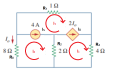
Here's the original circuit with symbolic reference designators for each component (I prefer to work that way). I've defined the currents exactly the same way that the TS did.

DualSourceMesh.png

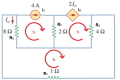
The first recommendation I suggested to the TS was to see if they could tweak the layout of the circuit to eliminate the need for a supermesh. To see how this might be done, we need to understand why we need supermeshes in general. We can't write KVL around a mesh that has a current source in it because we don't have a suitable way of representing the voltage drop across it. But mesh analysis favors current sources as long as only one mesh current goes through it because then the mesh current is equal to the source current. This, in turn, means that we love current sources when they are in the perimeter of the circuit but hate them when they are elsewhere. So let's move the R1 so that the two current sources are in the perimeter of the layout.

DualSourceMeshTweaked.png

We now have a very simple analysis task since two of the mesh currents are equal to the two source currents:

I2 = Is = 4 A
I3 = Id = 2·Io = 2·(I4 - I2) = 2·(I4 - Is)

We then only have one mesh equation to construct:

-I2·(R8) - I3·(R4) + I4·(R1 + R4 + R8) = 0

Before we go any further, we should note that R2 does not appear in any of these equations. That should raise a red flag and force us to pause and ask if this makes sense.

After checking that our equations are correct and, sure enough, R2 doesn't appear anywhere among them, we are left to ponder why this is the case.

Consider the junction between the two sources (which is where R2 connects, also). Since these ARE current sources, the current in R2 is completely determined by the difference between them, namely that the current flowing downward through R2 is (Is-Id), regardless of the value of R2 or the value of ANY other parameter in the circuit -- it is a consequence of the topology of the circuit itself.

But does this mean that R2 can be removed? After all, R2 = ∞ is a value and we usually equate this with an open circuit.

However, IF we remove R2 completely, then we have two (ideal) current sources in series, which is only possible if they just happen to be set to the exact same current. But THIS would introduce a FOURTH equation, namely Is = Id, making our system overconstrained. It would be highly likely that NO solution exists for the circuit. We would have to make some other independent parameter a variable to find a solution.

So what if we leave R2 in place and set its resistance to infinity?

That's fine. I just means that we will have an infinite resistance with (Is-Id) flowing through it. This is NOT a contradiction because we've already stipulated that the current sources will put out whatever voltage is required, including an infinitely large voltage, in order to drive that difference current through R2. The ratio of an infinite voltage to finite current is indeterminate unless something else makes it determinable -- in this case that ratio happens to be R2, namely 2 Ω. In the case of a true open circuit, the current would be identically zero which would contradict the existence of any non-zero difference in currents between the two sources.

Hence, from a pure theory and mathematical sense, there IS a difference between an open circuit and an infinite resistance.

The next question might be to ask if the value of R2 has any effect on the circuit at all. It might be tempting to say no because it doesn't appear in our equations. But it is important to remember that the equations we've set up ONLY get us as far as determining the mesh currents. That is well short of solving the circuit as a whole. We also have to solve for the node voltages, and while the specific value of R2 might not have any effect on the mesh currents, it DOES affect at least one of the node voltages -- namely the voltage at the node between the two current sources. This, in turn, also means that it affects the power balance in the circuit. As R2 is made larger and larger, it dissipates more and more power (since the current is fixed), meaning that the one or both sources must deliver the additional power.

Take just a moment to reflect on what we've already learned -- and we haven't even solved the circuit yet!

So let's solve the circuit.

-I2·(R8) - I3·(R4) + I4·(R1 + R4 + R8) = 0

-Is·(R8) - 2·(I4 - Is)·(R4) + I4·(R1 + R4 + R8) = 0

I4·(R1 + R4 + R8 - 2·R4) = Is·(R8 - 2·R4)

I4 = Is·[ (R8 - 2·R4) / (R1 - R4 + R8) ]

Before we plug in the numbers, let's consider what this tells us.

Since both the numerator and the denominator involve the difference of terms, it is possible for one or both to be zero.

If the numerator is zero then I4 is 0. That a particular mesh current might turn out to be zero is not too shocking -- it just means that the circuit components are balanced in such a way that that's how things work out. However, notice that, unlike the case of R2, which was fundamental to the topology (meaning that it did not depend on any of the circuit parameters, only on how they were hooked up), if I4 = 0 this does NOT mean that R1 doesn't matter topologically. Yes, for the specific choices of component values that makes I4 equal to zero, would can make R1 equal to whatever we want -- including removing it from the circuit (because the current in it is zero, which was not the case for R2). But we can ONLY do that when certain component values just happen to have a specific relationship, either by coincidence or selection.

But if the denominator is zero, the I4 could become infinite. This is generally a bad thing and, in most circuits, means that a voltage supply has become short circuited -- or that we have made an error. But we don't have any voltage sources, so this, too, should raise warning flags about the possibility that we've made a mistake.

As an aside, because I was checking this possibility, I DID find and fix an error -- a sign error I made that was unrelated to this issue. The point being that in the process of checking your work for specific concerns, you are still checking your work and thus the likelihood of spotting ANY mistake you've made (and we ALL make plenty of them) go up considerably.

So what, physically (within the context of ideal sources, of course), does it mean if I4 becomes infinite. How is this possible?

Looking at the circuit, if I4 is infinite then I0, the controlling current for the dependent current source, is also infinite (just 4 A less). That means that the current produced by the dependent source is also infinite (but twice as infinite). This current then divides (roughly in half) between R1 and R4 (both currents still being infinite) and that flows through R4 joins I0 and flows upward through R2 to get back to the dependent source. This requires just the right split in the current which is attained by selecting the values of R1, R4, and R8 such that the denominator becomes zero.

But what if BOTH the numerator AND the denominator become zero?

First, is this even possible? A quick examination shows that it is. If R8 = 2·R4 and R1 = 3·R4, then both go to zero.

Then I4 becomes indeterminate. In general, this usually just means that there is more than one solution to the problem. It could (but doesn't have to) mean that ANY current is a solution.

Considering that to result in this situation all that would have been required would have been to change R1 to 12 Ω, the circuit would not have looked suspicious at all. More to the point, this behavior happens in real circuits using nonideal sources and components. There can be component choices that result in indeterminate behavior, which usually manifests itself as circuit operation that varies wildly or that settles and unpredictable operating points based on second and higher order effects that very possibly are not even known, let alone reasonably modeled.

Once again, we've learned a lot without yet having solved the circuit. So let's finally do that.

As it turns out, the component parameters are such that the numerator for I4 is making I4 equal to zero. Thus we have:

I4 = 0
I3 = -8 A
I2 = 4 A

Choosing the bottom node (of the original circuit) as our common reference node, we see that both the left side of the independent source and the right side of the dependent source are at a voltage of -32 V. The voltage between the current supplies is 0 V + R2·(I2 - I3) = 24 V

Now let's check to see if the answer is correct.

Since I4 = 0, Io must be the opposite of Is since they are in series (but their reference directions are opposite). This requires that

I0 = -I2 = -4 A (matches)

This then requires that

Id = I3 = -8 A (matches)

The 24 V between the supplies results in 12 A flowing downward through R4, which this splits sending 4 A to the left back to Is and 8 A to the right back to Id. So this matches.

A final check can be made by considering the power balance.

The power dissipated in the resistances are

P_R1 = 0
P_R2 = (12 A)²·(2 Ω) = 288 W
P_R4 = (8 A)²·(4 Ω) = 256 W
P_R8 = (4 A)²·(8 Ω) = 128 W

Total power dissipated = 672 W

The power delivered by sources are

P_Is = (24 V - -32 V)·(4 A) = 224 W
P_Id = (-32 V - 24 V)·(-8 A) = 448 W

Total power supplied = 672 W
 

MrAl

Joined Jun 17, 2014
13,680
As you have said elsewhere, the threads in the homework help forum remain archived as time passes, and people who read them in the future may derive some learning from them. In this particular thread the TS never did post his equations, although it appears he was on the right track. You added commentary beyond just leading the TS to the correct solution, commentary intended to elicit deeper understanding. The TS hasn't said anything to show that he actually considered why the 2 Ω resistor doesn't show up in the "equations". How would a reader who comes along later know what equations you're referring to? Are they your equations; are they the TS's equations, which might not be the same as yours (but probably are)?

A subsequent reader of the thread might make a mistake in their equations and include the 2 Ω resistor, not realizing that they have made a mistake, and they might then think that the TS's equations were wrong to not include the 2 Ω resistor.

I was anticipating what that later reader might be thinking because even without completing a nodal analysis it's obvious that the 2 Ω resistor will figure into a nodal solution. He might wonder "How can the 2 Ω resistor be part of a nodal solution but not part of a mesh solution?"

I was fishing to see if the TS or you would add to the desired deeper understanding by explaining as you did, rather than leaving it an unanswered question.

It might also be noticed that the 1 Ω resistor doesn't have an effect on the final solution even though it is included in the (unshown) equations.
Hello there,

You've touched on a side subject here which is interesting i think. Maybe future students will see the posts and use them as a cheat sheet :)
I dont care too much for mesh either though.
 
Top