Can someone explain the complete flow of this circuit in detail?

Thread Starter

DABaRReTT96

Joined Dec 10, 2014
5
It is an Insanity Alarm that when in complete darkness, the speaker will sound. Otherwise, the circuit will not operate. I can't understand which way everything is flowing in the two different situations (Darkness vs Light hitting the CDS cell) and the process behind which each component is doing to operate the circuit. Any help would be GREATLY appreciated as this is for a poster project I have due tomorrow. Thanks guys.20141209_162933.jpg
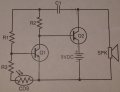
Link to schematic: http://imgur.com/F2BtLpa
Parts List:

C1 - .01 µF Disc Capacitor (103)

Q1 – 2N3904 NPN Transistor

Q2 – 2N3906 PNP Transistor

R1, R3 – 15kΩ Resistor

R2 – 620kΩ Resistor

SPK – Speaker

CDS – CDS Cell

Misc. – Battery Snap, 1 pc wire
 
Last edited:

wayneh

Joined Sep 9, 2010
18,104
The resistance of the CdS goes from very high in the dark to lower in the light. So in the light, the base of Q1 is pulled too close to the emitter voltage (ground) for Q1 to ever turn on and conduct.
 

Thread Starter

DABaRReTT96

Joined Dec 10, 2014
5
Okay. That makes sense as far as the CDS is concerned. If someone could also explain the flow of the entire circuit from start to finish and what each transistor/capacitor is doing that would be perfect. I am a beginner at circuits and this is providing a lot of trouble for me seeing as for my project I am required to explain everything that is happening in regards to this circuit and the flow through each component to power the speaker. Thanks!
 

MikeML

Joined Oct 2, 2009
5,444
It is a dumb circuit. It will kill a 9V battery in a couple of minutes. It puts a huge DC component through the speaker coil. Q2 will get stinking hot unless mounted on a heat sink.
 

Thread Starter

DABaRReTT96

Joined Dec 10, 2014
5
I agree but this is the kit I was given :( its an entry level electrical engineering class. I just don't understand fully what is going on.
 

Thread Starter

DABaRReTT96

Joined Dec 10, 2014
5
I'm not sure :\ I have it all connected to the breadboard and it works as it is supposed to (when placed in a closed, dark box)
 

MikeML

Joined Oct 2, 2009
5,444
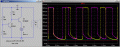
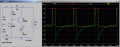
I have no idea what values of components the kit used. I made up ones that sort of work... With the values shown, it will not oscillate when R3 <2.2K, but will oscillate if R3=>2.4K

I dont have time to explain it right now. 95.gif
 

Thread Starter

DABaRReTT96

Joined Dec 10, 2014
5
All components are listed in first post. I REALLY do appreciate that Mike, thank you sir, but this is a first year, fall semester course Electrical engineering class so too much depth is not necessary. I more or less need help understanding the flow of the circuit and what each component, as it proceeds through, is doing to make this circuit work. (thanks again !)
 

crutschow

Joined Mar 14, 2008
38,503
The circuit is a complementary relaxation oscillator, similar to circuit 4 shown here.
If you look at the various waveforms in Mike's simulation you should be able to discern how it operates.
 

iimagine

Joined Dec 20, 2010
512
Q2 is on all the time:
When Q1 is inactive Q2's base voltage is being pulled down via R2, R1, R3 and CDS
When Q1 is active it pulls Q2's base LOW, cutting off its own bias voltage; C1 discharges via R2, R1, R3 and CDS, keeping Q1 on for a bit longer then Q1 is off and the cycle restart, thus oscillate

Voltage at the base of Q1 is:
Vout = (R3 + CDS's resistance) / (R2 + R1 + R3 + CDS's resistance)

Let there be light! Lets have CDS's resistance = 3.3k:
Vout = (15k + 3.3k) / (620k + 15k + 15k + 3.3k)
Vout = ~280mV
Q1's base voltage is ~280mV so it is inactive

Let there be darkness!. Lets have CDS's resistance = 33k:
Vout = (15k + 33k) / (620k + 15k + 15k + 33k)
Vout = ~703mV
Q1's base voltage is ~ 703mV so it is in the active region
 

crutschow

Joined Mar 14, 2008
38,503
Q2 is on all the time:
..............................
What do you mean by "on"?
When the circuit is not oscillating, Q2 is only slightly on due to the small base current through R1.
When the circuit is oscillating Q2 switches on and off (which powers the speaker).
 
Top