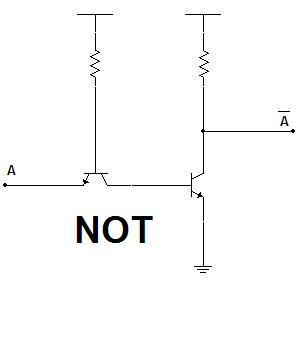
The left part is confusing me. I understand how a one-transistor not gate works, but I can't understand this one. I also tried drawing it in some simulation programs and it doesn't work like a NOT gate.
Thanks
The transistor on the right is already an inverting amplifier, i.e. a NOT gate.
The transistor on the left increases the overall gain.
When A is logic-HI, the base resistor turns on the second transistor giving a LOW output.
When A is logic-LOW, the first transistor is turned ON, pulling the base of the second transistor to GND, giving a HIGH output.
The transistor on the right is already an inverting amplifier, i.e. a NOT gate.
The transistor on the left increases the overall gain.
When A is logic-HI, the base resistor turns on the second transistor giving a LOW output.
When A is logic-LOW, the first transistor is turned ON, pulling the base of the second transistor to GND, giving a HIGH output.
Thank you for the answer.The first transistor confused me because I thought that both base and collector can only receive V, but here they are opposed.
Thank you for the answer.The first transistor confused me because I thought that both base and collector can only receive V, but here they are opposed.
In theory, the emitter and collector of a BJT are interchangeable. In practice, the geometry and doping profiles mean that the characteristics are very different -- but if you swap them it IS still an NPN transistor, just not a very good one. This circuit exploits this behavior.
Without the input stage, the input to the circuit would be limited to no more that about 0.7 V. This allows the input to vary over the entire power supply range.
Your simulator has to be good enough to be able to properly simulate a BJT operated in reverse-active mode. Not all simulators can do that and, even if they can, not all device models are good enough to give reasonable results in that region.
The input transistor rather acts as a gate for the base current.
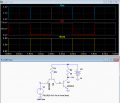
When the input is low, the current through the base resistor flows through the base-emitter junction to ground through the input and pulls the base (red trace) of the output transistor to near ground.
When the input is high, the input transistor is cut off and the base resistor current flows through the base-collector junction to turn on the output transistor.
It's the basis for TTL logic.

 Facebook
 Google
 GitHub
 Linkedin