Can somebody lend a hand with a simple circuit?

Thread Starter

fusionwerks

Joined Oct 11, 2017
11
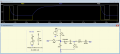
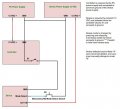
Below is the current setup that i am working with.
The "Controller" shares a common ground (-) with multiple different voltage power supplies for devices (in this case it is 12 VDC) There is also a 5 VDC, and 24 VDC in my setup (Not shown).
The Devices are wired to the corresponding voltage power supply (+)
The "DEVICE" is a 12 VDC beacon light that has 2 modes: (A) Strobe, (B) Rotate sequence
It has a momentary switch (S2) that when shorted to ground changes the modes.
The device defaults back to mode A whenever the circuit is broken and then re-established.
I believe that the device has a 14 pin chip that is programmed to make this change. I do not know enough about it to try to replace / re-program.
What i would like to do is somehow create a simple 555 circuit to make this change to mode B.
It would have to send a simulated button press and release immediately after S1 closes on the controller.
I have read a little about 555 circuits but i dont know how to do this using the ground as a signal (trigger) or if its even possible.
Im asking for a simple circuit that i can build and a "dumbed down" explanation of how to connect it. Im sure if it is possible, its extremely easy, i just dont know.
schematic.JPG
 

Reloadron

Joined Jan 15, 2015
7,887
What sort of event do you want to cause a mode change? You could easily place a NPN transistor like a 2N2222 across S2 bringing the mode select to a logic low and changing the mode. I guess I don't see what the 555 timer would be doing? I think I see where you want to go when you mention S1. You could likely use a simple One Shot so anytime S1 is pressed you get a one shot pulse and using the transistor as I mentioned simulate an S2 momentary closure.

<EDIT> Bad choice of words on my part. I see S1 looks to be just an On/Off switch but you could take the Logic Low from S1 and use it to trigger a 555 as a one shot. Use a one shot pulse duration of maybe 0.5 second. That should simulate a button push on S2. </EDIT>

Ron
 
Last edited:

MaxHeadRoom

Joined Jul 18, 2013
30,654
Could do with more info on the unit, for e.g. what is the 14pin IC No.?
Do you have any instructional or schematics on the unit?
Max.
 

Thread Starter

fusionwerks

Joined Oct 11, 2017
11
I guess i wasn't explaining it correctly. S1 is not really a switch it was just the only symbol i could find to represent it best. It's really just an output on a control board. When directed by the PC through software it basically just sends ground to that pin to complete the 12v circuit. What i need to do is to simulate a button press and release on S2 right after S1 closes in order to switch the mode. It doesn't have to be perfect, but i would like it to happen quickly. I am by no means an electronics guy, but i can build something off a schematic if someone provided it.

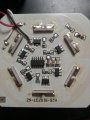
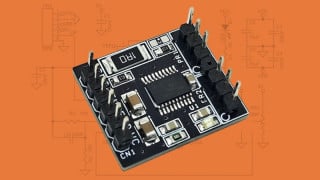
There is no markings on the 14 pin IC. I included a picture of the lights board if someone wants to try to decipher it. Maybe i can solder a jumper across something? The traces are hard to see, but, obviously the red is 12v+ and the black is -, and the white wire switches the modes when shorted to ground momentarily. the 6 larger solder points are to the LED lights that surround it. The switch is on the other end of the cable.20171010_103219.jpg
 

Reloadron

Joined Jan 15, 2015
7,887
It's really just an output on a control board. When directed by the PC through software it basically just sends ground to that pin to complete the 12v circuit.
OK, so it goes low making a ground. I would just use a 555 configured as a one shot the way I mentioned. Use that low going signal to trigger a 555 One Shot and use the output pin of the 555 (pin 3) to drive a transistor like a 2N2222 or 2N3904 as the push button switch. Leave the PB switch in circuit. Just add the switching transistor across it.

Ron
 

Thread Starter

fusionwerks

Joined Oct 11, 2017
11
Thank you Ron, I do understand the THEORY of what your talking about, but can you possible draw the circuit for me so i can understand enough to build this, i really am new to this.
 

Thread Starter

fusionwerks

Joined Oct 11, 2017
11
Still trying to figure this out. Can anyone help me by drawing this out so i can understand it better? Including capacitors and resistors i would need?
 

Alec_t

Joined Sep 17, 2013
15,117
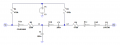
I wonder if it might be necessary to have a slight delay between S1 closing and S2 pulsing low, in case the chip has a start-up delay? If so, here's a suggested circuit :
DelayedPulseGen.PNG
R1C1 introduce that slight delay, then C2R3 set the duration of the pulse which pulls S2 low.
U1 is a CD4016 hex CMOS Schmitt inverter gate. U1b can sink a couple of mA pulling S2 low, but if you need more current-sinking you can connect the 4 otherwise-unused gates in U1 in parallel with U1b. If this sink-current boosting isn't needed then any unused gate inputs should be grounded.
A 100nF decoupling cap (not shown) should be connected across and close to the IC supply pins (7 and 14).
 

Alec_t

Joined Sep 17, 2013
15,117
On further thought it would be advisable to prevent the delay timing of my circuit from being affected by the impedance of components in the controller module. So here's a modification :
DelayedPulseGen2.PNG
 
Top