Facebook
 Google
 GitHub
 Linkedin
Hi again, I'm continue to work on developing a wireless flash trigger for under water strobes (see previous threads linked below on ultrasonic and VLF options). I've come up with a third possibility, which is to run a receiver antenna wire just below (or even touching) the transmitter antenna.
I've attached a crude diagram, but here is the basic idea: My underwater camera housing has plenty of space in it to mount a trigger to the hot shoe which activates the transmitter to send a brief pulse (my plan is to use a roughly ~3-6V, 27 or 40 mHz system from RC cars). The antenna wire can wrap around the inside of the housing, terminating below the camera. Each flash housing would have an external aluminum attachment point for an antenna wire (the attachment would be built into the housing so that on the inside, it could connect to the receiver board to activate the flash). Those antenna wires could then run down the flexible arms of the camera rig, terminating just below the housing, under the transmitter wire. Thus, even though they are VHF, the signal only has to go through a few mm of plastic and water.
An additional possibility is to actually have a direct connection. The camera housing has a metal plate mounted in the bottom, and I could easily contact the transmitter antenna to it on the inside, and the receiver antennae on the outside.
White this is not a truly wireless option, it does solve most of the issues I had with big, bulky, waterproof wires that needed waterproof connection points to each flash and camera housing.
My questions are:
1. What happens if I make contact between transmitter and receiver antennae? Does that guarantee that the signal transmits, or does it make the whole thing non-functional?
2. Assuming they don't touch, how important is antenna length in a scenario like this where the distance between them is minimal? I know you are meant to calculate ideal antenna length based on frequency, but it is not clear to me what happens if you don't follow that in a scenario like this where all I need is to transmit a quick pulse over a short distance.
3. What happens if the two flashes are on a single long antenna (wire) stretched between them?
4. Are there other issues I haven't thought of that make this a non-viable option?
Thanks again
https://forum.allaboutcircuits.com/...ter-flash-strobe-trigger.199138/#post-1889190
https://forum.allaboutcircuits.com/...ver-for-underwater-flash.199232/#post-1890173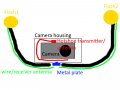
I've attached a crude diagram, but here is the basic idea: My underwater camera housing has plenty of space in it to mount a trigger to the hot shoe which activates the transmitter to send a brief pulse (my plan is to use a roughly ~3-6V, 27 or 40 mHz system from RC cars). The antenna wire can wrap around the inside of the housing, terminating below the camera. Each flash housing would have an external aluminum attachment point for an antenna wire (the attachment would be built into the housing so that on the inside, it could connect to the receiver board to activate the flash). Those antenna wires could then run down the flexible arms of the camera rig, terminating just below the housing, under the transmitter wire. Thus, even though they are VHF, the signal only has to go through a few mm of plastic and water.
An additional possibility is to actually have a direct connection. The camera housing has a metal plate mounted in the bottom, and I could easily contact the transmitter antenna to it on the inside, and the receiver antennae on the outside.
White this is not a truly wireless option, it does solve most of the issues I had with big, bulky, waterproof wires that needed waterproof connection points to each flash and camera housing.
My questions are:
1. What happens if I make contact between transmitter and receiver antennae? Does that guarantee that the signal transmits, or does it make the whole thing non-functional?
2. Assuming they don't touch, how important is antenna length in a scenario like this where the distance between them is minimal? I know you are meant to calculate ideal antenna length based on frequency, but it is not clear to me what happens if you don't follow that in a scenario like this where all I need is to transmit a quick pulse over a short distance.
3. What happens if the two flashes are on a single long antenna (wire) stretched between them?
4. Are there other issues I haven't thought of that make this a non-viable option?
Thanks again
https://forum.allaboutcircuits.com/...ter-flash-strobe-trigger.199138/#post-1889190
https://forum.allaboutcircuits.com/...ver-for-underwater-flash.199232/#post-1890173