Can I connect a common base amplifier voltage output to a commercial comparator chip directly?

Thread Starter

bstdms

Joined Jun 14, 2023
22
Here’s the information I know now:
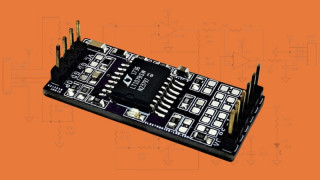
The comparator I’m going to use is MAX40025.
The output impedance of the common base amplifier is 300ohm(Rc), the input capacitance of the chip is 2pF. I would like to transfer a fast signal to the comparator(over 45MHz).
What should I consider when connect the CBA to the comparator? I cannot find the input impedance information from the datasheet of this chip so I have no clue how to do the impedance matching. Will those parameters influence the speed of the signal?
thank you for any advice.
 

Papabravo

Joined Feb 24, 2006
22,058
Here’s the information I know now:
The comparator I’m going to use is MAX40025.
The output impedance of the common base amplifier is 300ohm(Rc), the input capacitance of the chip is 2pF. I would like to transfer a fast signal to the comparator(over 45MHz).
What should I consider when connect the CBA to the comparator? I cannot find the input impedance information from the datasheet of this chip so I have no clue how to do the impedance matching. Will those parameters influence the speed of the signal?
thank you for any advice.
Without some kind of schematic, it would be foolish in the extreme to speculate based on your verbal description.
Normally the input impedance of an opamp or comparator is quite high, like 100KΩ or more for example. So, what is the parallel combination of 300Ω and 100KΩ.

ETA #1: Check out Figure 6. of the datasheet for LVDS input circuitry. They seem to be suggesting 150Ω differential across the inputs. Then look at figures 8 and 9 of the datasheet for recommended interfacing. Their suggestions may or may not be applicable with long cable runs.

If you put 300Ω to GND from each input, for AC it looks like 150Ω differential.

ETA #2: Do you have a VNA you could use to sweep the MAX40025?
 
Last edited:

MisterBill2

Joined Jan 23, 2018
27,178
It should be possible to set the operating conditions of a common base amplifier to correctly drive that comparator as described.
Unfortunately we have no information that will be needed to select any of the component values for that circuit.

Thus we are unable to get past the "yes".
 

Thread Starter

bstdms

Joined Jun 14, 2023
22
Without some kind of schematic, it would be foolish in the extreme to speculate based on your verbal description.
Normally the input impedance of an opamp or comparator is quite high, like 100KΩ or more for example. So, what is the parallel combination of 300Ω and 100KΩ.

ETA #1: Check out Figure 6. of the datasheet for LVDS input circuitry. They seem to be suggesting 150Ω differential across the inputs. Then look at figures 8 and 9 of the datasheet for recommended interfacing. Their suggestions may or may not be applicable with long cable runs.

If you put 300Ω to GND from each input, for AC it looks like 150Ω differential.

ETA #2: Do you have a VNA you could use to sweep the MAX40025?
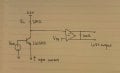
Thank you very much for your reply! I attached the circuit diagram here. This is a CBA without feedback.
For now, I just connect the signal directly to the comparator without inserting the 150ohm resistor between the input ports.
1703425257810.jpeg
If I understand it correctly, The equivalent resistance of parallel 300ohm and 100k ohm is around 299ohm. With the comparator input capacitance of 2pF, the cutoff frequency would be 1.6GHz. So the signal under 1.6GHz can pass to the comparator.
If connect the 150ohm input resistor, the resistance at the input node would be parallel of 300ohm, 150ohm and 100kohm which is 100ohm, and the bandwidth will be enlarged to 5GHz so maybe with this resistor it would work better?
Please correct me if the calculation is wrong.

I don't have a VNA now ;(
 

Papabravo

Joined Feb 24, 2006
22,058
Thank you very much for your reply! I attached the circuit diagram here. This is a CBA without feedback.
For now, I just connect the signal directly to the comparator without inserting the 150ohm resistor between the input ports.
View attachment 310786
If I understand it correctly, The equivalent resistance of parallel 300ohm and 100k ohm is around 299ohm. With the comparator input capacitance of 2pF, the cutoff frequency would be 1.6GHz. So the signal under 1.6GHz can pass to the comparator.
If connect the 150ohm input resistor, the resistance at the input node would be parallel of 300ohm, 150ohm and 100kohm which is 100ohm, and the bandwidth will be enlarged to 5GHz so maybe with this resistor it would work better?
Please correct me if the calculation is wrong.

I don't have a VNA now ;(
The diagram does not show clearly what you are proposing.
Looking at the LVDS specifications it seems that it is important to ensure that there is a differential voltage in the termination network that can be detected by the device. In your drawing it is not clear how such a differential voltage is produced. A standard LVDS transmitter produces a current of 3.5 mA which produces 350 mV in a 100Ω termination resistor.
 
Last edited:

MisterBill2

Joined Jan 23, 2018
27,178
For any comparator to deliver a useful output there must be a reference voltage to the other input to serve as the basis for comparison.
This means that you need to know both the DC level of the RF signal and the amplitude range of the signal being compared. If the DC portion of the signal is zero because the signal is AC coupled then the comparator must be operating as a "zero crossing detector", which usually requires that both negative and positive supply voltages must be supplied, OR additional biasing must be added to the circuit.
 
Top