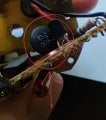
Can anyone identify this capacitor?

Thread Starter

Purple Badger

Joined Apr 11, 2025
5
Hi,

Having searched and searched I'm really stumped - I'm restoring a 1970s Smith car clock and while I know a little electronics I'm still very much a beginner so really could do with some help.

From what I can work out the clock uses a simple oscillator circuit (transistor, 3 resistors a capacitor) to oscillate a coil's magnetic field... Which then mechanically makes everything tick. However there's not enough power being sent to the coil at present to get any 'ticks'. So after checking for dry joints/breaks, I thought I'd replace what I assume is the capacitor (which must be 50 years old).

So I opened the clock up and found this in the attached photo - what looks like a capacitor, but with 47nZ written on it, rather than say 47nF - I'm now really doubting myself as I thought Z was for impedance - What's going on?

Thanks hugely for any help in this
 

Attachments

Thread Starter

Purple Badger

Joined Apr 11, 2025
5
Thanks so much! Interesting - like I say I'm no expert, still learning - and yup, replacing good components is a waste of time!

I had assumed the likely culprit was the capacitor as I've checked the resistors and I've lost count of the number of diodes or old capacitors I've replaced in other automotive circuits.

From what I can work out the transistor is operating in reverse avalanche mode - so is that more likely a culprit?

At the end of the day, it's such a simple circuit that de/resoldering a component out two in to it, is swift and easy (assuming I have them in my box of many bits!)
 

Thread Starter

Purple Badger

Joined Apr 11, 2025
5
So for other people finding this thread, I've fixed the clock.... And it was the capacitor as I originally thought.

Unfortunately, instead of just going with my gut, I second guessed myself and replaced the transistor first, which was difficult to source as it is now obsolete and why this has taken so long!

So I learnt 2 things here:

(1) it would seem old tech ceramic capacitors at low voltage/current do fail - especially if subjected for 50 years to the transient peak voltage and vibration of a car, while transistors operating in avalanche mode survive.

(2) I'm better at electronics than I thought and should have trusted myself in the first place.

Thanks to all who helped on this one and @dl324 you are astoundingly indeed correct 'replacing components that aren't defective is a waste of time, so ask for help, but trust your gut if you're still unsure after you've done all the diagnosis you can do..
 

Futurist

Joined Apr 8, 2025
721
So for other people finding this thread, I've fixed the clock.... And it was the capacitor as I originally thought.

Unfortunately, instead of just going with my gut, I second guessed myself and replaced the transistor first, which was difficult to source as it is now obsolete and why this has taken so long!

So I learnt 2 things here:

(1) it would seem old tech ceramic capacitors at low voltage/current do fail - especially if subjected for 50 years to the transient peak voltage and vibration of a car, while transistors operating in avalanche mode survive.

(2) I'm better at electronics than I thought and should have trusted myself in the first place.

Thanks to all who helped on this one and @dl324 you are astoundingly indeed correct 'replacing components that aren't defective is a waste of time, so ask for help, but trust your gut if you're still unsure after you've done all the diagnosis you can do..
Can you define "fail" with respect to this capacitor?

What was wrong with it? what leads you to believe it "failed"? Have you tested it? if so, what was the nature of the test?

@MrChips is - in my opinion - right, those kinds of components very rarely "fail".

Clue, thinking "Z" was an indication of impedance isn't an indication of being "better" at electronics, impedance is not an innate property of a capacitor.
 
Last edited:

Thread Starter

Purple Badger

Joined Apr 11, 2025
5
Lol - I came here looking for help, to fix a clock and maybe learn something from others experience. Members kindly gave help, I learned something and fixed the clock.. I came back and posted the results for others in case it might be helpful.

In other words, I and members who helped achieved something good and constructive with our posts (my clock is fixed).

What have you just archived with yours guys? Just because I know far less about electronics that you, doesn't mean I'm not 'better' than I thought I was (I have a pretty low opinion of myself in this subject)

Similarly, while I have no idea how or why a capacitor fails, not care as I have fixed the clock, it does not mean that the capacitor didn't fall.

So let's be more constructive in our posts - knowledge is to be shared, don't look down on others who know less than you - it just makes you look silly.

Anyway.... I know it was the capacitor by a process of elimination. The mechanics of a clock I know well, so that was what I checked first. Nothing was damaged, all was freely moving, nothing was magnetised when it shouldn't be (e.g mainspring) and nothing was 'unmagnetised' that should be (e.g. balance wheel). I cleaned and clock oiled everything and it still didn't work when reassembled.

I then focused on the PCB - the three resistors matched their resistance well enough (they'd drifted but only a little and that would just make the clock inaccurate). I then tested pcb traces and looked for dry joints using a loop - I reflowed the solder in several areas including the capacitor, translator and resistors just in case. I also tested for continuity to the board and the clock case/contacts. Again I reassembled, but the clock didn't work.

I then replaced the transistor, reassembled and tested - clock didn't work. I then took off the capacitor - once of the board this seemed to show steady resistance, rather than dropping, so I was hopeful it might be that - I replaced it and resembled the clock. The clock worked. Ergo it was the capacitor in my view.

But hey, in the end I have a working clock - that was the goal and I achieved it with a little help - and I now know what Z is - What's not to like ;-)
 

BobTPH

Joined Jun 5, 2013
11,463
Congratulations on your success. There is something to be learned here that I think you missed, though. If you had told us everything in you did in last post in your first post, you would not have gotten the incorrect answer. You were not going with your “gut”, you were going with information we did not have.
 

Thread Starter

Purple Badger

Joined Apr 11, 2025
5
Congratulations on your success. There is something to be learned here that I think you missed, though. If you had told us everything in you did in last post in your first post, you would not have gotten the incorrect answer. You were not going with your “gut”, you were going with information we did not have.
Yes, potentially I should have posted 'help me fix my clock' rather than 'can you identify this capacitor'. However, it was either the coil (unfixable), transistor (I have no oscilloscope to test it's behaviour) or the capacitor (which I had potentially had a spare for). So I was going to replace the capacitor first as it's cheap and then (if I had to) the transistor. Hence the original question - I just ended up doing things in reverse because the conversation evolved, which is cool.

At the end of the day, the components I replaced are literally 1000s times cheaper than a vintage Jaeger car clock (assuming I could even find one in the right model). So I'm just happy my clock is fixed.
 

Futurist

Joined Apr 8, 2025
721
Lol - I came here looking for help, to fix a clock and maybe learn something from others experience. Members kindly gave help, I learned something and fixed the clock.. I came back and posted the results for others in case it might be helpful.

In other words, I and members who helped achieved something good and constructive with our posts (my clock is fixed).

What have you just archived with yours guys? Just because I know far less about electronics that you, doesn't mean I'm not 'better' than I thought I was (I have a pretty low opinion of myself in this subject)

Similarly, while I have no idea how or why a capacitor fails, not care as I have fixed the clock, it does not mean that the capacitor didn't fall.

So let's be more constructive in our posts - knowledge is to be shared, don't look down on others who know less than you - it just makes you look silly.

Anyway.... I know it was the capacitor by a process of elimination. The mechanics of a clock I know well, so that was what I checked first. Nothing was damaged, all was freely moving, nothing was magnetised when it shouldn't be (e.g mainspring) and nothing was 'unmagnetised' that should be (e.g. balance wheel). I cleaned and clock oiled everything and it still didn't work when reassembled.

I then focused on the PCB - the three resistors matched their resistance well enough (they'd drifted but only a little and that would just make the clock inaccurate). I then tested pcb traces and looked for dry joints using a loop - I reflowed the solder in several areas including the capacitor, translator and resistors just in case. I also tested for continuity to the board and the clock case/contacts. Again I reassembled, but the clock didn't work.

I then replaced the transistor, reassembled and tested - clock didn't work. I then took off the capacitor - once of the board this seemed to show steady resistance, rather than dropping, so I was hopeful it might be that - I replaced it and resembled the clock. The clock worked. Ergo it was the capacitor in my view.

But hey, in the end I have a working clock - that was the goal and I achieved it with a little help - and I now know what Z is - What's not to like ;-)
You did well to get it running, no doubt. My own comments were intended to be thought provoking nothing more, things to motivate you to learn more, like the impedance of a capacitor doesn't depend only on its capacitance. There might well be something wrong with that capacitor but it is rare for them to fail and there are only a couple of ways for it to fail so its conceivable it was soldered poorly and that was the true cause of your problem.

A golden rule with complex machinery be it hardware or software is: ASSUME NOTHING.

When I was a teenager (1970s), meters like this that can measure capacitance simply were not available not for 36 dollars anyway. If you're truly interested in this subject get one, there are numerous experts here (not me) and you'll have access to them.

https://www.amazon.com/dp/B091FCWMP1?ref_=ppx_hzsearch_conn_dt_b_fed_asin_title_1

So, nice work and I hope you stick around.
 
Last edited:
Top