I think you are right! After seeing your post I made some really crude coils from stiff wire (only about 15 turns each) and stuffed them into the probe signal BNCs next to each other. Low and behold, when I approached the two coils (no touching) with a screwdriver, there was output and deflection of the dial. When I withdrew the screwdriver to about 6 inches away, output stopped. I repeated this basic & crude experiment with various metal objects and achieved the same result.
One that hasn't been mentioned. It could be a Higgs-Boson detector. Don't be too fast to say no. Divinity has to do with God, and the Higgs-boson is also called the "God Particle".
I'm pretty sure it is a high-end "scientific" dowser (water finder). Apparently in some countries it is still allowable to advertise such "scientific" services to unsuspecting and gullible people and not be arrested for it. Seems India has a few such as Scientific Water Diviner.
I'm pretty sure it is a high-end "scientific" dowser (water finder). Apparently in some countries it is still allowable to advertise such "scientific" services to unsuspecting and gullible people and not be arrested for it. Seems India has a few such as Scientific Water Diviner.
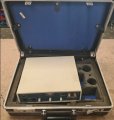
Just to throw the cat amongst the pigeons This is a picture of the device in it's case. The cut-outs in the foam seem to indicate that the probes may have been cylindrical and of about 2" diameter. There also seems to be space for a battery charger? I should have thought of posting this image in my OP.
I suggest possibly a water-leak detector. There are various methods for finding leaks in high-pressure buried pipes, involving remote sensing. The closest I have been is to watch a specialist use one on my property, so I'm no expert.
I find it hard to believe it is something other than a metal detector when it clearly works as a metal detector even when random coils replaced the probe that it is designed to work with.
And, once again, a scam device would be unlikely to be built with that kind of quality, unless it was being sold to the military for $10000. Why go to the trouble of making a working device if you were trying to sell something that had no chance f working?
No, there is unfortunately no model number as such. The plate on the back simply repeats what is on the front i.e "Model: Deviner" and, other than the serial number I quoted above, there is no further information. I'll let this roll on a bit in case someone who has used one or was employed by the company who made it comes forward. Currently I'm expecting it to remain a mystery (although I'm inclined to believe it is a detector of metal or water .... most likely the former)
That is interesting! I note that they started up in 1989, which is interesting since this device was manufactured in 1990. Good find! I will certainly email them. Thanks.

 Facebook
 Google
 GitHub
 Linkedin