Can anyone help me get a simple op amp integrator to function?

Papabravo

Joined Feb 24, 2006
22,084
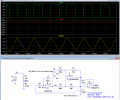
Yes. Ignoring the blips at the peaks, the non-constant behavior in between tells you the green trace does NOT have linear segments. The only changes for single supply operation are the power supply connections and the reference voltage at the non-inverting "+" input changes to one-half of VCC.
 

crutschow

Joined Mar 14, 2008
38,532
For your amusement, below is the LTspice sim of an unconventional integrator that allows the use of the slow, dual LM358 or quad LM324 to integrate a fast rise-time square-wave without glitches at the peaks of the triangle-wave.
It uses a modified Howland constant-current circuit to charge and discharge a capacitor to generate the triangle.

It includes an integrator feedback circuit (U2) to adjust the V(off) bias so that the average output voltage is always equal to V(Ref), independent of the square-wave duty-cycle.

U3 is just to buffer the high-impedance signal across C1.

1742622734239.png
 
Last edited:

Papabravo

Joined Feb 24, 2006
22,084
For your amusement, below is the LTspice sim of an unconventional integrator that allows the use of the slow, dual LM358 or quad LM324 to integrate a fast rise-time square-wave without glitches at the peaks of the triangle-wave.
It uses a modified Howland constant-current circuit to charge and discharge a capacitor to generate the triangle.

It includes an integrator feedback circuit (U2) to adjust the V(off) bias so that the average output voltage is always equal to V(Ref), independent of the square-wave duty-cycle.

U3 is just to buffer the high-impedance signal across C1.

View attachment 345125
Certainly, a more useful configuration than the integrator alone. Using a current source to charge and discharge C1 is definitely the way to go and produces a ramp which is much closer to linear.
 

MrAl

Joined Jun 17, 2014
13,711
Hello, Thankyou for reading my post. I apologise for my inadequacies in communication. I have drawn out a circuit schemmatic and would very much welcome your comments as an expert on circuits and electronics. I always look at the comments you have kindly given to other people.
Robert
Hi,

First, you usually do not need R2 with the LM358. You do have to watch the DC gain though because of the possible input offset voltage.
Second, you should show your power supply voltage(s) and how they connect to the circuit. Single supply or dual.
Third, you should show your input voltage signal exactly.
Fourth, the input signal should be plus and minus or else the DC offset will integrate up or down. You did not show your input yet though so it's hard to tell.
 
Top