Camera flash sync and Led

Thread Starter

Jeremy Talus

Joined Mar 21, 2018
10
Hi Raymond,
It was a time where camera didn't have any electronic on it and the exposure was to the apreciation of the eyes of the phtographer :)

the PC sync is just a switch and there is no batery in the camera, the only batery that the camera can have, is not in the camera but in the TTL unit (which one is just an accessory, and have no control on the camera operation).

There are many modern day LED strobes for photography and I understand that many of hen work fine. Do not, however, expect great results if you are using a simple LED strip or panel that is not designed for photography.
I build my own panel using hight brightness LED, theses LED are designed to be used in lighting spot
Yes, I can appreciate what you are saying and also, I do not want to suggest that the duration of the PC Synch signal is dynamically altered by the camera for different exposures. "Disastrous" was too strong and "probably unnecessary" would have been better.

I think that the OP needs to do a little homework on this before we all jump in with circuits. That is why I linked to the manual for the camera (assuming that is the correct model).
If you want I can also share you the repair manual of he camera, but in russian :), I know how my camera work, and the PC sync work only a 1/30s,

here is a french guide, on how dissasembly the camera, it's for the kiev 6C, but it's almost the same camera :http://www.suaudeau.eu/memo/rep/Kiev_6c.html
as you can see there is no batery compartiment or electronics, inside the camera

If I connect my LED on the batery, I got a full illumination, but on the PC I get a dim flash

Where are you located?
In France

a simple RCR circuit will do the job to strech the pulse
charge via low R and discharge throught higher R ?
 

ericgibbs

Joined Jan 29, 2010
21,448
hi J,
Have you had chance to check your transistor stock?
Let us know what you have available, so that we can post a simple pulse stretch circuit.
E
 
Hi Raymond,
It was a time where camera didn't have any electronic on it and the exposure was to the apreciation of the eyes of the phtographer :)

the PC sync is just a switch and there is no batery in the camera, the only batery that the camera can have, is not in the camera but in the TTL unit (which one is just an accessory, and have no control on the camera operation).
All good information. When you had said "it's a Kiev 60", I posted a link to the the manual, in which it states "A battery with initial voltage of 4 to 4.5 V (dia. 11.6 mm, length 16.2 mm) is used as a power source of the exposure time meter. The battery may comprise, for example, three cells type PX675, RM675 or MS".

That is where I am getting the battery information from...but maybe that is for a Kiev 60TTL and not a Kiev 60. Although a Kiev 60 also is listed as using a battery http://mattsclassiccameras.com/slr/kiev-60/ for the exposure meter/ You are saying that it is a cold shoe and nothing more than a mechanical switch that shorts the two connectors?

In any event, you would know.

I think that you are close and so I will leave you folks to it - let me / us know how it turns out.

Edited to add: You may want to take a look at the references/circuits below to get some ideas on construction of an LED driver for a camera flash.

https://www.electroschematics.com/12394/camera-white-led-flash-illumination/
https://www.analogictips.com/camera-flash-led-driver-delivers-1-2a/
http://www.richtek.com/en/Products/LED Driver/White LED Driver/RT9387A
 
Last edited:
Hi Raymond,
/---/
I build my own panel using hight brightness LED, theses LED are designed to be used in lighting spot
/---/
If I connect my LED on the batery, I got a full illumination, but on the PC I get a dim flash
Sorry that my previous posts were so scattered-brained, I should know better than to try and carry on multiple tasks concurrently.
With regard to the Hot/Cold shoe, let's assume that the trigger is operating ok the way you have that part done.

In order to be able to use LEDs as a photographic flash, they need to provide a great deal of light very quickly. If you simply have 20 LEDs in parallel, you may have the capability to serve as a photographic flash, but not by driving them "normally. In your circuit, you are basically just running the LEDs off of ~6V (as per the drawing) and 400 mA total (again by your text) and I don't think that will ever work as a photo-flash like that.

Simply substituting the transistor or stretching the pulse is not going to be a solution in my opinion. LED photoflashes "overdrive" the LEDs for a very brief time and I think that is the key. If you look through the references I included in my last post, that is why those specialized ICs with charge pumps are used.

Another reference that I would suggest you look at is here: https://petermobbs.wordpress.com/20...d-based-flash-gun-for-high-speed-photography/ as well as related entries of his.

This fellow has done a very nice job of presenting the issue as well as developing and testing some different ways to get there.

Hope that helps.
 
Last edited:

Reloadron

Joined Jan 15, 2015
7,891
Here is what I would do which is based on Analog's post. This is a link to a Flash Slave Trigger Circuit where a transistor is used to drive an SCR. I understand you do not want a flash slave and only wish to drive a flash, be it LED or whatever. All you need to do is momentarily turn on (pulse) Q2. Replace Q1 with your flash sync output of the camera.

My read of a few reviews of the Kiev 60 are it is a really decent medium format camera for the buck, well built and as reliable as anyone could want.

Ron
 

Thread Starter

Jeremy Talus

Joined Mar 21, 2018
10
Have you had chance to check your transistor stock?
Not yet, still at work, i'm software engineer, and it's deployement night :)
hi J,
Have you had chance to check your transistor stock?
Let us know what you have available, so that we can post a simple pulse stretch circuit.
E
Here is what I have in stock :
Bc547
Bc639
Bc238
Bc308
Irf9540
2n6509
Mpsa42
2n2905
2n2219
2n1893
2n2907
F245a
Pn2222a

Sorry that my previous posts were so scattered-brained, I should know better than to try and carry on multiple tasks concurrently.
Thanks for these useful links


Here is what I would do which is based on Analog's post. This is a link to a Flash Slave Trigger Circuit where a transistor is used to drive an SCR. I understand you do not want a flash slave and only wish to drive a flash, be it LED or whatever. All you need to do is momentarily turn on (pulse) Q2. Replace Q1 with your flash sync output of the camera.

My read of a few reviews of the Kiev 60 are it is a really decent medium format camera for the buck, well built and as reliable as anyone could want.

Ron
Thx, I will make a try on the bread board

Yes the Kiev is awesome rustic but work like a charm when you got how to tweak it
 
Here is what I would do which is based on Analog's post. This is a link to a Flash Slave Trigger Circuit where a transistor is used to drive an SCR. I understand you do not want a flash slave and only wish to drive a flash, be it LED or whatever. All you need to do is momentarily turn on (pulse) Q2. Replace Q1 with your flash sync output of the camera.

My read of a few reviews of the Kiev 60 are it is a really decent medium format camera for the buck, well built and as reliable as anyone could want.

Ron
"be it LED or whatever"

I think that makes good sense, but not for LEDs. The circuit the OP has provides ~ 20 mA to each LED - right? Everything I have read suggests that is not enough for this kind of application. Then again, I have never built one.

From "https://petermobbs.wordpress.com/20...d-based-flash-gun-for-high-speed-photography/ (where he is introducing the basic approach - again a very nice presentation)...

"These authors had succeeded in driving a variety of 3 to 77W LEDs at between 30 and 220A, many times their continuous current ratings of between 1.5 and 36A, without destroying them, by using current pulses in the 1 to 20us range."

When I first read this post, I just didn't pay attention and thought that the OP had a commercial LED photoflash that he wanted to trigger with the old camera. Obviously that was not the case.
 
Last edited:

Thread Starter

Jeremy Talus

Joined Mar 21, 2018
10
"be it LED or whatever"

I think that makes good sense, but not for LEDs. The circuit the OP has provides ~ 20 mA to each LED - right? Everything I have read suggests that is not enough for this kind of application. Then again, I have never built one.

From "https://petermobbs.wordpress.com/20...d-based-flash-gun-for-high-speed-photography/ (where he is introducing the basic approach - again a very nice presentation)...

"These authors had succeeded in driving a variety of 3 to 77W LEDs at between 30 and 220A, many times their continuous current ratings of between 1.5 and 36A, without destroying them, by using current pulses in the 1 to 20us range."

When I first read this post, I just didn't pay attention and thought that the OP had a commercial LED photoflash that he wanted to trigger with the old camera. Obviously that was not the case.
Yes I'm building my own LED photoflash
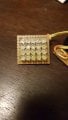
In attached file you can see the small panel and the lighting at 3meter using my 3.7v cell the LED are rated for 4.8v max
 

Attachments

Yes I'm building my own LED photoflash
In attached file you can see the small panel and the lighting at 3meter using my 3.7v cell the LED are rated for 4.8v max
Yes, I get that. They are rated at 4.8v max and have a current rating as well. I am saying that driving them within their normal ratings is not going to do it for this application as a photo flash. Over driving them for a very short burst, seems to be the way this gets accomplished. Of course over driving for too long will burn them up.

Try it the way you are going (lengthening the pulse / changing the transistor / use an SCR) and the ways that have been recommended by some very knowledgeable folks here. If it works or not, I would love to hear about it as this is an area that interests me.
 
Last edited:

Thread Starter

Jeremy Talus

Joined Mar 21, 2018
10
Yes, I get that. They are rated at 4.8v max and have a current rating as well. I am saying that driving them within their normal ratings is not going to do it for this application as a photo flash. Over driving them for a very short burst, seems to be the way this gets accomplished. Of course over driving for too long will burn them up.

Try it the way you are going (lengthening the pulse / changing the transistor / use an SCR) and the ways that have been recommended by some very knowledgeable folks here. If it works or not, I would love to hear about it as this is an area that interests me.
Hell yeah I will keep you updated

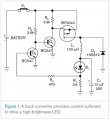
I found this schematic, by searching on how drive high brightness LED, and I have all components
A small buck converter

I will also try it
 

Attachments

ericgibbs

Joined Jan 29, 2010
21,448
hi J,
Using LTSpice, that buck converter will not work on less than 4V input, I even tried BC547C 'high gain version'.
I would be interested to hear how the actual circuit performs.
Eric
 
Top