BW limited current source

Thread Starter

kubeek

Joined Sep 20, 2005
5,796
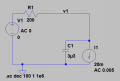
I am trying to simulate a current source that has 40dB/dec roll off at 250Hz, which should represent a 4-20mA sensor in side a measurement loop. I can easily do 20dB/dec, but I cannot see how to make it second-order 40dB/dec?
 

Attachments

OBW0549

Joined Mar 2, 2015
3,566
If you want to simulate a current source with 250 Hz bandwidth and 40 dB/decade rolloff, probably the most straightforward way to do it is to start with a voltage source (DC + AC), pass its output through a 2-pole 250 Hz filter, and apply the filter output to a voltage-controlled current source (VCCS).
 

cmartinez

Joined Jan 17, 2007
8,759
I am trying to simulate a current source that has 40dB/dec roll off at 250Hz, which should represent a 4-20mA sensor in side a measurement loop. I can easily do 20dB/dec, but I cannot see how to make it second-order 40dB/dec?
kubeek, I'd like to see the result of your final simulation, if you don't mind. There's a lot for me to learn in this thread.
 

Thread Starter

kubeek

Joined Sep 20, 2005
5,796
No problem, I will post what I come up with, but I am still a bit uncertain what exactly I want to simulate. The goal is to get a feeling for how HART signalling works on the 4-20mA loop. The DC (analog) signals should have a bandwidth of 0 to 25Hz, and the digital 1200/2200 hz FSK data stream superimposed on top of that should have bandwidth of 250Hz to 10kHz.

So I was trying to simulate the transmitter, which I thought should only behave like a current source up to that 25Hz boundary and then like, hmm, something else, but I am not so sure about that now. It now seems that an ideal DC to daylilght current sink would be enough to get a result that is not completely unreal.
 

OBW0549

Joined Mar 2, 2015
3,566
It now seems that an ideal DC to daylilght current sink would be enough to get a result that is not completely unreal.
I think that's the approach to take: take your band-limited (25 Hz) analog signal, sum it with a 1200 Hz/2200 Hz FSK signal, and feed the result into a broadband current source/sink. If I recall correctly, for HART the amplitude of the FSK component of the current output signal should be 1 mA peak-to-peak, superimposed on the 4-20 mA analog signal level.
 

Thread Starter

kubeek

Joined Sep 20, 2005
5,796
Actually I am designing the other side and wanted to have a sensor close to reality where I could test what signal it sees, and for this a plain ideal current sink looks just right.
But I will have to incorporate the receive direction as well, and for this the summed signal seems to be the correct approach.

But I still want to finish the "BW limited" current source just for future reference, such that it has high impedance for low frequency and low impedance for high frequency, with 40dB/dec. That should not be that hard, right? ;)
 

OBW0549

Joined Mar 2, 2015
3,566
But I still want to finish the "BW limited" current source just for future reference, such that it has high impedance for low frequency and low impedance for high frequency, with 40dB/dec. That should not be that hard, right? ;)
A current source has high impedance at ALL frequencies, so that its output current is independent of load impedance; otherwise it's not a current source.

If you want to give its output a limited bandwidth, limit the bandwidth of whatever voltage signal is driving it, as I described.
 
Last edited:

AnalogKid

Joined Aug 1, 2013
12,127
A current source has high impedance at ALL frequencies, so that its output current is independent of load impedance
That's the important point. A bandwidth limited voltage source makes a lower voltage at the higher frequencies, but at each of those higher frequencies the voltage for that frequency is a constant. So a bandwidth limited current source is a high impedance current source whose current decreases with increasing frequency, but again is a constant value that does not change with load impedance at each of those higher frequencies. I was going to post an approach to this, but OBW beat me to it in #2.

ak
 

Thread Starter

kubeek

Joined Sep 20, 2005
5,796
Ok, I am probably calling it wrong. What I meant by BW limited current source was a constant DC current source, like you would make say with an opamp, and is badwidth limited in the same way like the opamp is BW limited and can´ t keep up with high frequency changes in the voltage across the current source, so with higher frequency disturbance it stops regulating the current completely constant and the disturbing voltage has influence on the current. Is that more clear?
 

OBW0549

Joined Mar 2, 2015
3,566
Ok, I am probably calling it wrong. What I meant by BW limited current source was a constant DC current source, like you would make say with an opamp, and is badwidth limited in the same way like the opamp is BW limited and can´ t keep up with high frequency changes in the voltage across the current source, so with higher frequency disturbance it stops regulating the current completely constant and the disturbing voltage has influence on the current. Is that more clear?
Maybe, maybe not: what you're describing seems to be the same as what you showed in the diagram attached to your top post: a current source shunted by a capacitor. But calling it a "bandwidth-limited current source" is misleading since it's not the current source that has limited bandwidth, but rather the capacitor/current source combination.

A current source is a current source is a current source: it has infinite (or at least, very high) impedance. If it doesn't, it's not a current source, BW-limited or otherwise.
 

Thread Starter

kubeek

Joined Sep 20, 2005
5,796
So, by that logic if you have a current source circuit that works perfectly well for DC, and you know that above some frequency it doesn´t act like a current source anymore because the impedance drops, do you not call it a current source?
When that frequency limit is set intentionally and is not a direct result of nonideal components, does that change anything?

The whole purpose of this is to model a typical non-ideal, bandwidth limited current source circuit with a few simple components to speed up simulation, instead of using the real circuit with detailed models of opamps etc.
 

OBW0549

Joined Mar 2, 2015
3,566
So, by that logic if you have a current source circuit that works perfectly well for DC, and you know that above some frequency it doesn´t act like a current source anymore because the impedance drops, do you not call it a current source?
I think of it as being exactly what it is: a circuit (part of which can be modeled as a current source) with specific impedance characteristics. I would not call it a "bandwidth-limited current source", because that's an ambiguous term that can lead to misunderstanding, as in my post #2 above.

The whole purpose of this is to model a typical non-ideal, bandwidth limited current source circuit with a few simple components to speed up simulation, instead of using the real circuit with detailed models of opamps etc.
One source of good info on the equivalent output capacitance of current sources (or at least the Howland current source) is this paper by Bob Pease.
 
Top