Butterworth second order filter, help!

crutschow

Joined Mar 14, 2008
38,512
did you read my article (linked above)? Maximum GAIN is three
Yes, and I saw no mention of a Maximum GAIN (why do you keep shouting) of three.
The circuit is exactly as shown by the OP,
But that doesn't have the proper values for a Butterworth rolloff.
Build one.
Sorry , I don't do things on demand.
Your one-second transient analysis shows a DC voltage - it should be showing an AC waveform. Check your schematic - it's wrong. There's no 1/2 supply reference, and the DC is amplified by the feedback network. Use a dual supply.
No, the schematic is not wrong but your understanding is.
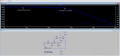
I applied a small DC bias to the input, so the circuit is in the linear range and doesn't need dual supplies to demonstrate the response from the filter.
The input step went from 0.1V to 0.2V for an output of 1V to 2V.
I was trying to make the point that this topology cannot be operated with a gain of more than three (assuming equal value R & C).
Why are you making that assumption about the R & C values (which I didn't see previously stated)?
That restriction is not required for the Sallen-Key structure.
A Sallen-Key structure with a gain of or even above "three" never can result in a Butterworth lowpass. It is an unstable circuit and will show (hardlimited) oscillations.
Then why does my sim look perfectly stable with a basically Butterworth rolloff and step response?
 

Thread Starter

Amadeu2000

Joined Oct 2, 2024
4
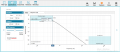
From what I understand, and please note that I’m completely new to this, so I don’t want to contradict anyone—you surely have more experience than I do—when using the Analog Filter Wizard and entering the values (fc = 500 Hz, gain 10V/10V), it gives me the following component values:
Gain 10.png

1728055475901.png

Source: Analog Filter Wizard


Analyzing the circuit with AC Analysis in LTspice, everything seems fine, and the -3 dB point appears exactly at 500 Hz, and we have -40db/dec from that. The circuit doesn't seem to oscillate and behaves exactly as I intended.

My question arises from the resources I’ve consulted—some specifically mention that Q = 1/(3 - A) and that the damping factor = 2/Q, which would mean that any gain above 3 would make Q negative, potentially causing my filter to lose its properties.

However, based on the simulation, this doesn’t seem to be true right?! How is the ratio between the capacitors and resistors calculated, or how are the values determined to make this possible?
 

Papabravo

Joined Feb 24, 2006
22,082
From what I understand, and please note that I’m completely new to this, so I don’t want to contradict anyone—you surely have more experience than I do—when using the Analog Filter Wizard and entering the values (fc = 500 Hz, gain 10V/10V), it gives me the following component values:
View attachment 333017

View attachment 333018

Source: Analog Filter Wizard


Analyzing the circuit with AC Analysis in LTspice, everything seems fine, and the -3 dB point appears exactly at 500 Hz, and we have -40db/dec from that. The circuit doesn't seem to oscillate and behaves exactly as I intended.

My question arises from the resources I’ve consulted—some specifically mention that Q = 1/(3 - A) and that the damping factor = 2/Q, which would mean that any gain above 3 would make Q negative, potentially causing my filter to lose its properties.

However, based on the simulation, this doesn’t seem to be true right?! How is the ratio between the capacitors and resistors calculated, or how are the values determined to make this possible?
Using nodal analysis in the Laplace domain you can derive the transfer function in terms of the component values. The denominator will be a 2nd order polynomial with parameters:

\( \omega_0\text{, and }Q \)

From that you can determine the values of the two parameters in terms of the component values.
 

schmitt trigger

Joined Jul 12, 2010
2,090
To add to Papa’s answer, there are pre-calculated tables which have done the mathematical calculations. You only select the filter order and the desired response (Butterworth, Chebyshev, Bessel….) and the resistance and capacitance coefficients are shown for a radial frequency ω0 of 1. You then multiply those coefficients by the desired frequency.
If the calculated values are unrealistic, let’s say too low a resistance, you then perform impedance scaling. You can multiply ALL the resistance values by, let’s say 10 times, as long as you DIVIDE ALL the capacitance values by the same ratio.
 

rod-e

Joined Jun 17, 2016
22
Using nodal analysis in the Laplace domain you can derive the transfer function in terms of the component values. The denominator will be a 2nd order polynomial with parameters:

\( \omega_0\text{, and }Q \)

From that you can determine the values of the two parameters in terms of the component values.
I'd forget about it - Curmudgeon (non) Elektroniker refuses to admit he's wrong. He won't perform a simulation that shows the AC transient performance (DC doesn't count) and he won't build one (even if he'd learn something in the process). I don't believe in lost causes.
 

crutschow

Joined Mar 14, 2008
38,512
refuses to admit he's wrong.
I will if I'm wrong, but just because you say so, doesn't make me wrong.
He won't perform a simulation that shows the AC transient performance (DC doesn't count)
That's flat-out wrong.
My sim shows the time-domain results for an input between two DC levels, which is indeed the transient response for a step function.
It shows any overshoot or ringing in the response that could indicate instability in the circuit.
I don't believe in lost causes.
And I don't care for arrogant know(not)-it-all's who just joined this forum and start making ad hominem comments.
 
Last edited:

rod-e

Joined Jun 17, 2016
22
(Almost) no one tests a filter's response with a single step as a first approximation. A filter is designed to remove parts of an AC signal, so an AC signal is required. The final schematic shown by crutschow does (kind of) work, but as shown it's not Butterworth and I doubt it fulfils the criteria for Sallen-Key.

I've been on this forum for around 8 years, but I rarely post anything as most times the question has been answered. There was no ad hominem 'attack' - I was responding directly to your language.

It's worth noting that you failed to point out in your final circuit that you were no longer using the OP's equal-value components, upon which the entire discussion was based. Reducing the feedback cap will result in stable operation with a selected gain, and I apologise for not noticing that's what you did, and for my reaction.

As I'm sure you appreciate, for a 'perfect' Butterworth response, you end up with very non-standard cap values (or resistor values for a high-pass version). This rather defeats the purpose of the 'simple' Sallen-Key topology.

This could have been a very interesting discussion, but unfortunately it became too hot to handle.
 

LvW

Joined Jun 13, 2013
2,029
My question arises from the resources I’ve consulted—some specifically mention that Q = 1/(3 - A) and that the damping factor = 2/Q, which would mean that any gain above 3 would make Q negative, potentially causing my filter to lose its properties.

However, based on the simulation, this doesn’t seem to be true right?! How is the ratio between the capacitors and resistors calculated, or how are the values determined to make this possible?
My answer to your question:
Unfortunately, the discussion was sometimes somewhat opaque because there are preferred variants of Sallen key structures that are sometimes automatically referred to without always explicitly mentioning this.
For reasons related to a favorable choice of components, one of the following 3 variants is usually chosen:
(a) Unity gain
(b) Gain of two
(c) Two equal R and two equal C in the filter network (“equal component design”).
In this case, the gain must not be greater than A=3.

I guess that this was one of the reasons for some misunderstandngs.

However, for a Sallen-Key topology you can, of course, choose any other opamp gain (like 10), but in this case, the component spread will be rather large. More than that, it is known that the pole-Q for Sallen-Key topologies is very sensible to gain uncertainties (tolerances).
For this reason, it is advisable to either use one of the three variants as mentioned above or to select another topology which is better suited for high gains (like MFB).

Let me add a final remark:
There are many circuit structures for active filters.
And under ideal conditions (no tolerances, ideal opamps), all of these variants can realize the desired transfer function without any deviations.
Differences only become apparent under non-ideal conditions leading to some recommendations for a particular topology - depending on filter specifications (frequency range, gain, pole quality factor Qp).
This is because different filter topologies react differently upon such non-idealities.
And in this context (a) the sensitivity to component tolerances and (b) to the real opamp properties play a dominant role.
It is, therefore, quite a challenge to select a favorable filter structure for a specific purpose with special requirements.
 
Last edited:

du00000001

Joined Nov 10, 2020
189
(Almost) no one tests a filter's response with a single step as a first approximation. A filter is designed to remove parts of an AC signal, so an AC signal is required. . . .
<...snipped...>
I've designed some low-pass filters during my career. Believe it or not - most of these filters didn't get more evaluation than 2 steps (1 up, 1 down) prior realization. For low-pass filters the step response clearly indicates the filter characteristics (time constant and gain) - what else should I want? And this test is fast and simple.
 

crutschow

Joined Mar 14, 2008
38,512
The final schematic shown by crutschow does (kind of) work, but as shown it's not Butterworth and I doubt it fulfils the criteria for Sallen-Key.
What does "kind of" and "doubt" mean as pertains to the filter response?
(Almost) no one tests a filter's response with a single step as a first approximation.
I'm glad that "almost" allows for a few of us that do.
It's a second test that gives an indication of the filters stability.
You also need to do an AC (Bode) simulation to see response with frequency, of course.
There was no ad hominem 'attack' - I was responding directly to your language.
So not agreeing with you is the language you didn't like?
And if think your post #27 was not an ad hominem 'attack', then you don't know the meaning of the phrase.
your final circuit that you were no longer using the OP's equal-value components, upon which the entire discussion was based.
I see no mention that the equal-value components were a requirement for the filter in this discussion.
Sorry if I missed that assumption.

Note that I never mean to imply the circuit I posted with a filter gain of 10 was the preferred way to do a Sallen-Key filter configuration with gain, only that it is possible.
Likely better is to use a filter with a gain of 1 followed by an amp with a gain of 10, or if its a small signal then the gain of 10 first.
 
Last edited:
Top