Butterworth second order filter, help!

Thread Starter

Amadeu2000

Joined Oct 2, 2024
4
db.pngScreenshot_2.png

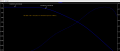
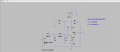
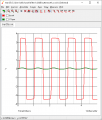
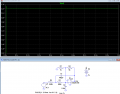
Hi, I’m trying to design a second-order low-pass Butterworth filter with, 10 gain, and cutoff frequency about 500 Hz, but the simulation results don’t make sense to me.

The maximum gain is around 20 dB, so the cutoff frequency should be at 17 dB (20 dB - 3 dB), meaning the frequency at that point should be 500 Hz. From there, the filter should attenuate at a rate of -40 dB per decade. However, this isn’t happening in my simulation. What could be wrong, Am I missing some concepts?

I'm assuming 1nF capacitor,
Screenshot_3.png
 

Attachments

Last edited:

Papabravo

Joined Feb 24, 2006
22,058
You do NOT have a 2nd Order Butterworth Filter Response. What you have done is to cascade two 1st order sections. The problem with that approach is that it places a double pole on the negative real axis, and the second section loads the first section producing the observed result. What you want is a complex conjugate pair of poles with a Q of 0.707.

If you don't know how to design a 2nd order Butterworth filter the following website may be helpful

Filter Design and Analysis (okawa-denshi.jp)

Click on the Sallen-Key Low pass Filter Box. You need to select E24 series for capacitor values and E96 series for resistor values. Set corner frequency at 500 Hz., set Q=0.707, and set Gain to 10. Once you have something working, I suggest you go back and research how the values and the transfer function is derived.
 
Last edited:

rod-e

Joined Jun 17, 2016
21
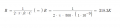
You CANNOT build a Butterworth filter with a gain of 10. The topology you showed requires a very precise gain to obtain Butterworth (Q=0.707). The gain must be 1.586 - no more, no less. The simulator doesn't understand the circuit in the frequency domain, but it will oscillate is the gain is greater than 3.
 

Papabravo

Joined Feb 24, 2006
22,058
You CANNOT build a Butterworth filter with a gain of 10. The topology you showed requires a very precise gain to obtain Butterworth (Q=0.707). The gain must be 1.586 - no more, no less. The simulator doesn't understand the circuit in the frequency domain, but it will oscillate is the gain is greater than 3.
You can build a Butterworth filter with a gain of 10, but it might not be a Sallen-Key topology. The appropriate gain stage can be located on either side of the filter.
 
Last edited:

rod-e

Joined Jun 17, 2016
21
Yes you CAN.
The reference in post #5 calculates the values for one.
The calculator is wrong. If you don't believe me, try to do a TRANSIENT simulation or build one. It will oscillate. The gain limit is three - above that you have an oscillator with this particular topology. Any gain needed can be added externally. Frequency analysis in most simulators will give a response similar to that shown at the beginning, but it's incorrect and misleading.

The simulator I use (SIMetrix) reports '*** ERROR *** No convergence in transient analysis' with a transient analysis, but shows the response as shown above with frequency analysis. When working with filters you'll get caught if you don't run both analysis methods. You may want to read https://sound-au.com/articles/active-filters.htm.
 

rod-e

Joined Jun 17, 2016
21
Okay.
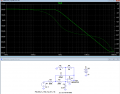
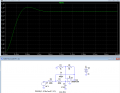
Ltspice sims below for both AC and transient analysis:

View attachment 333003__View attachment 333004
The transient analysis runs for just 4ms - it doesn't tell you anything useful. You seem to want to argue on this, but any decent description of this topology will explain that the gain MUST NOT be greater than three or it will oscillate. A transient analysis from SIMetrix (tuned to 1.59kHz) with +/-5V supplies shows what happens. The green trace is a 100mV peak, 1kHz input, the output is rail-to-rail clipping because it's oscillating.

You obviously won't accept this, so BUILD ONE! It will oscillate.
 

Attachments

crutschow

Joined Mar 14, 2008
38,316
The transient analysis runs for just 4ms - it doesn't tell you anything useful.
Does to me.
But is 1 second more to your liking?
1728022378661.png

but any decent description of this topology will explain that the gain MUST NOT be greater than three or it will oscillate.
I know the Q can't be more than 3 but what "decent description of this topology" says the gain can't be more than three?
A transient analysis from SIMetrix (tuned to 1.59kHz) with +/-5V supplies shows what happens.
Why should I believe your simulator over mine?
Post the exact circuit you simulated, not just arm waving about the results.
BUILD ONE! It will oscillate.
Have you BUILT ONE that oscillates?
 

rod-e

Joined Jun 17, 2016
21
Does to me.
But is 1 second more to your liking?
View attachment 333007

I know the Q can't be more than 3 but what "decent description of this topology" says the gain can't be more than three?
Why should I believe your simulator over mine?
Post the exact circuit you simulated, not just arm waving about the results.
Have you BUILT ONE that oscillates?
Yes! That why I know it does so. You seem to think I'm arguing for the sake of it - did you read my article (linked above)? Maximum GAIN is three, which gives a Q of about 5. Increase the gain to 3.1 and it's an oscillator. The circuit is exactly as shown by the OP, but with 10k/10nF tuning, and gain setting resistors to suit. I'm not trying to trick anyone, just set things straight.

Your one-second transient analysis shows a DC voltage - it should be showing an AC waveform. Check your schematic - it's wrong. There's no 1/2 supply reference, and the DC is amplified by the feedback network. Use a dual supply.
 

Papabravo

Joined Feb 24, 2006
22,058
The calculator is wrong. If you don't believe me, try to do a TRANSIENT simulation or build one. It will oscillate. The gain limit is three - above that you have an oscillator with this particular topology. Any gain needed can be added externally. Frequency analysis in most simulators will give a response similar to that shown at the beginning, but it's incorrect and misleading.

The simulator I use (SIMetrix) reports '*** ERROR *** No convergence in transient analysis' with a transient analysis, but shows the response as shown above with frequency analysis. When working with filters you'll get caught if you don't run both analysis methods. You may want to read https://sound-au.com/articles/active-filters.htm.
Ah, a 2nd order Butterworth filter is only allowed to have a Q of 0.707. This places the two poles, a complex conjugate pair, squarely in the left half plane. Your assertion that such a filter can oscillate is just plain golden ear audiophile nonsense.
 

LvW

Joined Jun 13, 2013
1,995
Ah, a 2nd order Butterworth filter is only allowed to have a Q of 0.707. This places the two poles, a complex conjugate pair, squarely in the left half plane. Your assertion that such a filter can oscillate is just plain golden ear audiophile nonsense.
A Sallen-Key structure with a gain of or even above "three" never can result in a Butterworth lowpass. It is an unstable circuit and will show (hardlimited) oscillations.
For max. gain of 10, either a separate gain stage (after the S&K filter, preferrable unity gain) is required or you have to select another filter topology (preferrable Multiple Feedback (MFB) or GIC-based)
 

Ian0

Joined Aug 7, 2020
13,097
You do NOT have a 2nd Order Butterworth Filter Response. What you have done is to cascade two 1st order sections.
Actually it is the correct circuit for a Sallen & Key filter with gain, just the wrong component values.
The value of C1 does depend on the gain. (and there is a limit to the gain that can be used for a Q of 0.7, as @LvW said)
 
Last edited:

rod-e

Joined Jun 17, 2016
21
A Sallen-Key structure with a gain of or even above "three" never can result in a Butterworth lowpass. It is an unstable circuit and will show (hardlimited) oscillations.
For max. gain of 10, either a separate gain stage (after the S&K filter, preferrable unity gain) is required or you have to select another filter topology (preferrable Multiple Feedback (MFB) or GIC-based)
Quite so - I should have mentioned that the circuit can't be Butterworth, as I was trying to make the point that this topology cannot be operated with a gain of more than three (assuming equal value R & C). It's just an oscillator, but not even a very good one.
 
Top