Building a low power coil that heats to 37

Thread Starter

Eric Vaughn

Joined Apr 27, 2017
3
Hi,

I want to start by saying I know very little about circuits in general. I've done some searching, but this is really a time sensitive thing so I don't have a lot of time to learn everything -- hence, I'm hoping someone can tell me what I need, or at least specifically what I need to learn.

That said, I'm a biologist trying to build a coil to go around a small plastic test tube (its about 1.5 inches in diameter) that will heat to 37 degrees for a 30 minute reaction. What will I need to build this?

Thanks,
Eric
 
Hi,

I want to start by saying I know very little about circuits in general. I've done some searching, but this is really a time sensitive thing so I don't have a lot of time to learn everything -- hence, I'm hoping someone can tell me what I need, or at least specifically what I need to learn.

That said, I'm a biologist trying to build a coil to go around a small plastic test tube (its about 1.5 inches in diameter) that will heat to 37 degrees for a 30 minute reaction. What will I need to build this?

Thanks,
Eric
There are lots of approaches. You are probably going to have to be more specific and give some more details.

Assume that you mean 37 C which is 98.6 F or normal body temperature. Further, as stated, you want the coil to be at this temperature, not the test tube or its contents.

Here is one approach.

Get one of these, a 12V power supply, a couple of thermistors and an Arduino UNO with an LCD display. Add to this the switch logic to power the heating pad on an off and some control. Program the Arduino to turn it on until it hits 98.6, by reading the thermistors that are attached to the heating pad, and then off (there is some proportional control schemes that you would use, but that's the gist of it. The arduino can also time the action.

That being said, the more details you give, the better the quality of responses.

How fast does the heating reaction have to be. Do you need to monitor just the temperature of the heating coil or of the contents of the test tube. What is the length of the test tube and is it sitting in any kind of apparatus? All that good stuff :)
 

WBahn

Joined Mar 31, 2012
33,076
Hi,

I want to start by saying I know very little about circuits in general. I've done some searching, but this is really a time sensitive thing so I don't have a lot of time to learn everything -- hence, I'm hoping someone can tell me what I need, or at least specifically what I need to learn.

That said, I'm a biologist trying to build a coil to go around a small plastic test tube (its about 1.5 inches in diameter) that will heat to 37 degrees for a 30 minute reaction. What will I need to build this?

Thanks,
Eric
The most important detail is a good understanding of what your requirements really are.

What is it that you want to be at that temperature? The coil? The test tube? The contents of the test tube?

How close and stable does the temperature need to be? Ask your self questions like: If I think that it (whatever "it" is from the previous question) at 37°C but it is actually at 35°C, is that good enough? What range of temperatures will qualify as "good enough"? A different question to ask is how important it is that you know the actual temperature. For instance, the answer to the question above might be no, that's not good enough. But perhaps the 35°C itself is not a problem, as long as you know that it was actually at 35°C. So there are two issues here: First, what is the range of temperatures that are acceptable, and second, how well do I need to know what the actual temperature really is? The next question to ask is how stable does the temperature need to be. For instance, it might be okay for the temperature to be 35°C or 40°C as long as it doesn't vary by more than half a degree over the thirty minutes.

The there is the question of ramp up and down. How critical is the "30 minutes"? When does the clock start and when does it end in relation to the actual temperature.

You might also consider alternatives. What about a water bath? That provides a large thermal mass that will improve temperature stability, it is something that is easy to measure the temperature of, and it provides good thermal conduction to the outside wall of the test tube (and you might need to consider whether the insulating effect of the plastic test tube itself is an issue).
 

Thread Starter

Eric Vaughn

Joined Apr 27, 2017
3
Wow, that was a lot of quick replies! Thanks everyone.

Sorry for not including more details. The actual surface area that needs to be heated is very small -- the tube is about 1.5 inches in diameter and about 4 inches tall, but the liquid/cells within the tube are only about a half inch from the bottom of the tube, which is perfectly cylindrical with no slimming in the width. The temperature is mostly for the enzymes to get to a good activity level, so 37 in the solution, give or take a degree is fine. It doesn't have to be extremely precise. The ramp up should be pretty graded, I'd say 3-5 minutes to heat to 37 (the cells need a gentle rise in temperature or they risk dying). There isn't any temperature gauge, although I have a laser temperature monitor I can use to ballpark the heat.
 

bertus

Joined Apr 5, 2008
22,992
Hello,

In NMR, the sample is heated by heated air or nitogen gas.
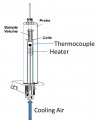
Here is how it looks in a NMR probe:

vt_control.jpg

There is a heater dewar with a heater element inside.
Just below the sample there is the head of themocouple to measure the temperature.
A regulations system allows you to adjust the temperature inside the probe.

The picture is taken from this page:
http://chem.rutgers.edu/~skim/nmr_training_setup_hardware.html

Bertus
 
Top