Buck switching current regulator

Thread Starter

ArakelTheDragon

Joined Nov 18, 2016
1,366
Good day! I need a regulator for current and voltage similar to LM2576, which is only for voltage. I need it to build a power supply for charging a battery.

I can not use LM317 as its a linear regulator and it will heat too much at 1A.
 

DickCappels

Joined Aug 21, 2008
10,661
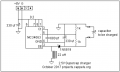
This is what I use to charge supercaps and you can probably adapt it to charging a battery provided your battery does not have stringent charging requirements (provided it is not a Lithium battery):

upload_2018-5-20_18-8-52.png

It is a boost converter with a negative output voltage, taken from figure 13 of the ON Semiconduuctor data sheet MC34063A/D, August, 2010 − Rev. 23, which is attached. The limiting voltage is set with the two resistors connected to pin 5 of the MC34063 and the current is set with the resistor between MC34063 pins 6 and 7. Consult the datasheet for details.

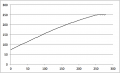
Below is tens of millivolts out vs seconds while charging a 100F capacitor.The point is that the current is constant (as indicated by the slope) until the 2.5 volt limit is reached.
upload_2018-5-20_18-17-46.png
 

Attachments

Thread Starter

ArakelTheDragon

Joined Nov 18, 2016
1,366
Both options seem good. How does the cycle by cycle current limit function work? When I put LEDs with LM2576, they drew a large current and burned.
 

Thread Starter

ArakelTheDragon

Joined Nov 18, 2016
1,366
Yes I need to control the current over the load, if necessary I can put a MOS FET transistor on the output with low Rdson (20mR). But I would have to switch it with a timer 555 at something like 10kHz.
 

Thread Starter

ArakelTheDragon

Joined Nov 18, 2016
1,366
This is what I needed:
http://www.st.com/en/power-management/l6902.html

I want to know how to calculate the current rise over the load, in order to determine at what frequency should I switch the transistor? Also how much will be needed in order for the heat over the load to dissipate, so I can apply another impulse.

The other option is that despite that the current rises over the limits, if its for a short time, the load will not get damaged, but I still need to know how to calculate the frequency, time possible for applying the impulse and time needed to rest. Any ideas?
 

Thread Starter

ArakelTheDragon

Joined Nov 18, 2016
1,366
The circuit in post 14 is what I needed, I was searching for it but I could not find it. Thanks, can you answer my switching question, as I know the frequencies from practice, but not how to calculate them.
 

ian field

Joined Oct 27, 2012
6,536
Both options seem good. How does the cycle by cycle current limit function work? When I put LEDs with LM2576, they drew a large current and burned.
If the chip has an inhibit pin; you can sense current to drive it for burst mode - OK for battery charging, not so good for driving LEDs.

Not impossible - but you have to make the burst rate fast enough to filter easily.
 

Thread Starter

ArakelTheDragon

Joined Nov 18, 2016
1,366
I am familiar with invertors. The only thing I do not know is how to calculate the frequency. If anyone can help, it would be quite useful.
 

eetech00

Joined Jun 8, 2013
4,705
I am familiar with invertors. The only thing I do not know is how to calculate the frequency. If anyone can help, it would be quite useful.
Hi

So...looking thru the messages in this thread, you haven’t given us a design spec.
What input voltage, output voltage/current, etc? Or why you need an external mosfet?
:(

eT
 

Alec_t

Joined Sep 17, 2013
15,119
Post the schematic of your inverter, so that we can assist. So far we've only been discussing a current regulator.
 

Thread Starter

ArakelTheDragon

Joined Nov 18, 2016
1,366
Yes from the current regulator (a voltage regulator with a MOS at the output to switch the current in order for the impulse to not rise over a certain level) I thought of asking how to calculate MOS frequencies for limiting the current over the load. If its an inverter, not only that we need to calculate at what frequency to limit the current, but also how to reduce the losses of the switching.
 
Top