Facebook
 Google
 GitHub
 Linkedin
Good Day,
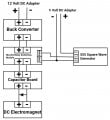
I like to discuss this circuit. It provides pulsating current to the electromagnet. I used a buck converter, a mosfet switching module and a capacitor bank.
This is the Mosfet switching module.
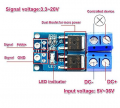
https://zbotic.in/product/5-36v-swi...L7-DXSK7NUbNSbSbloIzSPcGeC61mCt4aAtzmEALw_wcB
This circuit provides 3.75 Amperes at 7.48 Volts from the buck converter. What I wanted to do is to control the vertical down limit of the current which is zero now while switching OFF time period. I checked the Mosfet module input and output pins. The resistance is zero between the "+" input and "+" output. Whereas the "-" input and "-" output terminals are open when the PWM signal reaches 0. So I connected a power resistor of suitable value 1.6 Ohms connecting the "-" input and output terminals as shown in the below circuit.
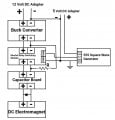
Now I can send 2 Ampere current through the load when the PWM signal is zero. So the pulsing waveform is passed through the load as calculated without hitting zero.
Now I like to try something more. I like to connect another buck converter 2 in parallel to the buck converter 1 as shown below. So I can manually adjust the vertical max and min value of the pulsing current.
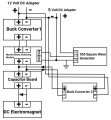
My doubt is would this work out? I want to discuss it here before trying it out and take advice. Two buck converters are in parallel one would supply the current always to the load. The other one will cut in and cut out controlled by PWM generator. So I expect the peak value would be the sum of two currents during the ON time period and during the OFF time period only buck converter 2 supplies the current to the load. I have placed diodes at the buck converter 2 outputs.
These are the buck converters I am using one is a high power one and other one is a low power one. In case of parallel connection I should use the low power mosfet for switching.
https://www.xcluma.com/20a-300w-dc-...qIDwfa9c4iY10S_HjZeqvYh4mdoH28rxoCwpsQAvD_BwE
https://robocraze.com/products/5a-d...sfojt8U8MAEwqTAyheLFW1eLyvgkNEJhoCE3MQAvD_BwE
I like to discuss this circuit. It provides pulsating current to the electromagnet. I used a buck converter, a mosfet switching module and a capacitor bank.
This is the Mosfet switching module.
https://zbotic.in/product/5-36v-swi...L7-DXSK7NUbNSbSbloIzSPcGeC61mCt4aAtzmEALw_wcB
This circuit provides 3.75 Amperes at 7.48 Volts from the buck converter. What I wanted to do is to control the vertical down limit of the current which is zero now while switching OFF time period. I checked the Mosfet module input and output pins. The resistance is zero between the "+" input and "+" output. Whereas the "-" input and "-" output terminals are open when the PWM signal reaches 0. So I connected a power resistor of suitable value 1.6 Ohms connecting the "-" input and output terminals as shown in the below circuit.
Now I can send 2 Ampere current through the load when the PWM signal is zero. So the pulsing waveform is passed through the load as calculated without hitting zero.
Now I like to try something more. I like to connect another buck converter 2 in parallel to the buck converter 1 as shown below. So I can manually adjust the vertical max and min value of the pulsing current.
My doubt is would this work out? I want to discuss it here before trying it out and take advice. Two buck converters are in parallel one would supply the current always to the load. The other one will cut in and cut out controlled by PWM generator. So I expect the peak value would be the sum of two currents during the ON time period and during the OFF time period only buck converter 2 supplies the current to the load. I have placed diodes at the buck converter 2 outputs.
These are the buck converters I am using one is a high power one and other one is a low power one. In case of parallel connection I should use the low power mosfet for switching.
https://www.xcluma.com/20a-300w-dc-...qIDwfa9c4iY10S_HjZeqvYh4mdoH28rxoCwpsQAvD_BwE
https://robocraze.com/products/5a-d...sfojt8U8MAEwqTAyheLFW1eLyvgkNEJhoCE3MQAvD_BwE