Buck converters and remote sensing

Thread Starter

engr_david_ee

Joined Mar 10, 2023
358
I am wondering about how we do the remote sensing in switch mode "buck converters". Is it possible to have remote sensing in switch mode buck converters.

I understand the remote sensing concept when the load is far away from linear power supplies and how do we connect the sense wires in linear power supplies.

This post is about remote sensing in switch mode "buck converters".
 

ronsimpson

Joined Oct 7, 2019
4,647
Lenear / PWM I see no difference in the error amplifier.
Look for the difference of v+ and V- at the load. Reference to ground as seen by the IC (linear or PWM) and feed that into the error amp pin.
 
I would use a coax (shielded) cable and transfer an error signal with appropriate power level, few mA at least, not an uAmps.
So you need to buffer the error signal on load side.
 

ronsimpson

Joined Oct 7, 2019
4,647
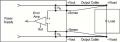
Link EDN
1722528275719.png
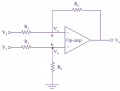
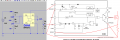
This amp looks at V1-V2 and references them to ground. You can add this in front of the error amp, (with a gain of 1 or 0.5 or even less. Or you can set the old error amp to have a gain of 1 and make this amp have a large amount of gain.
1722528413991.png
 

Thread Starter

engr_david_ee

Joined Mar 10, 2023
358
Link EDN
View attachment 328373
This amp looks at V1-V2 and references them to ground. You can add this in front of the error amp, (with a gain of 1 or 0.5 or even less. Or you can set the old error amp to have a gain of 1 and make this amp have a large amount of gain.
View attachment 328374
In case of linear regulator we have error amplifier which compares the voltage divider output to a reference and drives the pass element to regulate the output voltage. The sense +ve wire need to be attached from the remote load to the top resistor of the voltage divider. The bottom of the voltage divider resistor and the ground of the reference need to be connected to the sense -ve. I know the operation how the output is regulated. How it work in switch mode buck converter is my question.

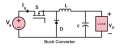
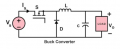
I have attached buck converter circuit. Do we need to add error amplifier and the pass element at the output of the buck converter ? If yes then the output of the buck converter has to be at least 0.6 V (Vbe) higher then the required regulation, right ?
 

Attachments

Ian0

Joined Aug 7, 2020
13,097
Thanks. I will have a look and try to understand how UC3842 works.
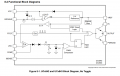
Its error amplifier amplifies and integrates the difference between the feedback voltage and a reference voltage. The output of the error amplifier controls the PWM pulse width. (This is a bit of an oversimplification).

Look for old devices. Their data sheets tend to have better block diagrams of internal circuitry. It is as if manufacturers of more modern devices don't like you knowing how they work.

Probably UC3842 wasn't the best choice when it comes to understanding a buck circuit. Try SG2535 instead. I couldn't think of it at the time.
 

ronsimpson

Joined Oct 7, 2019
4,647
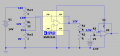
Example:
We want 12V across RL the load resistor. There is one ohm of wire Rw in each wire going to the load.
The Diff amp SSM2141 looks at the voltage across Rl and make 12V on the output. R1/R2 divides down to 2.5V.
The error amplifier comparts the 2.5V reference and the output of the diff amp.
1722550711515.png
 

Thread Starter

engr_david_ee

Joined Mar 10, 2023
358
I think in my post #8, FET is pass element in the buck converter circuit, but the gate driver, feedback from output and error amplifier are missing in the circuit of buck converter in post #8.

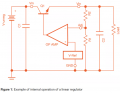
I found a circuit (see attachment) in which pass element (Q1), error amplifier (OP AMP), voltage reference (V-REF) and negative feedback which is a voltage divider consisting of R1 and R2 are shown.

I understand how it works. So this part was missing in the circuit from post #8.

I am taking this at conceptual design level understanding without the actual specifications.

As the output drops below the set point. The mid-point of the voltage divider (connected at -ve input of error amplifier) also drops. As it drops below the V-REF (connected at +ve input of error amplifier), the output of error amplifier will turn high which will turn on the pass element. This will increase the output voltage level.

As the output voltage level increase beyond the set value, the mid point of the voltage divider is also increase and will become higher then V-REF, this will make the output of the error amplifier low. The pass element will turn off.

Now regarding the attachment of sense wire. I think the sense wires should run from the top of the upper voltage divider resistor to the point of load and the other wire should run from bottom of the lower voltage divider resistor to the point of load reference.

The ground of the V-REF should also be attached to the bottom of the lower voltage divider resistor.
 

Attachments

Thread Starter

engr_david_ee

Joined Mar 10, 2023
358
Link EDN
View attachment 328373
This amp looks at V1-V2 and references them to ground. You can add this in front of the error amp, (with a gain of 1 or 0.5 or even less. Or you can set the old error amp to have a gain of 1 and make this amp have a large amount of gain.
View attachment 328374
Thanks for sharing how to attach the sense wires to the load. Can we say that the output of error amplifier will drive the FET of the buck converter ?
 

Ian0

Joined Aug 7, 2020
13,097
I think in my post #8, FET is pass element in the buck converter circuit, but the gate driver, feedback from output and error amplifier are missing in the circuit of buck converter in post #8.

I found a circuit (see attachment) in which pass element (Q1), error amplifier (OP AMP), voltage reference (V-REF) and negative feedback which is a voltage divider consisting of R1 and R2 are shown.

I understand how it works. So this part was missing in the circuit from post #8.

I am taking this at conceptual design level understanding without the actual specifications.

As the output drops below the set point. The mid-point of the voltage divider (connected at -ve input of error amplifier) also drops. As it drops below the V-REF (connected at +ve input of error amplifier), the output of error amplifier will turn high which will turn on the pass element. This will increase the output voltage level.

As the output voltage level increase beyond the set value, the mid point of the voltage divider is also increase and will become higher then V-REF, this will make the output of the error amplifier low. The pass element will turn off.

Now regarding the attachment of sense wire. I think the sense wires should run from the top of the upper voltage divider resistor to the point of load and the other wire should run from bottom of the lower voltage divider resistor to the point of load reference.

The ground of the V-REF should also be attached to the bottom of the lower voltage divider resistor.
No, S1 in post 8 is the pass element. What you appear to be describing is a linear regulator.
 

Thread Starter

engr_david_ee

Joined Mar 10, 2023
358
No, S1 in post 8 is the pass element. What you appear to be describing is a linear regulator.
And S is FET, right ?

If we don't have error amplifier, feedback resistors, voltage reference in buck converter circuit like I showed in post #14, then how do we achieve adjustable voltage from buck converter and where we attach the sense wires ?
 

BobTPH

Joined Jun 5, 2013
11,463
If we don't have error amplifier, feedback resistors, voltage reference in buck converter circuit like I showed in post #14
What you showed was the output circuit of a buck converter. It lacks all the control circuitry.

It could be driven by a fixed PWM signal, and then it would be an unregulated buck converter. I.e. the output voltage would vary with the input voltage and load. If that is what you want, there is no sensing of the output, remote or not.

To make it a buck regulator, it needs a much more complex circuit as others have pointed out.
 
Top