Bright LED

sghioto

Joined Dec 31, 2017
8,634
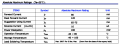
According to the spec sheet it requires 80ma to get between 16 to 20K mcd.
Do you need that much brightness is the question.
Maybe try using a different value resistors from 150 to 35 ohms to see.
 

Thread Starter

biferi

Joined Apr 14, 2017
529
I will be connecting it to a Battery Pack that holds 4. Dabble A Batteries.

Am I not Right the LED will Draw 80 mA even if it never gets to 20 mcd?

It just needs 80 mA to Run Right?
 

sghioto

Joined Dec 31, 2017
8,634
[QUOTE="biferi, post: 1947255, member:
Am I not Right the LED will Draw 80 mA even if it never gets to 20 mcd?
It just needs 80 mA to Run Right?
[/QUOTE]

No it runs on whatever current is allowed by the resistor. It say it needs 80ma to get 20k mcd
 

Tonyr1084

Joined Sep 24, 2015
9,744
How many Hours will a 4. Dabble A Battery Pack lest with the LED Running at 80 mA?
Screen Shot 2024-11-10 at 1.44.18 PM.pngSo it depends on how much current you draw. You don't have to run the LED at 80mA, you can run it more in the suggested range of 65 to 75mA. BUT you don't have to run it at those amperages either. You could run it as low as you like. Whatever gives you the amount of light you want.

In the datasheet that @LesJones refered to, I noticed that the beam angle is very narrow.
I saw that too. Perhaps a rethink on your entire design may be appropriate.
 

Tonyr1084

Joined Sep 24, 2015
9,744
You don't have to run the LED at 80mA, you can run it more in the suggested range of 65 to 75mA. BUT you don't have to run it at those amperages either. You could run it as low as you like. Whatever gives you the amount of light you want.
The lower you run at the longer it will run for. If you run at 80mA (max) then compare it to running at 40mA you'll find it lasts twice as long.
 

Thread Starter

biferi

Joined Apr 14, 2017
529
I found this LED I have it is 10,000 mcd and is Rated 3.4 Volts at 20 mA.

It has a 10 Viewing Angle.

Let me ask you about what you say about my 80 mA LED?

You say it needs 80 mA to get to 20 mcd.

You say I can Run the LED at a Loer Current.

I never thought you could because when you do the Math to get the Resistor you need to get the Voltage you need this will be what you need to get the Voltage you need.

If you up the Resistance you will not get the Voltage you need.

How can you do this?
 

djsfantasi

Joined Apr 11, 2010
9,237
If you up the Resistance you will not get the Voltage you need.
LEDs are not voltage driven; they are current driven. So the statement “you will not get the voltage you need” doesn’t make sense. You need the current and LEDs operate on a wide range of currents.
 

Ya’akov

Joined Jan 27, 2019
10,235
@biferi, stop for a moment. You have a basic misunderstanding which both @djsfantasi and @Tonyr1084 have alluded to:

The brightness of an LED will be proportional to the current you provide to it. The voltage is a side effect because it is determined by the selected current.

LEDs will light at incredibly low voltages, but proportionally dim. In empirical tests I have had been able to produce light, detectable to my eye (in a darkened room) with as little as 50µA!

Also, there is an unbreakable rule with no workaround: doing more work requires more power. The idea that you could somehow “cheat” and get the same output as you see from a single, high brightness LEDs by using several low brightness LEDs should seem silly to you on its face.

Ignoring the (very relevant but diverting topic of Lumens vs. Candela) while you can get the same photon flux from and array of lesser output devices as from one higher output LED, you will necessarily, within the efficiency of each, be using a very similar amount of power to do it. The idea that you can go from 80mA to 20mA (voltage generally remaining proportionally the same, resulting in a certain number of watts for each) is something that you should be able to reject on principle.
 

BobTPH

Joined Jun 5, 2013
11,515
Rated 3.4 Volts at 20 mA.

It has a 10 Viewing Angle.
Do you understand the meaning of the viewing angle? If you have a 10° viewing angle and you are 10 ft away, positioned so it looks maximally bright. Then you move 1 foot to the left or right, you are outside the viewing angle, and the brightness will be greatly reduced.

This is why the high mcd LEDs generally are low viewing angles. If you take a 10000 mcd 10° LED and make it 20° it becomes a 2500 mcd LED. Make it 120° and it becomes 833 mcd. All put out the same amount of light, but they concentrate it in different sized areas.
 

Thread Starter

biferi

Joined Apr 14, 2017
529
The LED I got at SparkFun Part Number 11118 I know has a Max of 20 mcd when you Run it with 3.2 Volts at 80 mA.

If I wanted to Run this at 10 mcd what Voltage and Amps would I use?
 

LesJones

Joined Jan 8, 2017
4,511
The datasheet does not give a graph of luminus intensity against current but from other LED datasheets the graph is close to a linear relations. Your statement in post #38 is wrong acording to the data sheet you get between 15000 and 20000 MCD with a current of 80 mA Bear in mind that there is a random variation between samples between 15 and 20 CD with a current of 0.08 amps (80 mA) You need to take notice of what you have been told many times in this thread that amps is not the same as milliamps and CD is not the same as MCD.
Do you realy want 10 MCD or 10 CD ?
Did they not teach you in school that metres is not the same as millimetres or kilometres
Les.
 

BobTPH

Joined Jun 5, 2013
11,515
What are you trying to do with this LED? A 10° viewing angle might be fine for a flashlight, but totally useless an indicator.
 
Top